
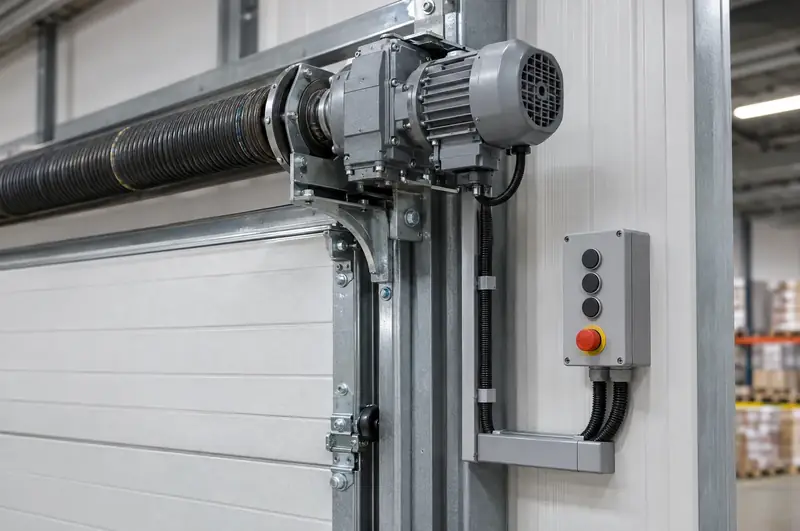
A loading bay door automation package is an electric operator, control panel and set of safety devices fitted to an existing manual sectional door or roller shutter so it opens and closes at the press of a button. Once motorised, the door is a power-operated door, so it needs protection against trapping, such as a safety edge and photocells, and a way to be opened by hand if the power fails.
What matters for loading bay door automation in Greater London?
Landlords upgrading manual doors across a multi-let estate in Greater London can standardise operators and controls so every tenant gets the same reliable setup. Operations in Greater London with manual sectional doors in good condition can often add an electric operator for much less than the cost of a new door.
Teams working on cold or wet docks in Greater London tend to leave doors open if they are hard to operate, so motorising them can help keep heat in.
Here is what happens after you contact us about a site in Greater London. We arrange a free survey, measure up and send a fixed written quote. If you go ahead, we manage the whole job, including ordering, delivery and coordination with your site team. Specialist installation engineers working under our management do the fitting, at times built around your loading schedule, with out-of-hours work by arrangement. Testing and handover documents close the job.
What is involved in fitting a motor to an existing dock door?
Fitting a motor to an existing dock door usually takes a few hours to a day per door, and starts with checking that the door itself is safe to automate.
- The door is checked for balance, spring condition, cable wear and track alignment.
- The operator is mounted on the shaft, ceiling rail or barrel bracket.
- The control panel is fixed in a safe position with a clear view of the door.
- A safety edge is fitted to the bottom rail and photocells are set across the opening.
- Limits, forces and controls are set, then the door is tested against the relevant safety checks.
You will need to provide a suitable isolated power supply near the door, or ask us to include it, and keep the door out of use during the work. Single-phase supplies suit many operators, but larger industrial operators may need three-phase power, which we confirm at survey.
How can door controls and interlocks make the dock safer?
Interlocks link the door to the rest of the dock so that each piece of equipment can only move when it is safe, which reduces both accidents and damage.
- Leveller interlock: the leveller cannot be raised until the door is fully open, protecting the door from the lip.
- Restraint or traffic light interlock: the door only opens once the trailer is restrained or the outside light shows red to the driver.
- Shelter interlock: with inflatable shelters, the door opens only once the cushions have inflated.
- Control mode: hold-to-run keeps the operator watching the door, while impulse controls save time but need full safety sensing.
Interlocks are far simpler to add while a door is being automated than as a separate job later. See dock traffic lights and interlocks for how a full dock sequence is set up.
Towns we cover in Greater London
Find your town in the list below for details of loading bay door automation across Greater London, or contact us if your location is not shown.
- Barking
- Sutton
- Croydon
- Ilford
- Enfield
- Harrow
- Tottenham
- Walthamstow
- Dagenham
- Romford
- Hayes
- Wembley
- Edmonton
- Southall
- Uxbridge
- Hounslow
- Feltham
- Acton
- Greenford
- Thamesmead
- Barnet
- South Ruislip
- Harringay
- Enfield Lock
- Stepney
- Worcester Park
- Beckton
- Erith
- Park Royal
- Rainham
Budget range for supply and fit. The written quote after a free survey is the fixed price. All guide prices.
Planning, building control and safety law in England
Powered doors and dock equipment installed in England may carry the UKCA or the CE mark, and doors are covered by the product standard BS EN 13241. We hand over the relevant documentation for each item fitted in Greater London. Planning and Building Regulations questions are never assumed either way: we check what applies at survey, so you know before work is booked.
Questions
How long does installation take at a site in Greater London?
It depends on the equipment, the number of bays, the condition of the dock and whether any building or electrical work is needed. We agree a programme with you after the survey, setting out which bays are out of use and when. Larger jobs are usually phased so that part of the dock stays open, and out-of-hours working can be arranged.
Can you work outside our normal operating hours in Greater London?
Yes, by arrangement. Evening, night and weekend working can be planned so the installation causes as little disruption as possible to your loading schedule. Out-of-hours work can affect the price, so mention it at the survey and we will include it in the written quote. The agreed times are confirmed in the programme before the job starts.
Will we still be able to open the door in a power cut?
Yes, every automated door should have a manual override, typically a hand chain or a release that lets the door be lifted by hand. We show your team how to use it at handover, and it should be checked at each service visit so it works when needed.
What is the difference between hold-to-run and impulse control?
With hold-to-run the operator must keep pressing the button for the door to move, so they watch it throughout. With impulse control a single press opens or closes the door fully, which saves time but requires full safety sensing such as a safety edge and photocells, because no one may be watching.
Other services in Greater London
Full guide to loading bay door automation · All loading bay services in Greater London