
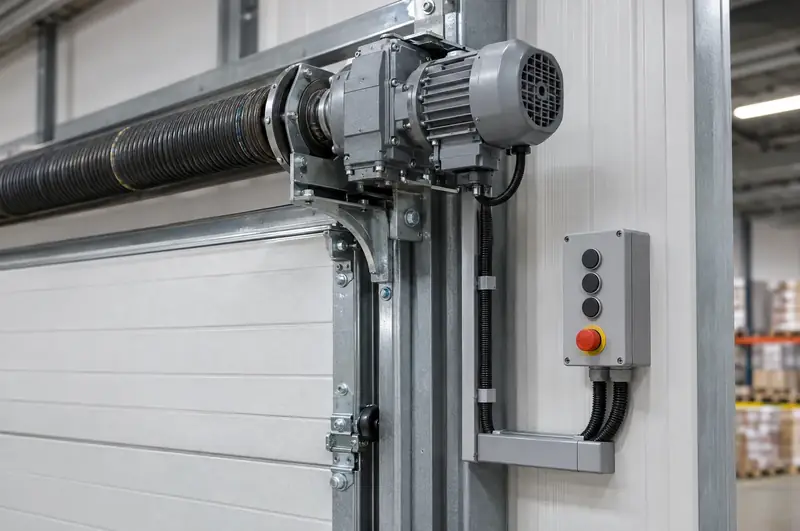
A loading bay door automation package is an electric operator, control panel and set of safety devices fitted to an existing manual sectional door or roller shutter so it opens and closes at the press of a button. Once motorised, the door is a power-operated door, so it needs protection against trapping, such as a safety edge and photocells, and a way to be opened by hand if the power fails.
How does this suit sites in Greater Manchester?
Landlords upgrading manual doors across a multi-let estate in Greater Manchester can standardise operators and controls so every tenant gets the same reliable setup. On older units in Greater Manchester where the original doors are still sound, automation keeps the existing door working while removing the effort of hand chains.
Operations in Greater Manchester with manual sectional doors in good condition can often add an electric operator for much less than the cost of a new door.
It starts with a free site survey in Greater Manchester, where we measure the openings, check the dock and talk through how the bay is used. You then receive a fixed written quote. Once you accept, we manage the job: specialist installation engineers carry out the work under our management, planned around your deliveries, and out-of-hours working can be arranged. At handover we test everything with you and leave the documentation.
What safety rules apply once a manual door is motorised?
Once a manual door is fitted with a motor it becomes a power-operated door, and the rules for powered doors apply in full. Automation is more than bolting on a motor.
- Workplace law: regulation 18 of the Workplace (Health, Safety and Welfare) Regulations 1992 in Great Britain, and the Workplace (Health, Safety and Welfare) Regulations (Northern Ireland) 1993, require powered doors to have suitable and effective features to prevent trapping, and to be operable by hand where necessary unless they open automatically on power failure.
- Safety in use: BS EN 12453 sets out safety requirements and test methods for power-operated doors, including how closing forces are limited and measured.
- Product standard: BS EN 13241 covers the door as a product.
- Marking: in Great Britain a powered door may carry the UKCA or the CE mark; in Northern Ireland the CE mark, or CE with UKNI, applies.
Enforcement sits with HSE in Great Britain and HSENI in Northern Ireland. The results of the safety checks carried out at commissioning form part of the handover.
What is involved in fitting a motor to an existing dock door?
Fitting a motor to an existing dock door usually takes a few hours to a day per door, and starts with checking that the door itself is safe to automate.
- The door is checked for balance, spring condition, cable wear and track alignment.
- The operator is mounted on the shaft, ceiling rail or barrel bracket.
- The control panel is fixed in a safe position with a clear view of the door.
- A safety edge is fitted to the bottom rail and photocells are set across the opening.
- Limits, forces and controls are set, then the door is tested against the relevant safety checks.
You will need to provide a suitable isolated power supply near the door, or ask us to include it, and keep the door out of use during the work. Single-phase supplies suit many operators, but larger industrial operators may need three-phase power, which we confirm at survey.
Towns we cover in Greater Manchester
We take enquiries about loading bay door automation from across Greater Manchester. These are the towns with their own pages:
- Manchester
- Oldham
- Wigan
- Bolton
- Stockport
- Salford
- Rochdale
- Sale
- Bury
- Altrincham
- Middleton
- Ashton-under-Lyne
- Leigh
- Stretford
- Urmston
- Chadderton
- Eccles
- Tyldesley
- Hyde
- Walkden
- Prestwich
- Radcliffe
Budget range for supply and fit. The written quote after a free survey is the fixed price. All guide prices.
Planning, building control and safety law in England
Workplace safety in England is regulated by HSE. For a loading bay in Greater Manchester, that means doors meeting regulation 18 of the Workplace (Health, Safety and Welfare) Regulations 1992, equipment maintained under PUWER and suitable safeguards against vehicles driving away too early. We check what applies at survey and design the bay accordingly.
Questions
What details do you need from us to quote for loading bay door automation?
To get started, send the site address in Greater Manchester, the number of bays or openings, approximate sizes, and photos of the dock from inside and outside. Tell us what vehicles you load, what goods you handle and any temperature requirements. Drawings help on new builds. We then arrange the free survey and confirm the details before the written quote is issued.
What warranty comes with new loading bay equipment?
New equipment comes with the manufacturer's warranty, which varies by product. Our workmanship terms are set out in writing in the quote for your Greater Manchester site, so you can see what is covered before you commit. Check the warranty terms for any servicing conditions, and we can quote for planned maintenance once the installation is complete.
What is the difference between hold-to-run and impulse control?
With hold-to-run the operator must keep pressing the button for the door to move, so they watch it throughout. With impulse control a single press opens or closes the door fully, which saves time but requires full safety sensing such as a safety edge and photocells, because no one may be watching.
Do we need a three-phase supply?
Not always. Many operators for small and medium doors run on a single-phase supply, while larger industrial operators for heavy dock doors often need three-phase power. We confirm the supply your door needs at survey and can include any electrical work in the written quote.
Other services in Greater Manchester
Full guide to loading bay door automation · All loading bay services in Greater Manchester