
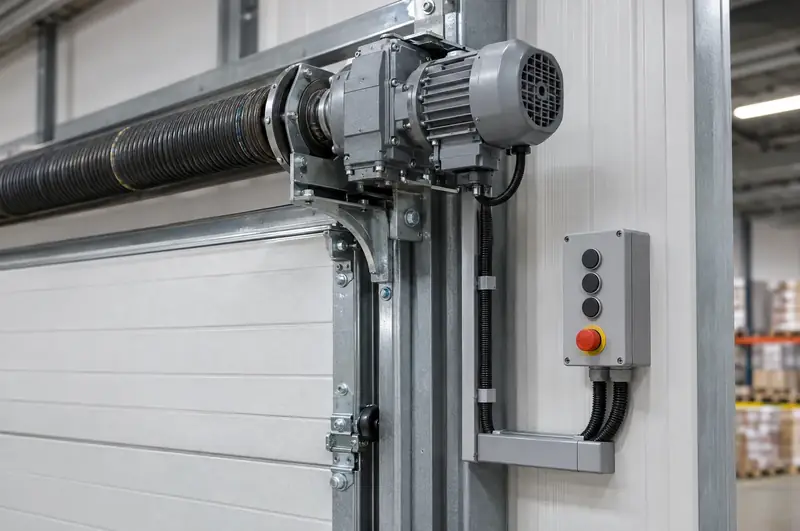
A loading bay door automation package is an electric operator, control panel and set of safety devices fitted to an existing manual sectional door or roller shutter so it opens and closes at the press of a button. Once motorised, the door is a power-operated door, so it needs protection against trapping, such as a safety edge and photocells, and a way to be opened by hand if the power fails.
Is this right for your site in Edinburgh and the Lothians?
Upgrading manual docks to electric operation is a practical first step for sites in Edinburgh and the Lothians that later plan to add interlocks and traffic lights. On older units in Edinburgh and the Lothians where the original doors are still sound, automation keeps the existing door working while removing the effort of hand chains.
Teams working on cold or wet docks in Edinburgh and the Lothians tend to leave doors open if they are hard to operate, so motorising them can help keep heat in.
Any project involving loading bay door automation at a working site in Edinburgh and the Lothians takes planning. We survey free of charge, quote a fixed price in writing, and then agree a programme that keeps as much of the dock running as possible. Specialist installation engineers carry out the work under our management, out of hours if that suits you better. On completion we test each item, show your team how it operates and leave the documentation with you.
What safety rules apply once a manual door is motorised?
Once a manual door is fitted with a motor it becomes a power-operated door, and the rules for powered doors apply in full. Automation is more than bolting on a motor.
- Workplace law: regulation 18 of the Workplace (Health, Safety and Welfare) Regulations 1992 in Great Britain, and the Workplace (Health, Safety and Welfare) Regulations (Northern Ireland) 1993, require powered doors to have suitable and effective features to prevent trapping, and to be operable by hand where necessary unless they open automatically on power failure.
- Safety in use: BS EN 12453 sets out safety requirements and test methods for power-operated doors, including how closing forces are limited and measured.
- Product standard: BS EN 13241 covers the door as a product.
- Marking: in Great Britain a powered door may carry the UKCA or the CE mark; in Northern Ireland the CE mark, or CE with UKNI, applies.
Enforcement sits with HSE in Great Britain and HSENI in Northern Ireland. The results of the safety checks carried out at commissioning form part of the handover.
Which type of door operator is right for my door?
The right operator depends on the door type, its weight and how many times a day it runs. Matching the operator's duty cycle to real use is what stops motors overheating and failing early.
- Shaft-mounted operator: fits directly on the spring shaft of a sectional door. Compact, strong and suited to heavy, busy dock doors.
- Trolley operator: runs along a rail on the ceiling and pulls the door. Suits lighter sectional doors on quieter bays.
- Tubular motor: sits inside the barrel of a roller shutter, keeping the installation tidy on small and medium shutters.
- External or side-mounted motor: drives a shutter barrel by chain, for larger and heavier shutters.
Every option should include a manual override, either a hand chain or a release, so the door can be used during a power cut. On bays that cycle many times an hour we specify an industrial operator rated for that duty rather than a light-use unit.
Towns we cover in Edinburgh and the Lothians
Looking for loading bay door automation in a specific part of Edinburgh and the Lothians? Start with the nearest town on this list.
Budget range for supply and fit. The written quote after a free survey is the fixed price. All guide prices.
Planning, building control and safety law in Scotland
Doors and dock equipment installed in Scotland may carry the UKCA or the CE mark, and we pass on the documentation for everything fitted in Edinburgh and the Lothians. Because building warrant and planning questions can affect the programme, we check what applies at survey and raise any approvals early rather than assuming none are needed.
Questions
Can you work alongside our main contractor on a new build in Edinburgh and the Lothians?
Yes. For new warehouses and fit-outs, we can supply and install the dock package as part of a wider project, working to the main contractor's programme, site rules and permits. We will need drawings, dock levels and the programme, and we coordinate pit details, power supplies and door openings with the relevant trades before installation begins.
Do you remove and dispose of the old equipment?
Yes, where it is part of the scope. When we replace doors, levellers, shelters or seals at a site in Edinburgh and the Lothians, removal and disposal of the old equipment can be included and is itemised in the quote, so it is clear what is covered. If anything should be kept, such as a frame or motor that is still serviceable, we agree that at survey.
Can any manual door be motorised?
No, only doors that are sound, balanced and run smoothly by hand should be motorised. Doors with weak springs, damaged panels, bent laths or obsolete parts may need repair first, or may be better replaced. We check this at survey and tell you which applies before quoting.
How long does it take to automate a dock door?
Most automations are completed within a working day per door, once any repairs to the door itself have been done. Larger shutters, or doors that need a new power supply, can take longer. We plan the work so that only the door being automated is out of use.
Other services in Edinburgh and the Lothians
Full guide to loading bay door automation · All loading bay services in Edinburgh and the Lothians