
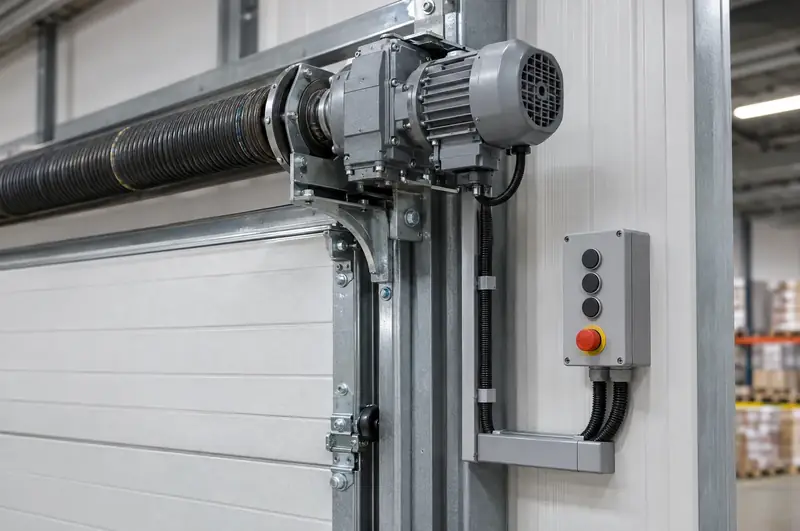
A loading bay door automation package is an electric operator, control panel and set of safety devices fitted to an existing manual sectional door or roller shutter so it opens and closes at the press of a button. Once motorised, the door is a power-operated door, so it needs protection against trapping, such as a safety edge and photocells, and a way to be opened by hand if the power fails.
What matters for loading bay door automation in Cumbria?
Landlords upgrading manual doors across a multi-let estate in Cumbria can standardise operators and controls so every tenant gets the same reliable setup. On older units in Cumbria where the original doors are still sound, automation keeps the existing door working while removing the effort of hand chains.
Preparing a site in Cumbria for a health and safety review is a good moment to motorise doors with proper trapping protection rather than leave staff on hand chains.
If you are planning loading bay door automation for a site in Cumbria, expect four stages. A free survey and fixed written quote come first. We then agree a programme with you, including any out-of-hours work. Specialist installation engineers carry out the installation under our management, with us as your single point of contact. Finally, the equipment is tested, your staff are shown how it works and everything is handed over with its documentation.
What safety rules apply once a manual door is motorised?
Once a manual door is fitted with a motor it becomes a power-operated door, and the rules for powered doors apply in full. Automation is more than bolting on a motor.
- Workplace law: regulation 18 of the Workplace (Health, Safety and Welfare) Regulations 1992 in Great Britain, and the Workplace (Health, Safety and Welfare) Regulations (Northern Ireland) 1993, require powered doors to have suitable and effective features to prevent trapping, and to be operable by hand where necessary unless they open automatically on power failure.
- Safety in use: BS EN 12453 sets out safety requirements and test methods for power-operated doors, including how closing forces are limited and measured.
- Product standard: BS EN 13241 covers the door as a product.
- Marking: in Great Britain a powered door may carry the UKCA or the CE mark; in Northern Ireland the CE mark, or CE with UKNI, applies.
Enforcement sits with HSE in Great Britain and HSENI in Northern Ireland. The results of the safety checks carried out at commissioning form part of the handover.
How can door controls and interlocks make the dock safer?
Interlocks link the door to the rest of the dock so that each piece of equipment can only move when it is safe, which reduces both accidents and damage.
- Leveller interlock: the leveller cannot be raised until the door is fully open, protecting the door from the lip.
- Restraint or traffic light interlock: the door only opens once the trailer is restrained or the outside light shows red to the driver.
- Shelter interlock: with inflatable shelters, the door opens only once the cushions have inflated.
- Control mode: hold-to-run keeps the operator watching the door, while impulse controls save time but need full safety sensing.
Interlocks are far simpler to add while a door is being automated than as a separate job later. See dock traffic lights and interlocks for how a full dock sequence is set up.
Towns we cover in Cumbria
We cover loading bay door automation throughout Cumbria, and the towns below each have their own page. If yours is not listed, get in touch anyway.
Budget range for supply and fit. The written quote after a free survey is the fixed price. All guide prices.
What do the rules in England mean for the work?
Sites in Cumbria fall under the rules for England. Structural changes such as forming a new opening or a dock leveller pit may need Building Regulations approval, and external structures such as loading houses, canopies or new dock approaches can need planning permission from the local planning authority. We check what applies at survey and build any approvals into the plan.
Questions
Is VAT included in your guide prices for loading bay door automation?
No. Our customers are businesses, so guide prices exclude VAT, which is added at the standard rate. The same guide range applies in Cumbria as everywhere else: for loading bay door automation, it is £1,100 to £2,400 per door, excluding VAT. It covers supply and fit for a typical installation. Your fixed written quote after the free survey shows the net price, the VAT and exactly what is included.
Will you deal with building control and planning for a project in Cumbria?
We check at survey whether the work is likely to need approval. Forming a new opening or dock pit may need Building Regulations approval, a building warrant or building control approval, depending on the nation, and external structures such as loading houses can need planning permission. Where approval is needed, we explain what is involved, work with your designer or agent, and build it into the programme.
Can drivers open the door without leaving the forklift?
Yes, pull cords, radio remotes and induction loops in the floor can all open a powered door without the driver getting down. The right choice depends on traffic, and any opening method that does not need a button held must be paired with safety devices so the door cannot close on a vehicle or person.
Will we still be able to open the door in a power cut?
Yes, every automated door should have a manual override, typically a hand chain or a release that lets the door be lifted by hand. We show your team how to use it at handover, and it should be checked at each service visit so it works when needed.
Other services in Cumbria
Full guide to loading bay door automation · All loading bay services in Cumbria