
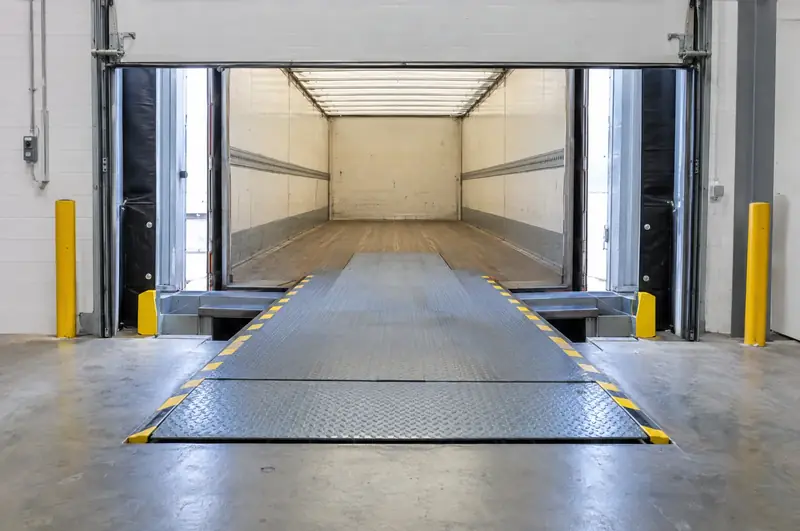
A telescopic-lip dock leveller is a hydraulic pit leveller whose front lip slides forward out of the platform, rather than swinging on a hinge, and can be extended by a controlled amount onto the trailer bed. Telescopic lips commonly extend 500 to 1,000 mm, which lets operators reach over tail lifts, place the lip between pallets and load the last row in a trailer.
What should sites in Powys consider?
Replacing worn swing-lip levellers at a site in Powys is a good moment to ask whether the current trailer mix now calls for telescopic lips. Manufacturing sites in Powys that end-load finished goods can place the lip precisely between pallets to reach the rear row.
Before recommending a lip extension for a dock in Powys, we record the trailers that actually arrive, including tail lifts and rear overhangs.
Our part of the job in Powys is to survey, quote and manage; the fitting itself is done by specialist installation engineers working under our management. The survey and the written quote are free. Once the fixed price is accepted, we agree dates that work around your deliveries and shifts, including out-of-hours working where needed. Every installation is tested before handover, and you receive the documentation for each item fitted.
How are drive-away risks managed while the lip rests on a trailer?
Drive-away risks are managed by stopping the vehicle leaving until loading has finished and the lip has been withdrawn, using traffic lights, vehicle or trailer restraints, or the person in charge keeping the keys or paperwork. HSE workplace transport guidance (HSG136) and the HSE loading factsheet (followed by HSENI in Northern Ireland) call for safeguards against drivers driving away too early.
- Why it matters: a lip resting on the bed is only safe while the trailer stays put, and trailer creep during forklift loading can open a gap at the dock edge.
- Equipment duties: the leveller is work equipment under PUWER 1998 in Great Britain or PUWER (Northern Ireland) 1999, so it must be maintained and inspected where deterioration could lead to danger. Engineering insurers commonly inspect at 12-month intervals.
- Standard: BS EN 1398:2009 sets the safety requirements for dock levellers and is current, under review.
Enforcement is by HSE in Great Britain and HSENI in Northern Ireland. Our guide to preventing drive-away and trailer creep compares the safeguards.
Why does a telescopic-lip leveller cost more than a swing-lip unit?
A telescopic-lip dock leveller typically costs £6,800 to £11,800 per leveller, excluding VAT, supply and fit, assuming an existing, sound pit. It costs more than a swing-lip unit because the lip slides in its own guides inside the platform, which means more steel, a longer lip and more involved hydraulics and controls.
Within the range, the price depends on:
- Lip extension: a longer reach needs a longer lip and stronger guides.
- Platform length and width: longer platforms give gentler gradients across mixed trailer heights.
- Capacity: higher ratings for heavy loads or large forklifts.
- Insulation: insulated platforms and pit seals for chilled and frozen docks.
- Controls: automatic return, interlocks and links to restraints and traffic lights.
New pits, pit repairs and groundworks are priced separately after survey, and the written quote is the fixed price. We often quote both lip types side by side, so you can see whether the extra flexibility justifies the cost on each bay.
Towns we cover in Powys
We take enquiries about telescopic-lip dock levellers from across Powys. These are the towns with their own pages:
Budget range for supply and fit. The written quote after a free survey is the fixed price. All guide prices.
Regulations and approvals in Wales
Sites in Powys follow the rules for Wales. Forming a new opening or dock pit may need Building Regulations approval, and loading houses, canopies or new dock approaches can need planning permission from the local planning authority. We check what applies at survey, so any approvals are understood before the programme is fixed.
Questions
Which building and safety rules apply to a site in Powys?
It depends on which UK nation the site is in. England and Wales use Building Regulations approval, Scotland uses building warrants and Northern Ireland uses building control approval from the council. Workplace safety is regulated by HSE in Great Britain and HSENI in Northern Ireland, and energy rules differ between nations. For your site in Powys, we check what applies at survey and design to it.
Will you deal with building control and planning for a project in Powys?
We check at survey whether the work is likely to need approval. Forming a new opening or dock pit may need Building Regulations approval, a building warrant or building control approval, depending on the nation, and external structures such as loading houses can need planning permission. Where approval is needed, we explain what is involved, work with your designer or agent, and build it into the programme.
Are telescopic levellers suitable for cold stores?
Yes, telescopic levellers are widely used in cold stores because refrigerated trailers are often loaded right to the rear doors. Insulated platforms and perimeter seals reduce cold loss through the pit, and the leveller is usually interlocked with the door and shelter.
Do telescopic levellers need more maintenance?
They have more moving parts than a swing-lip leveller, including the lip guides and lip cylinder, so these need checking and lubricating at each service. With planned servicing the extra work is modest. Servicing is chargeable, with the visit price agreed in advance.
Other services in Powys
Full guide to telescopic-lip dock levellers · All loading bay services in Powys