
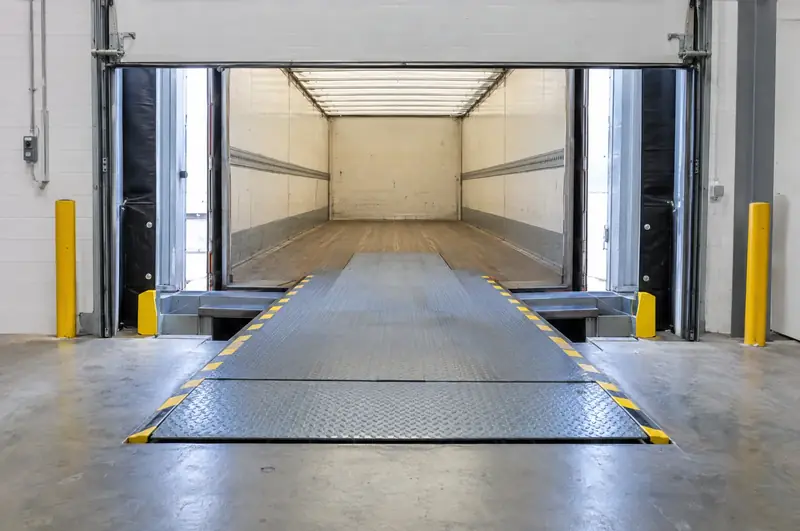
A telescopic-lip dock leveller is a hydraulic pit leveller whose front lip slides forward out of the platform, rather than swinging on a hinge, and can be extended by a controlled amount onto the trailer bed. Telescopic lips commonly extend 500 to 1,000 mm, which lets operators reach over tail lifts, place the lip between pallets and load the last row in a trailer.
How does this suit sites in Rutland?
Replacing worn swing-lip levellers at a site in Rutland is a good moment to ask whether the current trailer mix now calls for telescopic lips. Where docks in Rutland have deep bumpers that hold trailers away from the edge, a telescopic lip can bridge a gap a swing lip would struggle to cover.
Before recommending a lip extension for a dock in Rutland, we record the trailers that actually arrive, including tail lifts and rear overhangs.
Keeping the dock running is usually the first concern, so we plan around it. After a free survey of your Rutland site and a written quote at a fixed price, we agree when each bay can be released and whether any work should happen out of hours. Specialist installation engineers working under our management then fit the equipment, and we test it and hand over the documentation before the bay goes back into use.
How far should a telescopic lip extend?
A telescopic lip should extend far enough to reach clear bed space on every trailer you load, including over tail lifts, while still leaving a secure overlap on the bed. Telescopic lips commonly extend 500 to 1,000 mm.
- Around 500 mm: suits fleets without tail lifts that need precise placement and end loading.
- Up to around 1,000 mm: reaches over folded tail lifts and across the larger gap left where deep bumpers hold trailers back from the dock edge.
- Platform length: should match the lip, as a long reach on a short platform can leave steep gradients.
- Lip width: full-width lips suit most work, while narrower or tapered lips help with smaller vehicles.
We record the rear details of the trailers you receive, including tail lift depth and bumper projection, then recommend the shortest extension that covers them all. A longer lip than you need adds cost and weight without benefit.
How are drive-away risks managed while the lip rests on a trailer?
Drive-away risks are managed by stopping the vehicle leaving until loading has finished and the lip has been withdrawn, using traffic lights, vehicle or trailer restraints, or the person in charge keeping the keys or paperwork. HSE workplace transport guidance (HSG136) and the HSE loading factsheet (followed by HSENI in Northern Ireland) call for safeguards against drivers driving away too early.
- Why it matters: a lip resting on the bed is only safe while the trailer stays put, and trailer creep during forklift loading can open a gap at the dock edge.
- Equipment duties: the leveller is work equipment under PUWER 1998 in Great Britain or PUWER (Northern Ireland) 1999, so it must be maintained and inspected where deterioration could lead to danger. Engineering insurers commonly inspect at 12-month intervals.
- Standard: BS EN 1398:2009 sets the safety requirements for dock levellers and is current, under review.
Enforcement is by HSE in Great Britain and HSENI in Northern Ireland. Our guide to preventing drive-away and trailer creep compares the safeguards.
Towns we cover in Rutland
We cover telescopic-lip dock levellers throughout Rutland, and the towns below each have their own page. If yours is not listed, get in touch anyway.
Budget range for supply and fit. The written quote after a free survey is the fixed price. All guide prices.
What do the rules in England mean for the work?
Sites in Rutland fall under the rules for England. Structural changes such as forming a new opening or a dock leveller pit may need Building Regulations approval, and external structures such as loading houses, canopies or new dock approaches can need planning permission from the local planning authority. We check what applies at survey and build any approvals into the plan.
Questions
Do you remove and dispose of the old equipment?
Yes, where it is part of the scope. When we replace doors, levellers, shelters or seals at a site in Rutland, removal and disposal of the old equipment can be included and is itemised in the quote, so it is clear what is covered. If anything should be kept, such as a frame or motor that is still serviceable, we agree that at survey.
Can you work outside our normal operating hours in Rutland?
Yes, by arrangement. Evening, night and weekend working can be planned so the installation causes as little disruption as possible to your loading schedule. Out-of-hours work can affect the price, so mention it at the survey and we will include it in the written quote. The agreed times are confirmed in the programme before the job starts.
What overlap should the lip have on the trailer bed?
The lip should rest on the trailer bed with the overlap the manufacturer specifies, so it cannot slip off as the trailer moves under load. Extending further than needed adds no benefit. We show dock staff what a correct overlap looks like at handover.
Are telescopic levellers suitable for cold stores?
Yes, telescopic levellers are widely used in cold stores because refrigerated trailers are often loaded right to the rear doors. Insulated platforms and perimeter seals reduce cold loss through the pit, and the leveller is usually interlocked with the door and shelter.
Other services in Rutland
Full guide to telescopic-lip dock levellers · All loading bay services in Rutland