
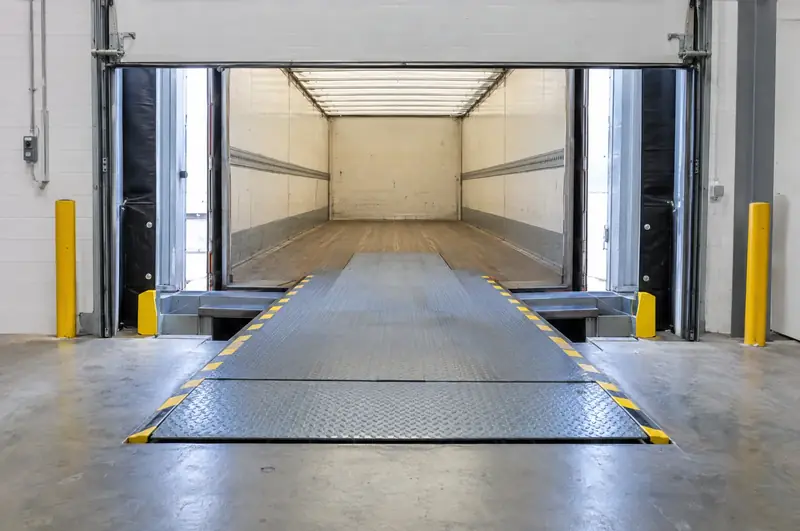
A telescopic-lip dock leveller is a hydraulic pit leveller whose front lip slides forward out of the platform, rather than swinging on a hinge, and can be extended by a controlled amount onto the trailer bed. Telescopic lips commonly extend 500 to 1,000 mm, which lets operators reach over tail lifts, place the lip between pallets and load the last row in a trailer.
Is this right for your site in the West Midlands?
Parcel and courier hubs in the West Midlands with varied vehicle types can use the longer lip reach to serve more of their fleet from fewer bays. Replacing worn swing-lip levellers at a site in the West Midlands is a good moment to ask whether the current trailer mix now calls for telescopic lips.
Cold chain operators around the West Midlands loading refrigerated trailers right to the doors may find a telescopic lip makes the last pallets far easier to handle.
A single contact at Loading Bay Doors handles your project in the West Midlands from start to finish. The free site survey and fixed written quote come first, with no obligation to proceed. We then book the installation for times that suit the operation, including out of hours by arrangement, and manage the specialist engineers on site. At the end we commission and test the equipment, walk your team through it and provide the documentation.
How should staff use a telescopic-lip leveller safely?
Staff should only operate a telescopic-lip leveller once the trailer is secured and the dock door is open, and should always return the lip and platform to the stored position before the trailer leaves. Simple routines prevent most damage.
- Extend the lip only as far as needed and check it has the overlap on the bed that the manufacturer specifies.
- Keep feet and loads clear of the platform sides while it moves; that is what the toe guards are for.
- Never operate the leveller with a forklift or load standing on it.
- Use the automatic return function where fitted, so the lip withdraws and the platform stores at the end of loading.
- Report hydraulic leaks, unusual noises or a sticking lip straight away.
Training new dock staff on these steps, and displaying them beside the control panel, keeps practice consistent across shifts.
How are drive-away risks managed while the lip rests on a trailer?
Drive-away risks are managed by stopping the vehicle leaving until loading has finished and the lip has been withdrawn, using traffic lights, vehicle or trailer restraints, or the person in charge keeping the keys or paperwork. HSE workplace transport guidance (HSG136) and the HSE loading factsheet (followed by HSENI in Northern Ireland) call for safeguards against drivers driving away too early.
- Why it matters: a lip resting on the bed is only safe while the trailer stays put, and trailer creep during forklift loading can open a gap at the dock edge.
- Equipment duties: the leveller is work equipment under PUWER 1998 in Great Britain or PUWER (Northern Ireland) 1999, so it must be maintained and inspected where deterioration could lead to danger. Engineering insurers commonly inspect at 12-month intervals.
- Standard: BS EN 1398:2009 sets the safety requirements for dock levellers and is current, under review.
Enforcement is by HSE in Great Britain and HSENI in Northern Ireland. Our guide to preventing drive-away and trailer creep compares the safeguards.
Towns we cover in the West Midlands
Choose a town below to see how we handle telescopic-lip dock levellers in that part of the West Midlands.
- Birmingham
- Coventry
- Wolverhampton
- Dudley
- Walsall
- Solihull
- Sutton Coldfield
- West Bromwich
- Halesowen
- Stourbridge
- Smethwick
- Willenhall
- Tipton
- Bloxwich
- Wednesfield
- Washwood Heath
- Aston
- Shirley
- Brierley Hill
- Aldridge
- Bartley Green
- Wednesbury
Budget range for supply and fit. The written quote after a free survey is the fixed price. All guide prices.
What do the rules in England mean for the work?
Lift tables and dock lifts in the West Midlands may fall under LOLER, with thorough examination at least every 12 months, or every 6 months where people are lifted. It depends on the equipment and how it is used, and your insurer or competent person will confirm. Dock levellers are usually treated as work equipment under PUWER. We check what applies at survey.
Questions
What details do you need from us to quote for telescopic-lip dock levellers?
To get started, send the site address in the West Midlands, the number of bays or openings, approximate sizes, and photos of the dock from inside and outside. Tell us what vehicles you load, what goods you handle and any temperature requirements. Drawings help on new builds. We then arrange the free survey and confirm the details before the written quote is issued.
Is VAT included in your guide prices for telescopic-lip dock levellers?
No. Our customers are businesses, so guide prices exclude VAT, which is added at the standard rate. The same guide range applies in the West Midlands as everywhere else: for telescopic-lip dock levellers, it is £6,800 to £11,800 per leveller, excluding VAT. It covers supply and fit for a typical installation. Your fixed written quote after the free survey shows the net price, the VAT and exactly what is included.
What overlap should the lip have on the trailer bed?
The lip should rest on the trailer bed with the overlap the manufacturer specifies, so it cannot slip off as the trailer moves under load. Extending further than needed adds no benefit. We show dock staff what a correct overlap looks like at handover.
Do telescopic levellers need more maintenance?
They have more moving parts than a swing-lip leveller, including the lip guides and lip cylinder, so these need checking and lubricating at each service. With planned servicing the extra work is modest. Servicing is chargeable, with the visit price agreed in advance.
Other services in the West Midlands
Full guide to telescopic-lip dock levellers · All loading bay services in the West Midlands