
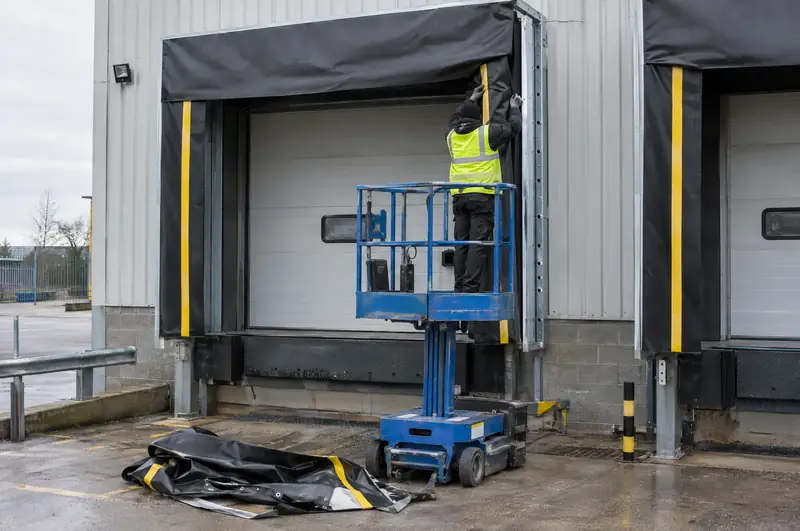
Dock shelter and seal repair covers restoring the weather seal around a docked trailer. Typical work includes replacing torn side and head curtains, worn foam seal pads and their covers, top pads and guide strips, repairing or replacing airbags and blowers on inflatable shelters, and straightening or replacing bent shelter frames, so the bay closes the gap between building and trailer again.
Where does this fit at a dock in Dundee and Angus?
Older retractable shelters on estates around Dundee and Angus can often be refurbished with new curtains and pads rather than replaced, provided the frame is still sound. Repairs to shelters and seals in Dundee and Angus follow the same process as anywhere else in the UK, with the visit price agreed in writing first.
Exposed yards in Dundee and Angus that catch strong winds can tear shelter curtains or strain frames, letting weather into the dock until parts are replaced.
Repair and service visits in Dundee and Angus are chargeable, and we agree the price with you in writing before anyone attends. Photos or a short video of the fault help us send the right engineer with the right parts. If the visit uncovers more work than expected, we quote it and wait for your approval before going ahead. After every visit you receive a written report on what was found and done.
How much does a dock shelter or seal repair cost?
A dock shelter or seal repair typically costs £380 to £1,800 per repair, excluding VAT. A pair of side curtains or seal pad covers sits towards the lower end; a full curtain set, a new frame or a set of airbags with a blower sits towards the top.
How the price is agreed:
- You describe the damage and send photos, ideally with a trailer docked.
- We agree the visit price in writing before anyone attends. Where parts are made to measure, that may cover a measuring visit and a fitting visit.
- Any extra work found on site is quoted and approved by you before it is done.
What moves the price:
- Parts: curtains, pads, airbags, blowers and frames differ widely in cost.
- Size: taller and wider shelters need more material.
- Access: head curtains and top pads may need powered access equipment.
- Number of bays and timing: several bays together lower the cost per bay; out-of-hours work adds to it.
VAT is added at the standard rate.
What happens on site during a shelter or seal repair?
During a shelter or seal repair the bay is closed to trailers while the engineer works from the yard, often using access equipment for the head curtain and top pad. Neighbouring bays can usually keep working, although access equipment may need space in front of them.
- Measure: where parts are made to measure, the shelter or seal is measured first and the parts ordered.
- Close the bay: no trailer on the dock and the yard area coned off.
- Isolate: on inflatable shelters, the blower supply is isolated and locked off.
- Replace parts: old curtains, pads or airbags are removed and new ones fitted, with frames straightened or replaced as agreed.
- Check the seal: overlap and compression are checked, with a trailer docked if one is available.
It helps if you can provide photos with a trailer docked, yard space for access equipment, a contact who can arrange electrical isolation and an agreed time when the bay can be released.
Towns we cover in Dundee and Angus
Find your town in the list below for details of dock shelter and seal repairs across Dundee and Angus, or contact us if your location is not shown.
The visit price is agreed before anyone attends. All guide prices.
What do the rules in Scotland mean for the work?
Doors and dock equipment installed in Scotland may carry the UKCA or the CE mark, and we pass on the documentation for everything fitted in Dundee and Angus. Because building warrant and planning questions can affect the programme, we check what applies before any work starts and raise any approvals early rather than assuming none are needed.
Questions
What is the difference between servicing and a statutory inspection?
Servicing keeps equipment working: cleaning, adjusting, lubricating and replacing worn parts. A statutory inspection or thorough examination is a separate check by a competent person, often arranged through your engineering insurer. Dock levellers are commonly inspected under PUWER at 12-month intervals, and lift tables may need LOLER thorough examination, depending on the equipment and how it is used. Your insurer or competent person will confirm what applies.
What happens if the engineer finds the equipment unsafe?
If equipment is found to be unsafe, the engineer will tell you straight away and recommend that it is isolated and taken out of use until it is repaired. That is recorded in the written report. We then quote the repair so you can decide how to proceed. Keeping an unsafe door or leveller in service puts people at risk, so we will always raise it.
Why do shelter curtains keep tearing?
Shelter curtains usually keep tearing because trailers arrive off-centre, the curtains are too short or tight for the trailers now in use, or worn bumpers let trailers reverse too far in. Fixing the cause, for example with wheel guides or resized curtains, stops repeat damage.
How is the price for a shelter or seal repair agreed?
You describe the damage and send photos, and we agree the visit price in writing before anyone attends. For made-to-measure parts that may include a measuring visit. Any extra work found on site is quoted and only carried out once you approve it.
Other services in Dundee and Angus
Full guide to dock shelter and seal repairs · All loading bay services in Dundee and Angus