
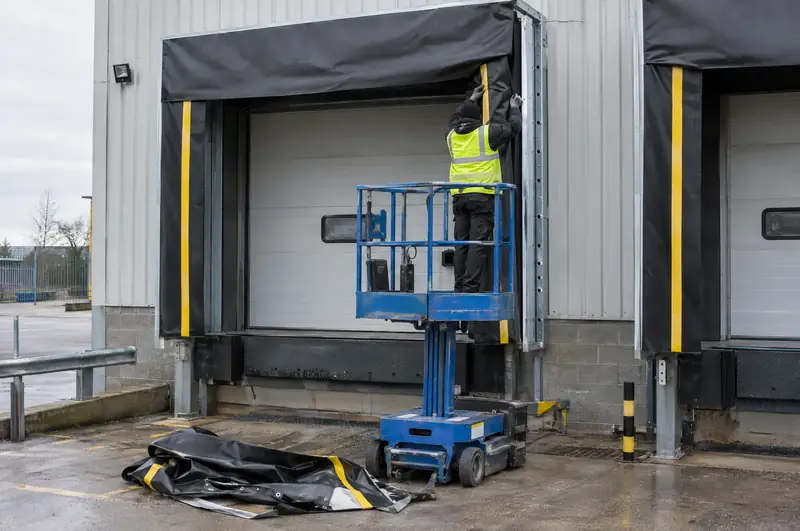
Dock shelter and seal repair covers restoring the weather seal around a docked trailer. Typical work includes replacing torn side and head curtains, worn foam seal pads and their covers, top pads and guide strips, repairing or replacing airbags and blowers on inflatable shelters, and straightening or replacing bent shelter frames, so the bay closes the gap between building and trailer again.
Why do sites in Fife choose this?
Curtains tearing at the corners at docks in Fife can be a sign that taller or wider trailers are arriving than the shelter was sized for. Exposed yards in Fife that catch strong winds can tear shelter curtains or strain frames, letting weather into the dock until parts are replaced.
Chilled distribution sites around Fife tend to notice failing seals quickly, as gaps around the trailer cause condensation and ice on the dock floor.
Before a repair visit in Fife, we ask three things: what the equipment is, what it is doing wrong and whether you can send photos. With that, we price the visit and confirm it in writing, and nobody attends until you agree. If the engineer finds further faults, they are quoted first and only fixed with your approval. Each visit ends with a written report of findings and work done.
How can I make shelter curtains and seal pads last longer?
Shelter curtains and seal pads last longest when trailers arrive straight, stop at the right distance and the parts are checked regularly. Most premature damage comes from how trailers are parked rather than from the material itself.
- Wheel guides: keep trailers centred so they do not drag one side curtain or crush one pad.
- Bumpers: worn bumpers let trailers reverse too far in and over-compress seals.
- Guide markings: clear centre lines on curtains and the dock help drivers line up.
- Early repairs: a small tear repaired early is cheaper than a full curtain later.
- Wear-resistant facings: seal pads can be specified with tougher covers where trailers rub most.
- Blower care: keeping blower intakes clear helps inflatable shelters inflate fully.
Our loading bay servicing includes shelters and seals, so wear is picked up alongside doors and levellers.
What happens on site during a shelter or seal repair?
During a shelter or seal repair the bay is closed to trailers while the engineer works from the yard, often using access equipment for the head curtain and top pad. Neighbouring bays can usually keep working, although access equipment may need space in front of them.
- Measure: where parts are made to measure, the shelter or seal is measured first and the parts ordered.
- Close the bay: no trailer on the dock and the yard area coned off.
- Isolate: on inflatable shelters, the blower supply is isolated and locked off.
- Replace parts: old curtains, pads or airbags are removed and new ones fitted, with frames straightened or replaced as agreed.
- Check the seal: overlap and compression are checked, with a trailer docked if one is available.
It helps if you can provide photos with a trailer docked, yard space for access equipment, a contact who can arrange electrical isolation and an agreed time when the bay can be released.
Towns we cover in Fife
Each of the following towns in Fife has its own page on dock shelter and seal repairs, covering how we work and what to send us.
The visit price is agreed before anyone attends. All guide prices.
What do the rules in Scotland mean for the work?
Energy standards for buildings in Scotland are set out in Section 6 of the Building Standards Technical Handbook. For new or replacement loading bay doors in Fife, we confirm the figure that applies to your project and check what applies before any work starts, rather than relying on rules written for elsewhere in the UK.
Questions
What is the difference between servicing and a statutory inspection?
Servicing keeps equipment working: cleaning, adjusting, lubricating and replacing worn parts. A statutory inspection or thorough examination is a separate check by a competent person, often arranged through your engineering insurer. Dock levellers are commonly inspected under PUWER at 12-month intervals, and lift tables may need LOLER thorough examination, depending on the equipment and how it is used. Your insurer or competent person will confirm what applies.
Do you provide a written report after each visit?
Yes. After every repair or service visit to a site in Fife, you receive a written report setting out what was checked, what was found, what work was carried out and anything that still needs attention, with a quote for further work where needed. The report is useful for your maintenance records and for discussions with your insurer or inspector.
Can worn dock seal covers be replaced without new foam?
Often, yes. If the foam inside a seal pad still springs back, a new cover can be fitted over it. If the foam has stayed compressed or soaked up water, the pad is usually replaced complete. Photos of the pads, front and side, help us judge which applies.
Do you repair inflatable dock shelters?
Yes. We repair and replace torn airbags, failed blower motors, controls and fixings on inflatable shelters. Where the shelter is interlocked with the dock controls so it only inflates with a trailer present, that link is checked as part of the repair.
Other services in Fife
Full guide to dock shelter and seal repairs · All loading bay services in Fife