
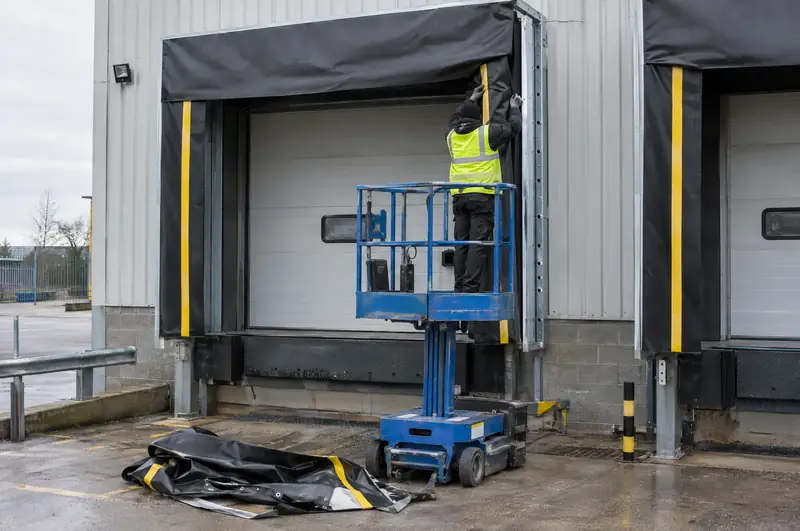
Dock shelter and seal repair covers restoring the weather seal around a docked trailer. Typical work includes replacing torn side and head curtains, worn foam seal pads and their covers, top pads and guide strips, repairing or replacing airbags and blowers on inflatable shelters, and straightening or replacing bent shelter frames, so the bay closes the gap between building and trailer again.
What should sites in Essex consider?
Repairs to shelters and seals in Essex follow the same process as anywhere else in the UK, with the visit price agreed in writing first. If tenants change at a unit in Essex, checking the shelters and seals is sensible, because a new fleet may not suit the old curtain sizes.
Older retractable shelters on estates around Essex can often be refurbished with new curtains and pads rather than replaced, provided the frame is still sound.
Servicing and repairs work slightly differently from installations. Visits to sites in Essex are chargeable, and the price is set out in writing before anyone comes out. To help us prepare, send photos of the equipment and the fault. The engineer carries out the agreed work, flags anything else that needs attention and quotes it before touching it. Afterwards, a written report records the condition of each item.
What happens on site during a shelter or seal repair?
During a shelter or seal repair the bay is closed to trailers while the engineer works from the yard, often using access equipment for the head curtain and top pad. Neighbouring bays can usually keep working, although access equipment may need space in front of them.
- Measure: where parts are made to measure, the shelter or seal is measured first and the parts ordered.
- Close the bay: no trailer on the dock and the yard area coned off.
- Isolate: on inflatable shelters, the blower supply is isolated and locked off.
- Replace parts: old curtains, pads or airbags are removed and new ones fitted, with frames straightened or replaced as agreed.
- Check the seal: overlap and compression are checked, with a trailer docked if one is available.
It helps if you can provide photos with a trailer docked, yard space for access equipment, a contact who can arrange electrical isolation and an agreed time when the bay can be released.
Do dock shelters and seals fall under PUWER?
Yes. Dock shelters and seals are work equipment under the Provision and Use of Work Equipment Regulations 1998 (PUWER), so they must be suitable, maintained in a safe condition and inspected where deterioration could lead to danger. In Northern Ireland the equivalent is PUWER (Northern Ireland) 1999.
Shelter and seal damage is often treated as a comfort or energy issue, but some faults are safety issues too:
- loose head curtains, top pads or fixings that could fall;
- bent or broken frame arms with sharp edges at head height;
- wet or icy dock floors caused by gaps around the trailer;
- electrical faults on inflatable shelter blowers.
The regulator is HSE in Great Britain and HSENI in Northern Ireland. Including shelters and seals in planned maintenance, and recording what is found, shows they are being kept in a safe condition. Problems found during servicing are quoted as repairs before any work is done.
Towns we cover in Essex
We take enquiries about dock shelter and seal repairs from across Essex. These are the towns with their own pages:
- Southend-on-Sea
- Basildon
- Colchester
- Chelmsford
- Harlow
- Grays
- Braintree
- Brentwood
- Clacton-on-Sea
- South Benfleet
- Canvey Island
- Billericay
- Rayleigh
- Stanford-le-Hope
- Wickford
- Witham
- Maldon
- Waltham Abbey
- South Ockendon
- Harwich
- Hadleigh
- Tilbury
The visit price is agreed before anyone attends. All guide prices.
Regulations and approvals in England
Workplace safety in England is regulated by HSE. For a loading bay in Essex, that means doors meeting regulation 18 of the Workplace (Health, Safety and Welfare) Regulations 1992, equipment maintained under PUWER and suitable safeguards against vehicles driving away too early. We check what applies before any work starts and design the bay accordingly.
Questions
Do you provide a written report after each visit?
Yes. After every repair or service visit to a site in Essex, you receive a written report setting out what was checked, what was found, what work was carried out and anything that still needs attention, with a quote for further work where needed. The report is useful for your maintenance records and for discussions with your insurer or inspector.
What is the difference between servicing and a statutory inspection?
Servicing keeps equipment working: cleaning, adjusting, lubricating and replacing worn parts. A statutory inspection or thorough examination is a separate check by a competent person, often arranged through your engineering insurer. Dock levellers are commonly inspected under PUWER at 12-month intervals, and lift tables may need LOLER thorough examination, depending on the equipment and how it is used. Your insurer or competent person will confirm what applies.
Do you repair inflatable dock shelters?
Yes. We repair and replace torn airbags, failed blower motors, controls and fixings on inflatable shelters. Where the shelter is interlocked with the dock controls so it only inflates with a trailer present, that link is checked as part of the repair.
How is the price for a shelter or seal repair agreed?
You describe the damage and send photos, and we agree the visit price in writing before anyone attends. For made-to-measure parts that may include a measuring visit. Any extra work found on site is quoted and only carried out once you approve it.
Other services in Essex
Full guide to dock shelter and seal repairs · All loading bay services in Essex