
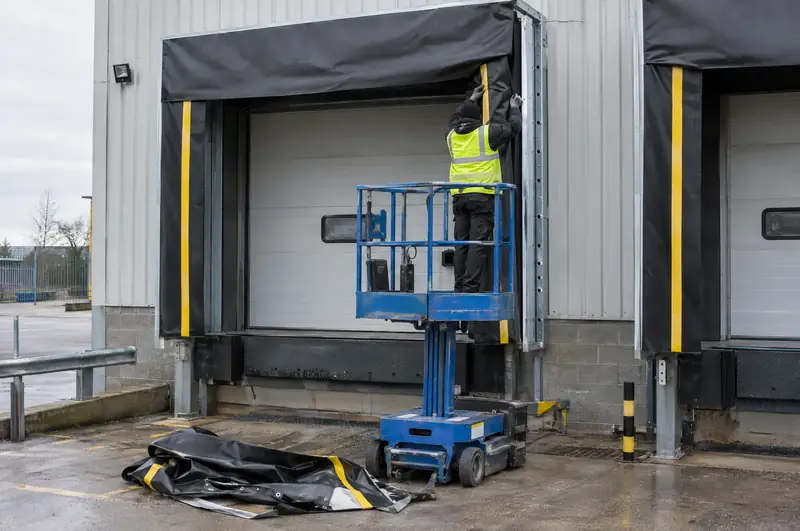
Dock shelter and seal repair covers restoring the weather seal around a docked trailer. Typical work includes replacing torn side and head curtains, worn foam seal pads and their covers, top pads and guide strips, repairing or replacing airbags and blowers on inflatable shelters, and straightening or replacing bent shelter frames, so the bay closes the gap between building and trailer again.
What should sites in Greater London consider?
Chilled distribution sites around Greater London tend to notice failing seals quickly, as gaps around the trailer cause condensation and ice on the dock floor. Exposed yards in Greater London that catch strong winds can tear shelter curtains or strain frames, letting weather into the dock until parts are replaced.
Older retractable shelters on estates around Greater London can often be refurbished with new curtains and pads rather than replaced, provided the frame is still sound.
For dock shelter and seal repairs at sites in Greater London, you will always know the cost before anyone sets off. The visit is chargeable and its price is agreed in writing. Clear photos of the problem help the engineer arrive prepared. Where the visit reveals more work, we stop, explain and quote before going further, and a written report follows every attendance so you have a record of the condition of each item.
Should I repair my dock shelter or change to a different type?
Repair is usually right when the shelter or seal still suits your trailers and the damage is wear and tear. Changing type is worth considering when the same damage keeps recurring because the equipment no longer suits the vehicles arriving.
- Repair: curtains torn by normal use, worn pad covers, a failed blower or a single bent frame arm.
- Resize: head curtains or pads that are too short for taller trailers now in your fleet.
- Seal to shelter: foam seals suit consistent trailer sizes; a mixed fleet or curtain-siders may need a shelter instead.
- Retractable to inflatable: chilled or frozen docks that need a tighter seal around varied trailers.
- Frame type: shelters repeatedly bent by trailers may suit a retractable frame that gives on impact.
Any change of type is quoted separately from the repair. Our guide to dock shelters vs dock seals explains how each type works and which trailers it suits.
How much does a dock shelter or seal repair cost?
A dock shelter or seal repair typically costs £380 to £1,800 per repair, excluding VAT. A pair of side curtains or seal pad covers sits towards the lower end; a full curtain set, a new frame or a set of airbags with a blower sits towards the top.
How the price is agreed:
- You describe the damage and send photos, ideally with a trailer docked.
- We agree the visit price in writing before anyone attends. Where parts are made to measure, that may cover a measuring visit and a fitting visit.
- Any extra work found on site is quoted and approved by you before it is done.
What moves the price:
- Parts: curtains, pads, airbags, blowers and frames differ widely in cost.
- Size: taller and wider shelters need more material.
- Access: head curtains and top pads may need powered access equipment.
- Number of bays and timing: several bays together lower the cost per bay; out-of-hours work adds to it.
VAT is added at the standard rate.
Towns we cover in Greater London
Each of the following towns in Greater London has its own page on dock shelter and seal repairs, covering how we work and what to send us.
- Barking
- Sutton
- Croydon
- Ilford
- Enfield
- Harrow
- Tottenham
- Walthamstow
- Dagenham
- Romford
- Hayes
- Wembley
- Edmonton
- Southall
- Uxbridge
- Hounslow
- Feltham
- Acton
- Greenford
- Thamesmead
- Barnet
- South Ruislip
- Harringay
- Enfield Lock
- Stepney
- Worcester Park
- Beckton
- Erith
- Park Royal
- Rainham
The visit price is agreed before anyone attends. All guide prices.
What do the rules in England mean for the work?
Sites in Greater London fall under the rules for England. Structural changes such as forming a new opening or a dock leveller pit may need Building Regulations approval, and external structures such as loading houses, canopies or new dock approaches can need planning permission from the local planning authority. We check what applies before any work starts and build any approvals into the plan.
Questions
What is the difference between servicing and a statutory inspection?
Servicing keeps equipment working: cleaning, adjusting, lubricating and replacing worn parts. A statutory inspection or thorough examination is a separate check by a competent person, often arranged through your engineering insurer. Dock levellers are commonly inspected under PUWER at 12-month intervals, and lift tables may need LOLER thorough examination, depending on the equipment and how it is used. Your insurer or competent person will confirm what applies.
Do you provide a written report after each visit?
Yes. After every repair or service visit to a site in Greater London, you receive a written report setting out what was checked, what was found, what work was carried out and anything that still needs attention, with a quote for further work where needed. The report is useful for your maintenance records and for discussions with your insurer or inspector.
Do you repair inflatable dock shelters?
Yes. We repair and replace torn airbags, failed blower motors, controls and fixings on inflatable shelters. Where the shelter is interlocked with the dock controls so it only inflates with a trailer present, that link is checked as part of the repair.
Can repairs help a chilled loading bay?
Yes. Gaps around a docked trailer let chilled air escape and warm, moist air in, which causes condensation and ice on the dock floor. Restoring the curtains, pads or airbags closes those gaps, helping keep the dock drier and safer to work in.
Other services in Greater London
Full guide to dock shelter and seal repairs · All loading bay services in Greater London