
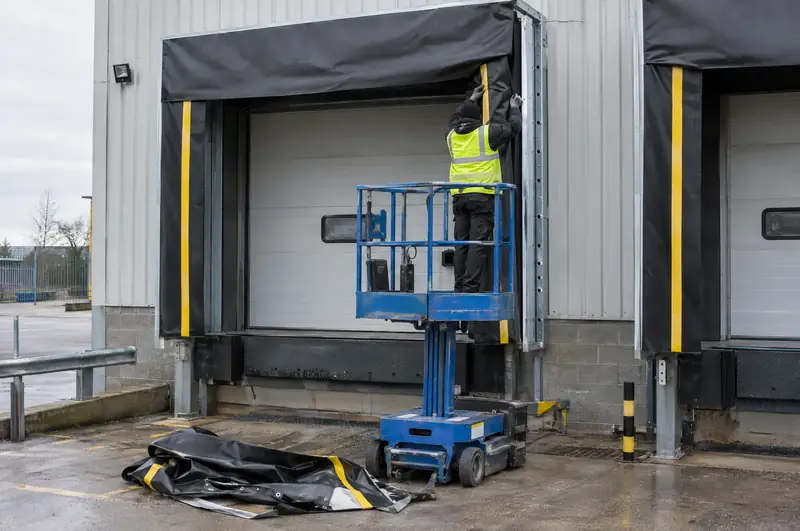
Dock shelter and seal repair covers restoring the weather seal around a docked trailer. Typical work includes replacing torn side and head curtains, worn foam seal pads and their covers, top pads and guide strips, repairing or replacing airbags and blowers on inflatable shelters, and straightening or replacing bent shelter frames, so the bay closes the gap between building and trailer again.
Why do sites in Renfrewshire and Inverclyde choose this?
Exposed yards in Renfrewshire and Inverclyde that catch strong winds can tear shelter curtains or strain frames, letting weather into the dock until parts are replaced. If tenants change at a unit in Renfrewshire and Inverclyde, checking the shelters and seals is sensible, because a new fleet may not suit the old curtain sizes.
Older retractable shelters on estates around Renfrewshire and Inverclyde can often be refurbished with new curtains and pads rather than replaced, provided the frame is still sound.
A chargeable visit, a price agreed in advance and a written report afterwards: that is our approach to dock shelter and seal repairs in Renfrewshire and Inverclyde. Photos of the fault, sent before the visit, help us diagnose it and bring suitable parts. Should the job turn out bigger than expected, the extra work is quoted and approved by you before it happens, so there are no surprises on the invoice.
Should I repair my dock shelter or change to a different type?
Repair is usually right when the shelter or seal still suits your trailers and the damage is wear and tear. Changing type is worth considering when the same damage keeps recurring because the equipment no longer suits the vehicles arriving.
- Repair: curtains torn by normal use, worn pad covers, a failed blower or a single bent frame arm.
- Resize: head curtains or pads that are too short for taller trailers now in your fleet.
- Seal to shelter: foam seals suit consistent trailer sizes; a mixed fleet or curtain-siders may need a shelter instead.
- Retractable to inflatable: chilled or frozen docks that need a tighter seal around varied trailers.
- Frame type: shelters repeatedly bent by trailers may suit a retractable frame that gives on impact.
Any change of type is quoted separately from the repair. Our guide to dock shelters vs dock seals explains how each type works and which trailers it suits.
What happens on site during a shelter or seal repair?
During a shelter or seal repair the bay is closed to trailers while the engineer works from the yard, often using access equipment for the head curtain and top pad. Neighbouring bays can usually keep working, although access equipment may need space in front of them.
- Measure: where parts are made to measure, the shelter or seal is measured first and the parts ordered.
- Close the bay: no trailer on the dock and the yard area coned off.
- Isolate: on inflatable shelters, the blower supply is isolated and locked off.
- Replace parts: old curtains, pads or airbags are removed and new ones fitted, with frames straightened or replaced as agreed.
- Check the seal: overlap and compression are checked, with a trailer docked if one is available.
It helps if you can provide photos with a trailer docked, yard space for access equipment, a contact who can arrange electrical isolation and an agreed time when the bay can be released.
Towns we cover in Renfrewshire and Inverclyde
Find your town in the list below for details of dock shelter and seal repairs across Renfrewshire and Inverclyde, or contact us if your location is not shown.
The visit price is agreed before anyone attends. All guide prices.
Regulations and approvals in Scotland
Energy standards for buildings in Scotland are set out in Section 6 of the Building Standards Technical Handbook. For new or replacement loading bay doors in Renfrewshire and Inverclyde, we confirm the figure that applies to your project and check what applies before any work starts, rather than relying on rules written for elsewhere in the UK.
Questions
What happens if the engineer finds the equipment unsafe?
If equipment is found to be unsafe, the engineer will tell you straight away and recommend that it is isolated and taken out of use until it is repaired. That is recorded in the written report. We then quote the repair so you can decide how to proceed. Keeping an unsafe door or leveller in service puts people at risk, so we will always raise it.
How often should equipment at our Renfrewshire and Inverclyde site be serviced?
It depends on how hard the equipment works and on the manufacturer's recommendations. A multi-shift dock with frequent trailer movements needs more attention than a door that opens a few times a day. We suggest a schedule after looking at the equipment and how it is used, and we can line visits up with your insurance inspections where that helps.
Can you replace just the curtains on a dock shelter?
Yes. If the frame is still sound, the side and head curtains can be replaced on their own, which is the most common shelter repair. Curtains are usually made to measure, so the shelter is measured first and the new curtains fitted on a second visit, with both visits priced in advance.
Why do shelter curtains keep tearing?
Shelter curtains usually keep tearing because trailers arrive off-centre, the curtains are too short or tight for the trailers now in use, or worn bumpers let trailers reverse too far in. Fixing the cause, for example with wheel guides or resized curtains, stops repeat damage.
Other services in Renfrewshire and Inverclyde
Full guide to dock shelter and seal repairs · All loading bay services in Renfrewshire and Inverclyde