
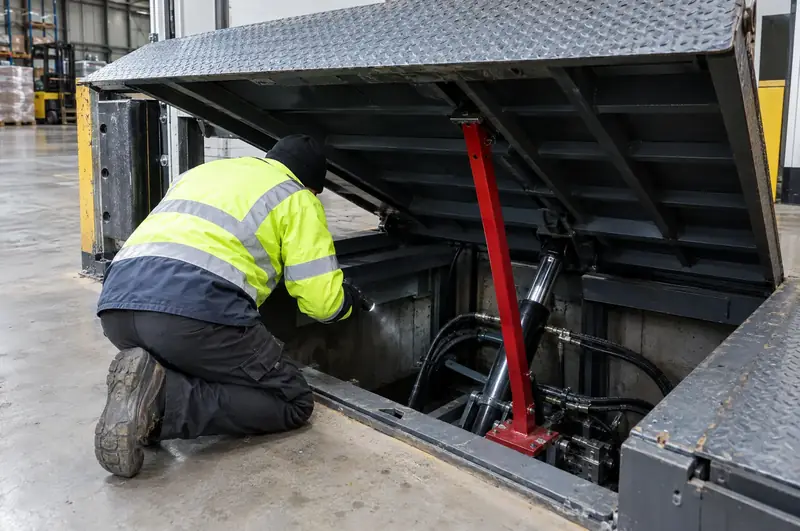
Dock leveller repair covers finding and fixing faults on the bridge between the dock and the trailer bed, including hydraulic cylinders, hoses and power packs, safety and check valves, lip hinges and lip cylinders, platform and lip damage, toe guards and control panels. It applies to swing-lip, telescopic-lip, mechanical and edge-of-dock levellers, with the aim of returning each one to safe working order.
Why do sites in Greater Manchester choose this?
Insurer inspections at sites around Greater Manchester may list leveller defects that need attention, and we can price each item directly from the report. Distribution docks in Greater Manchester that run several shifts put heavy cycles through leveller hydraulics, so leaks and slow operation can show up sooner.
Docks in Greater Manchester receiving trailers at widely varying bed heights can wear lip hinges faster, and hinge rebuilds are a routine part of leveller repair.
When something stops working at a loading bay in Greater Manchester, contact us with a description and, ideally, photos. We will confirm the cost of the visit in writing before booking anyone. If the engineer finds the problem goes further than expected, you receive a quote for the additional work and decide whether to proceed. Every visit is followed by a written report you can keep with your maintenance records.
How much does a dock leveller repair cost?
A dock leveller repair typically costs £220 to £2,600 per repair, excluding VAT. Replacing a hose or limit switch sits towards the lower end; a new power pack, cylinder set or rebuilt lip hinge sits towards the top.
How the price is agreed:
- You describe the fault, ideally with photos of the leveller, the pit and any labels.
- We agree the visit price in writing before anyone attends.
- Anything found on site beyond that scope is quoted and approved by you before it is done.
What moves the price:
- Parts: cylinders, power packs, valves and hinge components vary widely in cost.
- Welding and fabrication: cracked decks, broken hinge knuckles and bent lips take more time.
- Hydraulic work: an oil change and bleeding the system add to cylinder or hose repairs.
- Pit condition: heavy debris or standing water must be cleared first.
- Out-of-hours working and location: both are agreed in the visit price.
VAT is added at the standard rate.
What are the most common dock leveller faults?
The most common dock leveller faults are hydraulic leaks, power pack failures, lip and hinge damage, and control faults. The way the leveller behaves usually points to the cause.
- Will not rise, or rises slowly: power pack motor or pump, low oil, a failed contactor or a control fault.
- Sinks under load or drifts down when parked: leaking cylinder seals or a faulty check valve.
- Drops suddenly, then locks: the safety valve doing its job after a hose or fitting failure.
- Lip will not extend or falls short: a lip cylinder fault, a sequence valve problem or a seized lip hinge.
- Oil in the pit: a leaking hose, fitting or cylinder.
- Jerky or noisy movement: air in the hydraulics or worn pivots.
- Cracked deck, bent lip or broken hinge knuckles: impact damage or fatigue.
A leveller showing any of these faults should be taken out of use until it has been checked.
Towns we cover in Greater Manchester
Below is a list of towns in Greater Manchester for dock leveller repairs. Each page explains our approach for sites in that town.
- Manchester
- Oldham
- Wigan
- Bolton
- Stockport
- Salford
- Rochdale
- Sale
- Bury
- Altrincham
- Middleton
- Ashton-under-Lyne
- Leigh
- Stretford
- Urmston
- Chadderton
- Eccles
- Tyldesley
- Hyde
- Walkden
- Prestwich
- Radcliffe
The visit price is agreed before anyone attends. All guide prices.
Planning, building control and safety law in England
Workplace safety in England is regulated by HSE. For a loading bay in Greater Manchester, that means doors meeting regulation 18 of the Workplace (Health, Safety and Welfare) Regulations 1992, equipment maintained under PUWER and suitable safeguards against vehicles driving away too early. We check what applies before any work starts and design the bay accordingly.
Questions
What is the difference between servicing and a statutory inspection?
Servicing keeps equipment working: cleaning, adjusting, lubricating and replacing worn parts. A statutory inspection or thorough examination is a separate check by a competent person, often arranged through your engineering insurer. Dock levellers are commonly inspected under PUWER at 12-month intervals, and lift tables may need LOLER thorough examination, depending on the equipment and how it is used. Your insurer or competent person will confirm what applies.
Can you repair all makes of loading bay equipment?
We work on common makes and types of doors, dock levellers, shelters, seals and restraints. Parts availability varies, particularly for older or discontinued equipment, so it helps to send the make, model and photos of any data plates from your site in Greater Manchester. If original parts are not available, we tell you and price the alternatives, including replacement where that makes more sense.
Will the repair clear an insurer's defect notice?
A repair addresses the defect listed, and our written report records what was found and what was done, which you can keep with the insurer's report. Whether the insurer needs to re-inspect is between you and them. Any further defects found during the repair are quoted before work.
Do you repair mechanical dock levellers?
Yes, where parts are still available. Mechanical levellers use springs and a hold-down mechanism rather than hydraulics, and common repairs include springs, release mechanisms and lip hinges. Where parts are hard to find or faults keep recurring, the report may suggest pricing a hydraulic replacement.
Other services in Greater Manchester
Full guide to dock leveller repairs · All loading bay services in Greater Manchester