
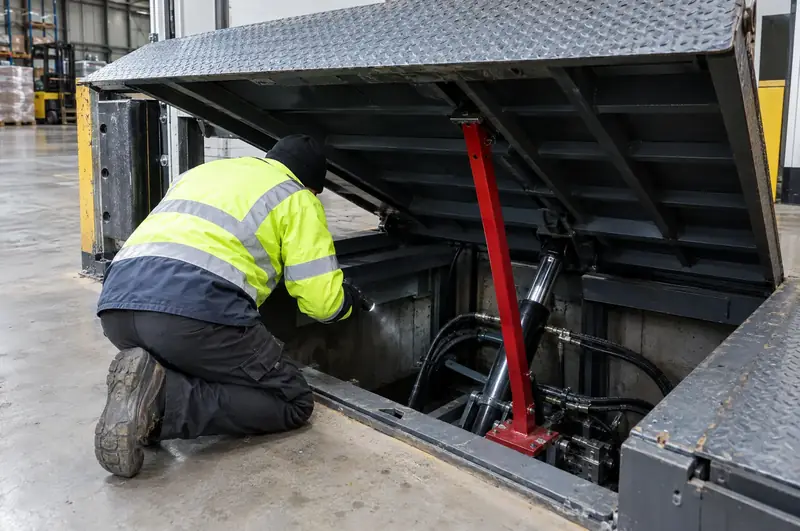
Dock leveller repair covers finding and fixing faults on the bridge between the dock and the trailer bed, including hydraulic cylinders, hoses and power packs, safety and check valves, lip hinges and lip cylinders, platform and lip damage, toe guards and control panels. It applies to swing-lip, telescopic-lip, mechanical and edge-of-dock levellers, with the aim of returning each one to safe working order.
What matters for dock leveller repairs in Dumfries and Galloway?
Landlords and managing agents in Dumfries and Galloway with several units can group leveller repairs into planned visits, keeping access costs down across the estate. Every leveller repair enquiry from Dumfries and Galloway starts with you describing the fault, then a visit price agreed in writing before an engineer attends.
Older units in Dumfries and Galloway may still run mechanical or early hydraulic levellers, where a well-judged repair can keep the bay working before replacement is needed.
Planned servicing and reactive repairs in Dumfries and Galloway are both chargeable. We agree the price of each visit in writing beforehand, and we never extend the scope without asking. Photos taken by your team help us plan the work and the parts. The engineer records the condition of doors, levellers, shelters and safety equipment as they go, and you receive that as a written report after the visit.
Should a dock leveller be repaired or replaced?
A dock leveller is usually worth repairing when the platform, lip and hinges are structurally sound and the fault is in the hydraulics, controls or a single component. Replacement is worth considering when the structure is fatigued or the leveller no longer suits your trailers.
Repair is likely to be the better option when:
- the fault is a hose, cylinder, valve or power pack;
- lip or hinge damage is limited to one area and can be welded or rebuilt;
- the leveller is the right length for your trailer height range.
Replacement is worth pricing when:
- the deck or hinge structure is cracking in several places;
- hydraulic failures keep recurring despite repairs;
- an old mechanical leveller needs major parts that are hard to find;
- trailers now arrive at heights the leveller cannot reach at a safe gradient.
Our guide to dock leveller repair or replace covers the signs in more detail.
What are the most common dock leveller faults?
The most common dock leveller faults are hydraulic leaks, power pack failures, lip and hinge damage, and control faults. The way the leveller behaves usually points to the cause.
- Will not rise, or rises slowly: power pack motor or pump, low oil, a failed contactor or a control fault.
- Sinks under load or drifts down when parked: leaking cylinder seals or a faulty check valve.
- Drops suddenly, then locks: the safety valve doing its job after a hose or fitting failure.
- Lip will not extend or falls short: a lip cylinder fault, a sequence valve problem or a seized lip hinge.
- Oil in the pit: a leaking hose, fitting or cylinder.
- Jerky or noisy movement: air in the hydraulics or worn pivots.
- Cracked deck, bent lip or broken hinge knuckles: impact damage or fatigue.
A leveller showing any of these faults should be taken out of use until it has been checked.
Towns we cover in Dumfries and Galloway
Looking for dock leveller repairs in a specific part of Dumfries and Galloway? Start with the nearest town on this list.
The visit price is agreed before anyone attends. All guide prices.
Which rules apply in Scotland?
HSE is the workplace safety regulator in Scotland. At a loading bay in Dumfries and Galloway, doors need to satisfy regulation 18 of the Workplace (Health, Safety and Welfare) Regulations 1992, dock equipment must be kept safe under PUWER, and drivers must be prevented from pulling away too early. We check what applies before any work starts.
Questions
What is the difference between servicing and a statutory inspection?
Servicing keeps equipment working: cleaning, adjusting, lubricating and replacing worn parts. A statutory inspection or thorough examination is a separate check by a competent person, often arranged through your engineering insurer. Dock levellers are commonly inspected under PUWER at 12-month intervals, and lift tables may need LOLER thorough examination, depending on the equipment and how it is used. Your insurer or competent person will confirm what applies.
Do you provide a written report after each visit?
Yes. After every repair or service visit to a site in Dumfries and Galloway, you receive a written report setting out what was checked, what was found, what work was carried out and anything that still needs attention, with a quote for further work where needed. The report is useful for your maintenance records and for discussions with your insurer or inspector.
Is it safe to keep using a leaking dock leveller?
No. A dock leveller leaking hydraulic oil should be taken out of use until it has been checked, because the leak may affect how the platform holds its position under load. Oil in the pit is also a slip and environmental hazard. Describe the leak and send photos so we can plan the repair.
Will the repair clear an insurer's defect notice?
A repair addresses the defect listed, and our written report records what was found and what was done, which you can keep with the insurer's report. Whether the insurer needs to re-inspect is between you and them. Any further defects found during the repair are quoted before work.
Other services in Dumfries and Galloway
Full guide to dock leveller repairs · All loading bay services in Dumfries and Galloway