
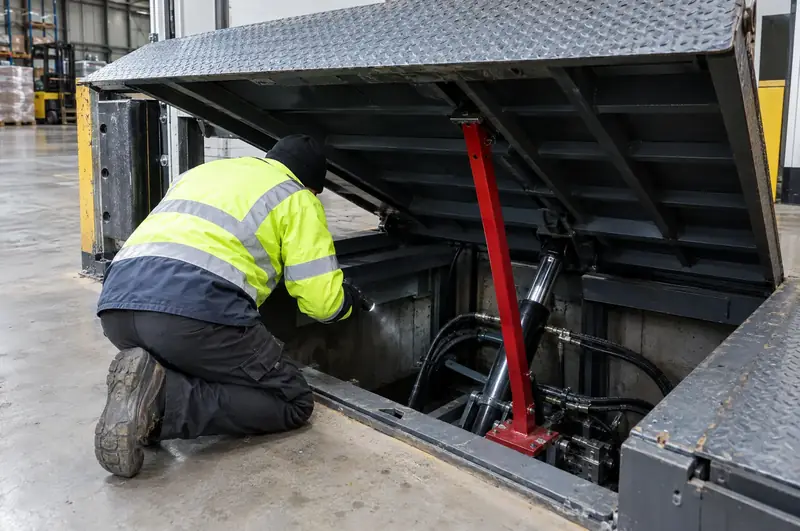
Dock leveller repair covers finding and fixing faults on the bridge between the dock and the trailer bed, including hydraulic cylinders, hoses and power packs, safety and check valves, lip hinges and lip cylinders, platform and lip damage, toe guards and control panels. It applies to swing-lip, telescopic-lip, mechanical and edge-of-dock levellers, with the aim of returning each one to safe working order.
What should sites in Renfrewshire and Inverclyde consider?
Every leveller repair enquiry from Renfrewshire and Inverclyde starts with you describing the fault, then a visit price agreed in writing before an engineer attends. Low temperatures at chilled and frozen docks in Renfrewshire and Inverclyde can affect hydraulic oil and seals, so it helps to mention the operating temperature when reporting a fault.
Docks in Renfrewshire and Inverclyde receiving trailers at widely varying bed heights can wear lip hinges faster, and hinge rebuilds are a routine part of leveller repair.
Servicing and repairs work slightly differently from installations. Visits to sites in Renfrewshire and Inverclyde are chargeable, and the price is set out in writing before anyone comes out. To help us prepare, send photos of the equipment and the fault. The engineer carries out the agreed work, flags anything else that needs attention and quotes it before touching it. Afterwards, a written report records the condition of each item.
What happens on site during a dock leveller repair?
During a leveller repair the bay is closed, the leveller is isolated and propped, and the engineer works from the pit or deck to diagnose and repair the fault. Neighbouring bays normally keep working.
- Close the bay: no trailer on the dock, the door closed and forklifts kept away.
- Isolate and prop: the leveller is electrically isolated and locked off, and the platform raised and supported on its maintenance strut before anyone goes underneath.
- Clean and inspect: debris and spilt oil are cleared from the pit so the fault can be traced.
- Repair: parts are fitted or welded. Anything beyond the agreed scope is quoted first.
- Test: the leveller is cycled, the lip checked and controls tested before the bay reopens.
It helps if you can provide a clear bay, a contact on site, photos or labels showing the leveller type and size, and any insurer inspection report that lists the defect.
What are the most common dock leveller faults?
The most common dock leveller faults are hydraulic leaks, power pack failures, lip and hinge damage, and control faults. The way the leveller behaves usually points to the cause.
- Will not rise, or rises slowly: power pack motor or pump, low oil, a failed contactor or a control fault.
- Sinks under load or drifts down when parked: leaking cylinder seals or a faulty check valve.
- Drops suddenly, then locks: the safety valve doing its job after a hose or fitting failure.
- Lip will not extend or falls short: a lip cylinder fault, a sequence valve problem or a seized lip hinge.
- Oil in the pit: a leaking hose, fitting or cylinder.
- Jerky or noisy movement: air in the hydraulics or worn pivots.
- Cracked deck, bent lip or broken hinge knuckles: impact damage or fatigue.
A leveller showing any of these faults should be taken out of use until it has been checked.
Towns we cover in Renfrewshire and Inverclyde
We take enquiries about dock leveller repairs from across Renfrewshire and Inverclyde. These are the towns with their own pages:
The visit price is agreed before anyone attends. All guide prices.
Planning, building control and safety law in Scotland
Lift tables at Scottish sites are lifting equipment under LOLER, which means thorough examination at least every 12 months, or every 6 months if people are lifted, depending on the equipment and its use. For a site in Renfrewshire and Inverclyde, your insurer or competent person will confirm the interval, and we check what applies before any work starts.
Questions
Can you take over our existing loading bay maintenance arrangement?
Yes. Send us a list of the equipment at your Renfrewshire and Inverclyde site, with makes, models and approximate ages if known, plus recent service or inspection reports. We will propose a planned maintenance schedule and price it per item per visit. The first visit records the condition of everything, so you have a clear starting point for future servicing.
How often should equipment at our Renfrewshire and Inverclyde site be serviced?
It depends on how hard the equipment works and on the manufacturer's recommendations. A multi-shift dock with frequent trailer movements needs more attention than a door that opens a few times a day. We suggest a schedule after looking at the equipment and how it is used, and we can line visits up with your insurance inspections where that helps.
How is the price for a leveller repair agreed?
You describe the fault and send photos, and we agree the visit price in writing before anyone attends. If the engineer finds more work is needed, it is quoted and only carried out once you approve it. The visit is chargeable, and the price is always agreed first.
Can a leveller be repaired without disturbing the pit?
Usually yes. Most leveller repairs are carried out in place, working from the deck or from the pit with the platform propped. If the pit itself is cracked, broken at the edges or holding water, that is noted in the report and any pit repair is priced separately.
Other services in Renfrewshire and Inverclyde
Full guide to dock leveller repairs · All loading bay services in Renfrewshire and Inverclyde