
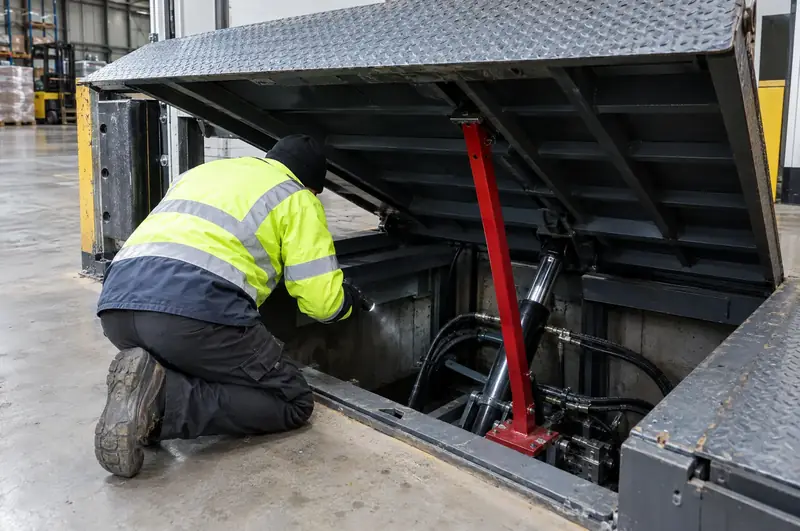
Dock leveller repair covers finding and fixing faults on the bridge between the dock and the trailer bed, including hydraulic cylinders, hoses and power packs, safety and check valves, lip hinges and lip cylinders, platform and lip damage, toe guards and control panels. It applies to swing-lip, telescopic-lip, mechanical and edge-of-dock levellers, with the aim of returning each one to safe working order.
What should sites in Shropshire consider?
Low temperatures at chilled and frozen docks in Shropshire can affect hydraulic oil and seals, so it helps to mention the operating temperature when reporting a fault. Insurer inspections at sites around Shropshire may list leveller defects that need attention, and we can price each item directly from the report.
Docks in Shropshire receiving trailers at widely varying bed heights can wear lip hinges faster, and hinge rebuilds are a routine part of leveller repair.
Before a repair visit in Shropshire, we ask three things: what the equipment is, what it is doing wrong and whether you can send photos. With that, we price the visit and confirm it in writing, and nobody attends until you agree. If the engineer finds further faults, they are quoted first and only fixed with your approval. Each visit ends with a written report of findings and work done.
What inspection rules apply to dock levellers?
Dock levellers are work equipment under the Provision and Use of Work Equipment Regulations 1998 (PUWER), so they must be maintained in a safe condition and inspected where deterioration could lead to danger. In Northern Ireland the equivalent is PUWER (Northern Ireland) 1999.
Engineering insurers commonly inspect dock levellers under PUWER at 12-month intervals. Their reports list defects, sometimes marked for action before further use, and repairs are often needed to clear them.
Most levellers are treated as work equipment under PUWER. A leveller designed or used to lift people may fall under the Lifting Operations and Lifting Equipment Regulations (LOLER), with 6-monthly thorough examination. This depends on the equipment and how it is used; your insurer or competent person will confirm.
Levellers are made to BS EN 1398:2009, the dock leveller safety standard. HSE guidance notes that guards or skirting may be needed where something could be caught, so damaged toe guards are repaired as part of the job. See our guide to dock leveller inspections under PUWER and LOLER.
Should a dock leveller be repaired or replaced?
A dock leveller is usually worth repairing when the platform, lip and hinges are structurally sound and the fault is in the hydraulics, controls or a single component. Replacement is worth considering when the structure is fatigued or the leveller no longer suits your trailers.
Repair is likely to be the better option when:
- the fault is a hose, cylinder, valve or power pack;
- lip or hinge damage is limited to one area and can be welded or rebuilt;
- the leveller is the right length for your trailer height range.
Replacement is worth pricing when:
- the deck or hinge structure is cracking in several places;
- hydraulic failures keep recurring despite repairs;
- an old mechanical leveller needs major parts that are hard to find;
- trailers now arrive at heights the leveller cannot reach at a safe gradient.
Our guide to dock leveller repair or replace covers the signs in more detail.
Towns we cover in Shropshire
We cover dock leveller repairs throughout Shropshire, and the towns below each have their own page. If yours is not listed, get in touch anyway.
The visit price is agreed before anyone attends. All guide prices.
What do the rules in England mean for the work?
Workplace safety in England is regulated by HSE. For a loading bay in Shropshire, that means doors meeting regulation 18 of the Workplace (Health, Safety and Welfare) Regulations 1992, equipment maintained under PUWER and suitable safeguards against vehicles driving away too early. We check what applies before any work starts and design the bay accordingly.
Questions
Can repairs be carried out outside our working hours?
Yes, by arrangement. Evening, night or weekend visits can be booked so that repairs and servicing at your Shropshire site cause less disruption to loading. Out-of-hours attendance usually affects the price, so we include it when we agree the visit charge in writing. Tell us your shift pattern and the times when the dock is quietest.
What is the difference between servicing and a statutory inspection?
Servicing keeps equipment working: cleaning, adjusting, lubricating and replacing worn parts. A statutory inspection or thorough examination is a separate check by a competent person, often arranged through your engineering insurer. Dock levellers are commonly inspected under PUWER at 12-month intervals, and lift tables may need LOLER thorough examination, depending on the equipment and how it is used. Your insurer or competent person will confirm what applies.
Can leveller repairs be done outside operating hours?
Yes, leveller repairs can be arranged for evenings or weekends where that suits your operation. Out-of-hours working costs more, and that is included in the visit price agreed in writing beforehand. Timing for each repair is agreed with you, and neighbouring bays can usually keep working.
Is it safe to keep using a leaking dock leveller?
No. A dock leveller leaking hydraulic oil should be taken out of use until it has been checked, because the leak may affect how the platform holds its position under load. Oil in the pit is also a slip and environmental hazard. Describe the leak and send photos so we can plan the repair.
Other services in Shropshire
Full guide to dock leveller repairs · All loading bay services in Shropshire