
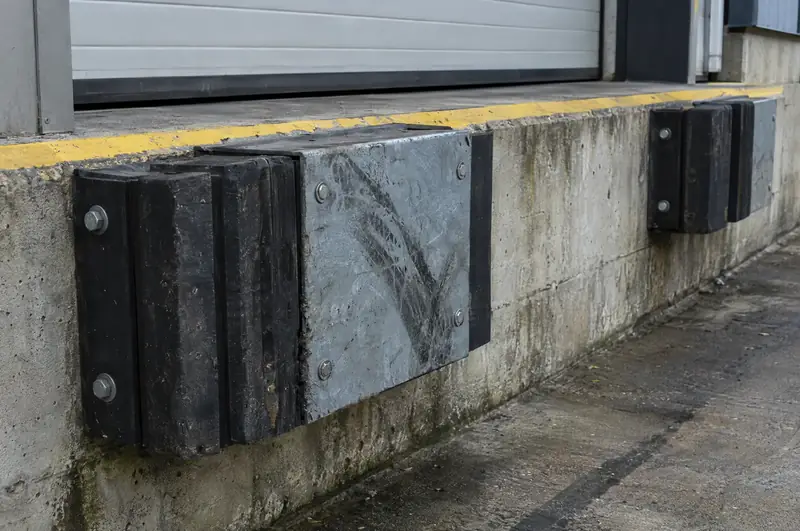
Dock bumpers are rubber or rubber-and-steel buffers fixed to the face of a loading dock, either side of the leveller, to absorb the impact of reversing vehicles. They hold the trailer a set distance from the building, protect the dock wall, leveller and door, and help a dock seal or shelter compress evenly. Most bays use two bumpers, replaced as they wear.
How does this suit sites in Edinburgh and the Lothians?
Distribution sheds in Edinburgh and the Lothians that take trailers on and off the dock all day wear through bumper rubber faster than quieter sites, so it pays to check them at every service. Older industrial units around Edinburgh and the Lothians sometimes still have their original bumpers, or none at all, leaving the dock wall and leveller lip to absorb every reversing impact.
For new-build warehouses in Edinburgh and the Lothians, bumpers are best specified alongside the leveller and seal so that projection and seal compression are correct before the first trailer arrives.
The survey is free, the quote is written and the price is fixed: that is how every installation in Edinburgh and the Lothians begins. We then manage the work from start to finish. Fitting is carried out by specialist installers under our management, phased so the operation keeps moving, and nights or weekends can be booked by arrangement. On the final day we test the equipment with you and hand over the operating and maintenance information.
When should dock bumpers be replaced?
Dock bumpers should be replaced when the rubber is worn close to the steel backing, split, missing layers or loose on its fixings. At that point the bumper no longer stops the trailer before it reaches the dock wall or leveller.
Common signs include:
- Rubber worn into a curve or step where trailer chassis rub against it.
- Laminated layers missing or bowed out between the steel angles.
- Loose bolts, cracked concrete or rust staining around the fixings.
- Uneven compression on a dock seal, showing trailers are sitting off-square.
Replace bumpers in pairs where possible, so the trailer is held square and both sides compress evenly. Steel-faced designs with replaceable faces can often be refreshed by changing the face plate alone, which keeps costs down on very busy bays.
Which dock bumper is best: laminated, moulded or steel-faced?
Laminated rubber bumpers suit most general docks, steel-faced bumpers suit busy bays where trailers rise and fall during loading, and moulded bumpers suit lighter vehicles and compact installations.
- Laminated rubber: layers of fabric-reinforced rubber pressed between steel angles on threaded bars. They absorb impact well, are economical and are the standard choice for many bays.
- Moulded rubber: solid rubber blocks in rectangular or curved profiles. They are neat and quick to fit, and work well for vans, rigid vehicles and lower-impact docks.
- Steel-faced: a rubber body behind a steel plate. As forklifts drive on and off, the trailer bed moves up and down and scrubs the bumper; the steel face takes that wear instead of the rubber.
- Vertical sliding: a face that travels up and down with the trailer, reducing abrasion on very busy bays.
Where a design has replaceable faces, worn plates can be changed without removing the whole bumper. Our guide to choosing dock bumpers and wheel guides covers projection and positioning in more detail.
Towns we cover in Edinburgh and the Lothians
We cover dock bumpers throughout Edinburgh and the Lothians, and the towns below each have their own page. If yours is not listed, get in touch anyway.
Budget range for supply and fit. The written quote after a free survey is the fixed price. All guide prices.
Which rules apply in Scotland?
In Scotland, building work such as forming a new opening or a dock leveller pit may need a building warrant from the local authority before it starts. For sites in Edinburgh and the Lothians, external structures such as loading houses or canopies may also need planning permission from the council. We check what applies at survey and factor any approvals into the programme.
Questions
Which building and safety rules apply to a site in Edinburgh and the Lothians?
It depends on which UK nation the site is in. England and Wales use Building Regulations approval, Scotland uses building warrants and Northern Ireland uses building control approval from the council. Workplace safety is regulated by HSE in Great Britain and HSENI in Northern Ireland, and energy rules differ between nations. For your site in Edinburgh and the Lothians, we check what applies at survey and design to it.
Do you remove and dispose of the old equipment?
Yes, where it is part of the scope. When we replace doors, levellers, shelters or seals at a site in Edinburgh and the Lothians, removal and disposal of the old equipment can be included and is itemised in the quote, so it is clear what is covered. If anything should be kept, such as a frame or motor that is still serviceable, we agree that at survey.
How many dock bumpers does a loading bay need?
Most loading bays need two dock bumpers, one fixed either side of the leveller. Docks receiving a wide mix of vehicles sometimes need taller bumpers or an extra lower pair so every vehicle meets rubber before it meets the wall. We confirm the number and layout at survey.
Can dock bumpers be fitted with an edge-of-dock leveller?
Yes. With an edge-of-dock leveller, bumpers are usually fixed to the dock face either side of the unit, or to the leveller's own mounting frame where it is designed for that. Their projection has to suit the short lip so it still reaches on to the trailer bed, which we check at survey.
Other services in Edinburgh and the Lothians
Full guide to dock bumpers · All loading bay services in Edinburgh and the Lothians