
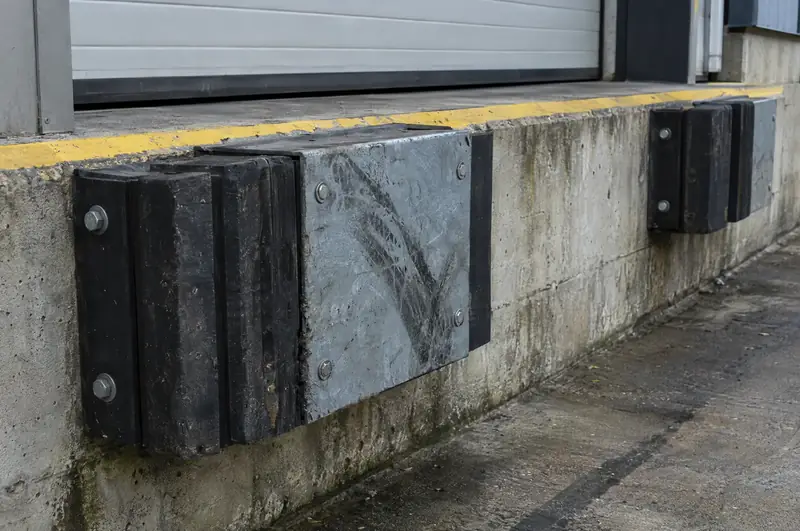
Dock bumpers are rubber or rubber-and-steel buffers fixed to the face of a loading dock, either side of the leveller, to absorb the impact of reversing vehicles. They hold the trailer a set distance from the building, protect the dock wall, leveller and door, and help a dock seal or shelter compress evenly. Most bays use two bumpers, replaced as they wear.
Where does this fit at a dock in City and County of Bristol?
For new-build warehouses in City and County of Bristol, bumpers are best specified alongside the leveller and seal so that projection and seal compression are correct before the first trailer arrives. Chilled and food distribution operations in City and County of Bristol depend on dock seals compressing evenly, which only happens when the bumpers behind them are still the correct depth.
Older industrial units around City and County of Bristol sometimes still have their original bumpers, or none at all, leaving the dock wall and leveller lip to absorb every reversing impact.
Step one is a survey at your site in City and County of Bristol, which costs nothing and carries no obligation. Step two is a written quote with a fixed price and a clear scope. Step three is installation, scheduled around your operation and carried out by specialist installation engineers working under our management, including evenings or weekends if agreed. Step four is handover, when the equipment is tested in front of you and the paperwork is passed over.
Where should dock bumpers be positioned on the dock face?
Dock bumpers are normally fixed either side of the leveller, at a height that catches the rear of the trailer before anything else touches the building.
- Height: typical UK dock height is around 1,200 mm, but trailer bed heights vary from roughly 900 to 1,600 mm, so bumpers must cover the range of vehicles you receive.
- Projection: bumpers commonly stand about 100 mm proud of the dock face. Too little and trailers hit the wall; too much and a swing lip of about 400 to 500 mm may not reach far enough on to the trailer bed.
- Spacing: bumpers should line up with the trailer chassis and sit clear of the leveller lip.
- Seals and shelters: projection controls how far a dock seal compresses, so it is set with the seal depth in mind.
Pairing bumpers with steel wheel guides helps drivers reverse square, so both bumpers take an equal share of each impact.
When should dock bumpers be replaced?
Dock bumpers should be replaced when the rubber is worn close to the steel backing, split, missing layers or loose on its fixings. At that point the bumper no longer stops the trailer before it reaches the dock wall or leveller.
Common signs include:
- Rubber worn into a curve or step where trailer chassis rub against it.
- Laminated layers missing or bowed out between the steel angles.
- Loose bolts, cracked concrete or rust staining around the fixings.
- Uneven compression on a dock seal, showing trailers are sitting off-square.
Replace bumpers in pairs where possible, so the trailer is held square and both sides compress evenly. Steel-faced designs with replaceable faces can often be refreshed by changing the face plate alone, which keeps costs down on very busy bays.
Towns we cover in City and County of Bristol
Below is a list of towns in City and County of Bristol for dock bumpers. Each page explains our approach for sites in that town.
Budget range for supply and fit. The written quote after a free survey is the fixed price. All guide prices.
What do the rules in England mean for the work?
Workplace safety in England is regulated by HSE. For a loading bay in City and County of Bristol, that means doors meeting regulation 18 of the Workplace (Health, Safety and Welfare) Regulations 1992, equipment maintained under PUWER and suitable safeguards against vehicles driving away too early. We check what applies at survey and design the bay accordingly.
Questions
Can you work alongside our main contractor on a new build in City and County of Bristol?
Yes. For new warehouses and fit-outs, we can supply and install the dock package as part of a wider project, working to the main contractor's programme, site rules and permits. We will need drawings, dock levels and the programme, and we coordinate pit details, power supplies and door openings with the relevant trades before installation begins.
How long does installation take at a site in City and County of Bristol?
It depends on the equipment, the number of bays, the condition of the dock and whether any building or electrical work is needed. We agree a programme with you after the survey, setting out which bays are out of use and when. Larger jobs are usually phased so that part of the dock stays open, and out-of-hours working can be arranged.
Can you replace just the face of a dock bumper?
Yes, on bumpers designed with replaceable faces. Steel-faced and some moulded designs let the worn face plate or rubber insert be changed while the backing stays bolted to the dock. Older laminated bumpers usually have to be replaced as a complete unit, which is still a modest cost compared with repairing impact damage to a leveller.
How many dock bumpers does a loading bay need?
Most loading bays need two dock bumpers, one fixed either side of the leveller. Docks receiving a wide mix of vehicles sometimes need taller bumpers or an extra lower pair so every vehicle meets rubber before it meets the wall. We confirm the number and layout at survey.
Other services in City and County of Bristol
Full guide to dock bumpers · All loading bay services in City and County of Bristol