
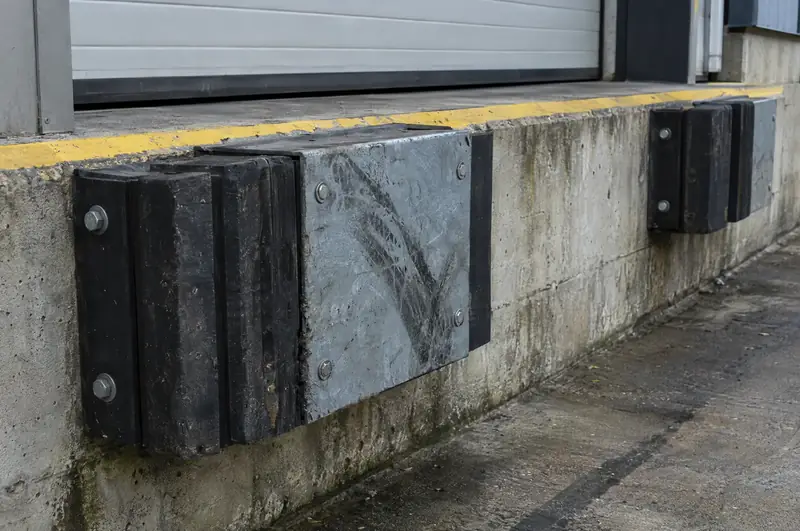
Dock bumpers are rubber or rubber-and-steel buffers fixed to the face of a loading dock, either side of the leveller, to absorb the impact of reversing vehicles. They hold the trailer a set distance from the building, protect the dock wall, leveller and door, and help a dock seal or shelter compress evenly. Most bays use two bumpers, replaced as they wear.
What should sites in Devon consider?
When a landlord in Devon re-lets a unit, replacing tired bumpers is a modest cost that protects the leveller and dock wall for the incoming tenant. We survey and quote for dock bumper work in Devon on the same basis as anywhere else in the UK, with the price fixed in a written quote.
Distribution sheds in Devon that take trailers on and off the dock all day wear through bumper rubber faster than quieter sites, so it pays to check them at every service.
Before anything is ordered, we visit your site in Devon for a free survey and then send a written quote with a fixed price. From that point we manage the installation, coordinating delivery, access and any other trades. Fitting is done by specialist installation engineers engaged and managed by us, at times that suit your operation, including out of hours where agreed. You get a tested installation, a demonstration for your team and the manufacturer documentation.
Which dock bumper is best: laminated, moulded or steel-faced?
Laminated rubber bumpers suit most general docks, steel-faced bumpers suit busy bays where trailers rise and fall during loading, and moulded bumpers suit lighter vehicles and compact installations.
- Laminated rubber: layers of fabric-reinforced rubber pressed between steel angles on threaded bars. They absorb impact well, are economical and are the standard choice for many bays.
- Moulded rubber: solid rubber blocks in rectangular or curved profiles. They are neat and quick to fit, and work well for vans, rigid vehicles and lower-impact docks.
- Steel-faced: a rubber body behind a steel plate. As forklifts drive on and off, the trailer bed moves up and down and scrubs the bumper; the steel face takes that wear instead of the rubber.
- Vertical sliding: a face that travels up and down with the trailer, reducing abrasion on very busy bays.
Where a design has replaceable faces, worn plates can be changed without removing the whole bumper. Our guide to choosing dock bumpers and wheel guides covers projection and positioning in more detail.
What happens on site when dock bumpers are fitted?
Fitting dock bumpers is a short job carried out from yard level, and only the bay being worked on is taken out of use.
- Isolate the bay: no trailer on the dock, the leveller parked and the door closed, with the yard area in front coned off.
- Remove the old bumpers: worn units and corroded fixings are taken off and the dock face is checked for cracked or spalled concrete.
- Fix the new bumpers: holes are drilled and the bumpers secured with resin or mechanical anchors, or welded to existing steelwork where that gives the better fixing.
- Allow cure time: resin anchors need time to cure before a trailer is reversed on to them, and the engineer will confirm when the bay can reopen.
We ask you to provide a clear bay, safe access to the yard, a named contact on the day and details of any permit-to-work or site induction. If the dock face needs concrete repair first, that is identified at survey and priced in the quote rather than discovered on the day.
Towns we cover in Devon
Each of the following towns in Devon has its own page on dock bumpers, covering how we work and what to send us.
Budget range for supply and fit. The written quote after a free survey is the fixed price. All guide prices.
Which rules apply in England?
Powered doors and dock equipment installed in England may carry the UKCA or the CE mark, and doors are covered by the product standard BS EN 13241. We hand over the relevant documentation for each item fitted in Devon. Planning and Building Regulations questions are never assumed either way: we check what applies at survey, so you know before work is booked.
Questions
Is the site survey in Devon free?
Yes. For new installations, replacements, upgrades, conversions and complete bays, the site survey and written quote are free and come with no obligation. The survey lets us measure the openings, check the dock and structure, and understand how the bay is used, so the quote reflects your site. Repair and servicing visits are different: they are chargeable, with the price agreed before anyone attends.
Is VAT included in your guide prices for dock bumpers?
No. Our customers are businesses, so guide prices exclude VAT, which is added at the standard rate. The same guide range applies in Devon as everywhere else: for dock bumpers, it is £120 to £480 per bumper, excluding VAT. It covers supply and fit for a typical installation. Your fixed written quote after the free survey shows the net price, the VAT and exactly what is included.
Are dock bumpers included in a complete bay package?
Yes. When we supply a complete loading bay, dock bumpers are specified alongside the leveller, door and shelter or seal so that projection, height and seal compression all work together. Bumpers can also be ordered with wheel guides and dock lights as part of a smaller safety upgrade on an existing bay.
Can dock bumpers be fitted with an edge-of-dock leveller?
Yes. With an edge-of-dock leveller, bumpers are usually fixed to the dock face either side of the unit, or to the leveller's own mounting frame where it is designed for that. Their projection has to suit the short lip so it still reaches on to the trailer bed, which we check at survey.
Other services in Devon
Full guide to dock bumpers · All loading bay services in Devon