
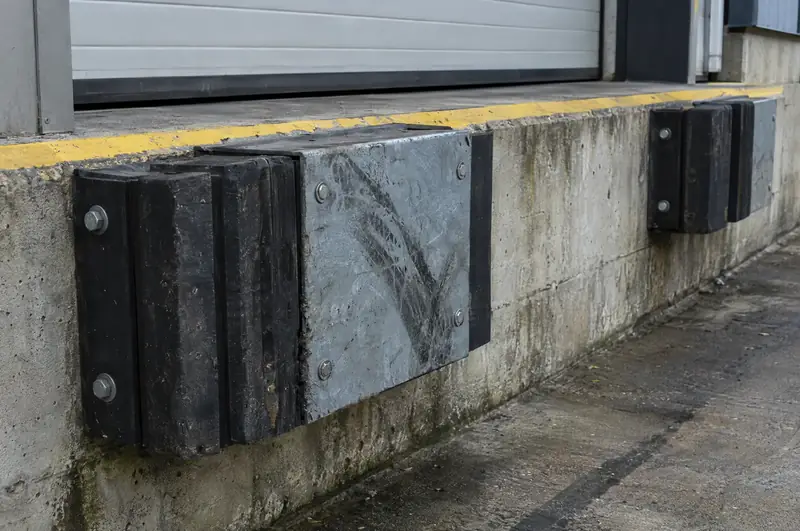
Dock bumpers are rubber or rubber-and-steel buffers fixed to the face of a loading dock, either side of the leveller, to absorb the impact of reversing vehicles. They hold the trailer a set distance from the building, protect the dock wall, leveller and door, and help a dock seal or shelter compress evenly. Most bays use two bumpers, replaced as they wear.
Why do sites in Lincolnshire choose this?
When a landlord in Lincolnshire re-lets a unit, replacing tired bumpers is a modest cost that protects the leveller and dock wall for the incoming tenant. For new-build warehouses in Lincolnshire, bumpers are best specified alongside the leveller and seal so that projection and seal compression are correct before the first trailer arrives.
Chilled and food distribution operations in Lincolnshire depend on dock seals compressing evenly, which only happens when the bumpers behind them are still the correct depth.
Your loading bay stays our responsibility from the survey to the handover. In Lincolnshire, the survey and written quote are free, and the quoted price is fixed for the agreed scope. Installation is carried out by specialist engineers working under our management, at times planned with you to protect your loading schedule. Out-of-hours work is available by arrangement. We finish by testing the equipment and handing over its documentation.
Which dock bumper is best: laminated, moulded or steel-faced?
Laminated rubber bumpers suit most general docks, steel-faced bumpers suit busy bays where trailers rise and fall during loading, and moulded bumpers suit lighter vehicles and compact installations.
- Laminated rubber: layers of fabric-reinforced rubber pressed between steel angles on threaded bars. They absorb impact well, are economical and are the standard choice for many bays.
- Moulded rubber: solid rubber blocks in rectangular or curved profiles. They are neat and quick to fit, and work well for vans, rigid vehicles and lower-impact docks.
- Steel-faced: a rubber body behind a steel plate. As forklifts drive on and off, the trailer bed moves up and down and scrubs the bumper; the steel face takes that wear instead of the rubber.
- Vertical sliding: a face that travels up and down with the trailer, reducing abrasion on very busy bays.
Where a design has replaceable faces, worn plates can be changed without removing the whole bumper. Our guide to choosing dock bumpers and wheel guides covers projection and positioning in more detail.
How much do dock bumpers cost?
Dock bumpers typically cost £120 to £480 per bumper, supplied and fitted, excluding VAT. Most bays need two, so the cost per dock depends mainly on the type of bumper and how it is fixed.
The main things that move the price are:
- Bumper type: laminated rubber is the most economical; moulded, steel-faced and vertical sliding designs cost more.
- Size and projection: deeper or taller bumpers use more material and heavier fixings.
- Fixing method: anchoring into sound concrete is simpler than welding to steel embeds or repairing a broken dock face first.
- Number of bays: doing several docks in one visit spreads access and travel costs.
- Working hours and location: out-of-hours working and remote or island sites add cost, and any travel cost is shown in the quote.
These are guide budgets. After a free site survey we send a written quote, and that quote is the fixed price. VAT is added at the standard rate.
Towns we cover in Lincolnshire
We provide dock bumpers right across Lincolnshire. Pick the town closest to your site from the list below.
- Lincoln
- Grimsby
- Scunthorpe
- Boston
- Grantham
- Cleethorpes
- Spalding
- Skegness
- Stamford
- Gainsborough
- Louth
- Sleaford
- Immingham
Budget range for supply and fit. The written quote after a free survey is the fixed price. All guide prices.
Which rules apply in England?
Powered doors and dock equipment installed in England may carry the UKCA or the CE mark, and doors are covered by the product standard BS EN 13241. We hand over the relevant documentation for each item fitted in Lincolnshire. Planning and Building Regulations questions are never assumed either way: we check what applies at survey, so you know before work is booked.
Questions
Which building and safety rules apply to a site in Lincolnshire?
It depends on which UK nation the site is in. England and Wales use Building Regulations approval, Scotland uses building warrants and Northern Ireland uses building control approval from the council. Workplace safety is regulated by HSE in Great Britain and HSENI in Northern Ireland, and energy rules differ between nations. For your site in Lincolnshire, we check what applies at survey and design to it.
What details do you need from us to quote for dock bumpers?
To get started, send the site address in Lincolnshire, the number of bays or openings, approximate sizes, and photos of the dock from inside and outside. Tell us what vehicles you load, what goods you handle and any temperature requirements. Drawings help on new builds. We then arrange the free survey and confirm the details before the written quote is issued.
Can you replace just the face of a dock bumper?
Yes, on bumpers designed with replaceable faces. Steel-faced and some moulded designs let the worn face plate or rubber insert be changed while the backing stays bolted to the dock. Older laminated bumpers usually have to be replaced as a complete unit, which is still a modest cost compared with repairing impact damage to a leveller.
How long do dock bumpers last?
There is no fixed lifespan for a dock bumper, because wear depends on how many trailers use the bay, how hard drivers reverse and how much the trailer moves during loading. A quiet dock may keep the same bumpers for many years, while a busy distribution bay can wear through the rubber much sooner. Checking them at each service visit catches wear early.
Other services in Lincolnshire
Full guide to dock bumpers · All loading bay services in Lincolnshire