
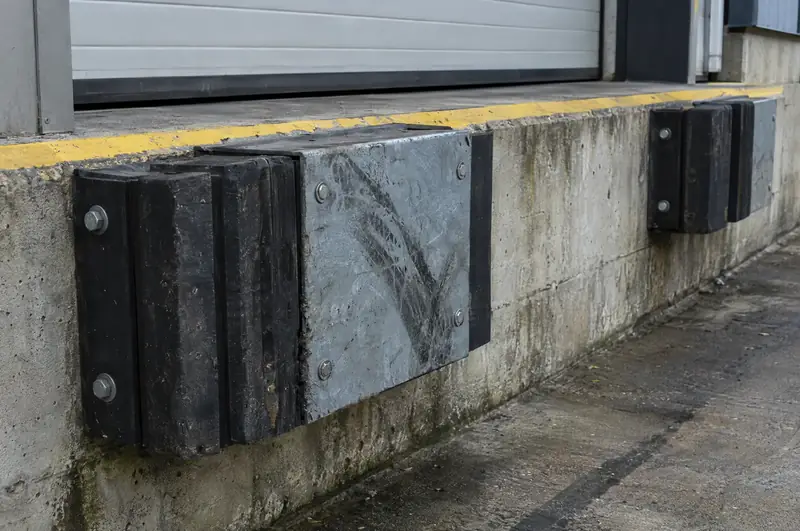
Dock bumpers are rubber or rubber-and-steel buffers fixed to the face of a loading dock, either side of the leveller, to absorb the impact of reversing vehicles. They hold the trailer a set distance from the building, protect the dock wall, leveller and door, and help a dock seal or shelter compress evenly. Most bays use two bumpers, replaced as they wear.
Is this right for your site in Dundee and Angus?
Distribution sheds in Dundee and Angus that take trailers on and off the dock all day wear through bumper rubber faster than quieter sites, so it pays to check them at every service. For new-build warehouses in Dundee and Angus, bumpers are best specified alongside the leveller and seal so that projection and seal compression are correct before the first trailer arrives.
Chilled and food distribution operations in Dundee and Angus depend on dock seals compressing evenly, which only happens when the bumpers behind them are still the correct depth.
For dock bumpers in Dundee and Angus, we begin with a free site survey and a fixed written quote, so you know the scope and cost before committing. We take responsibility for managing the job, and specialist installation engineers carry it out under our supervision. Bays are taken out of use in a planned sequence so the rest of the dock keeps working, and evening or weekend work can be arranged. Each item is tested at handover and the documentation is left with you.
Which dock bumper is best: laminated, moulded or steel-faced?
Laminated rubber bumpers suit most general docks, steel-faced bumpers suit busy bays where trailers rise and fall during loading, and moulded bumpers suit lighter vehicles and compact installations.
- Laminated rubber: layers of fabric-reinforced rubber pressed between steel angles on threaded bars. They absorb impact well, are economical and are the standard choice for many bays.
- Moulded rubber: solid rubber blocks in rectangular or curved profiles. They are neat and quick to fit, and work well for vans, rigid vehicles and lower-impact docks.
- Steel-faced: a rubber body behind a steel plate. As forklifts drive on and off, the trailer bed moves up and down and scrubs the bumper; the steel face takes that wear instead of the rubber.
- Vertical sliding: a face that travels up and down with the trailer, reducing abrasion on very busy bays.
Where a design has replaceable faces, worn plates can be changed without removing the whole bumper. Our guide to choosing dock bumpers and wheel guides covers projection and positioning in more detail.
Do dock bumpers need inspecting under PUWER?
Dock bumpers should be checked whenever the loading bay is serviced, because they protect equipment that the Provision and Use of Work Equipment Regulations 1998 (PUWER) apply to. In Northern Ireland the equivalent is PUWER (Northern Ireland) 1999.
PUWER requires work equipment, including dock levellers, loading bay doors and shelters, to be suitable, maintained in a safe condition and inspected where deterioration could lead to danger. A bumper worn down to its backing lets trailers strike the leveller lip and front plate, which can crack welds, bend hinges and leave a leveller that is no longer safe to drive across.
Engineering insurers commonly inspect dock levellers under PUWER at 12-month intervals. Replacing a worn bumper usually costs far less than repairing the leveller it should have protected.
The health and safety regulator is HSE in Great Britain and HSENI in Northern Ireland. Including bumpers in planned maintenance checks shows the dock is being looked after.
Towns we cover in Dundee and Angus
We take enquiries about dock bumpers from across Dundee and Angus. These are the towns with their own pages:
Budget range for supply and fit. The written quote after a free survey is the fixed price. All guide prices.
What do the rules in Scotland mean for the work?
Energy standards for buildings in Scotland are set out in Section 6 of the Building Standards Technical Handbook. For new or replacement loading bay doors in Dundee and Angus, we confirm the figure that applies to your project and check what applies at survey, rather than relying on rules written for elsewhere in the UK.
Questions
Do you remove and dispose of the old equipment?
Yes, where it is part of the scope. When we replace doors, levellers, shelters or seals at a site in Dundee and Angus, removal and disposal of the old equipment can be included and is itemised in the quote, so it is clear what is covered. If anything should be kept, such as a frame or motor that is still serviceable, we agree that at survey.
Do you cover Dundee and Angus for dock bumpers?
Yes. We take on dock bumpers for businesses in Dundee and Angus and across Dundee and Angus. We survey the site, provide a fixed written quote and manage the installation, with specialist installation engineers working under our management. Visits are arranged in advance at a time that suits your operation, and the same single contact stays with the job through to handover.
How many dock bumpers does a loading bay need?
Most loading bays need two dock bumpers, one fixed either side of the leveller. Docks receiving a wide mix of vehicles sometimes need taller bumpers or an extra lower pair so every vehicle meets rubber before it meets the wall. We confirm the number and layout at survey.
Are dock bumpers included in a complete bay package?
Yes. When we supply a complete loading bay, dock bumpers are specified alongside the leveller, door and shelter or seal so that projection, height and seal compression all work together. Bumpers can also be ordered with wheel guides and dock lights as part of a smaller safety upgrade on an existing bay.
Other services in Dundee and Angus
Full guide to dock bumpers · All loading bay services in Dundee and Angus