
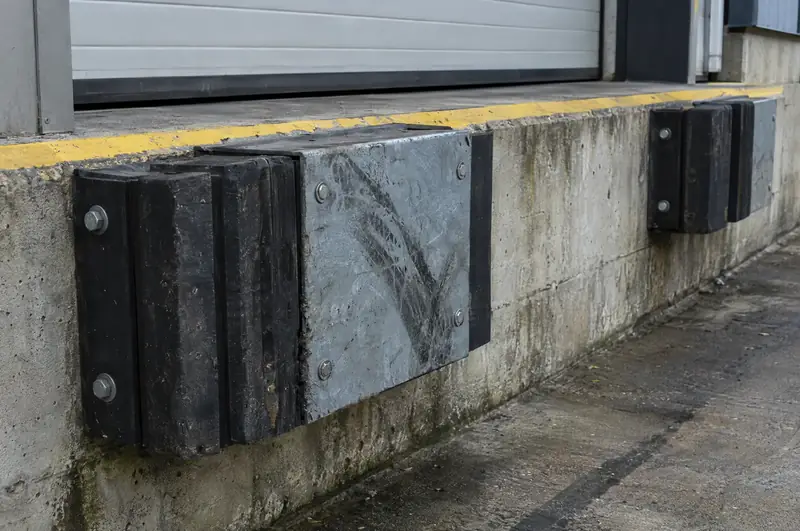
Dock bumpers are rubber or rubber-and-steel buffers fixed to the face of a loading dock, either side of the leveller, to absorb the impact of reversing vehicles. They hold the trailer a set distance from the building, protect the dock wall, leveller and door, and help a dock seal or shelter compress evenly. Most bays use two bumpers, replaced as they wear.
What matters for dock bumpers in Cambridgeshire?
Multi-tenant estates in Cambridgeshire often see new occupants arrive with different fleets, and bumpers set up for one tenant's trailers may not suit the next. We survey and quote for dock bumper work in Cambridgeshire on the same basis as anywhere else in the UK, with the price fixed in a written quote.
For new-build warehouses in Cambridgeshire, bumpers are best specified alongside the leveller and seal so that projection and seal compression are correct before the first trailer arrives.
It starts with a free site survey in Cambridgeshire, where we measure the openings, check the dock and talk through how the bay is used. You then receive a fixed written quote. Once you accept, we manage the job: specialist installation engineers carry out the work under our management, planned around your deliveries, and out-of-hours working can be arranged. At handover we test everything with you and leave the documentation.
Where should dock bumpers be positioned on the dock face?
Dock bumpers are normally fixed either side of the leveller, at a height that catches the rear of the trailer before anything else touches the building.
- Height: typical UK dock height is around 1,200 mm, but trailer bed heights vary from roughly 900 to 1,600 mm, so bumpers must cover the range of vehicles you receive.
- Projection: bumpers commonly stand about 100 mm proud of the dock face. Too little and trailers hit the wall; too much and a swing lip of about 400 to 500 mm may not reach far enough on to the trailer bed.
- Spacing: bumpers should line up with the trailer chassis and sit clear of the leveller lip.
- Seals and shelters: projection controls how far a dock seal compresses, so it is set with the seal depth in mind.
Pairing bumpers with steel wheel guides helps drivers reverse square, so both bumpers take an equal share of each impact.
Which dock bumper is best: laminated, moulded or steel-faced?
Laminated rubber bumpers suit most general docks, steel-faced bumpers suit busy bays where trailers rise and fall during loading, and moulded bumpers suit lighter vehicles and compact installations.
- Laminated rubber: layers of fabric-reinforced rubber pressed between steel angles on threaded bars. They absorb impact well, are economical and are the standard choice for many bays.
- Moulded rubber: solid rubber blocks in rectangular or curved profiles. They are neat and quick to fit, and work well for vans, rigid vehicles and lower-impact docks.
- Steel-faced: a rubber body behind a steel plate. As forklifts drive on and off, the trailer bed moves up and down and scrubs the bumper; the steel face takes that wear instead of the rubber.
- Vertical sliding: a face that travels up and down with the trailer, reducing abrasion on very busy bays.
Where a design has replaceable faces, worn plates can be changed without removing the whole bumper. Our guide to choosing dock bumpers and wheel guides covers projection and positioning in more detail.
Towns we cover in Cambridgeshire
Below is a list of towns in Cambridgeshire for dock bumpers. Each page explains our approach for sites in that town.
Budget range for supply and fit. The written quote after a free survey is the fixed price. All guide prices.
Which rules apply in England?
Sites in Cambridgeshire fall under the rules for England. Structural changes such as forming a new opening or a dock leveller pit may need Building Regulations approval, and external structures such as loading houses, canopies or new dock approaches can need planning permission from the local planning authority. We check what applies at survey and build any approvals into the plan.
Questions
Will you deal with building control and planning for a project in Cambridgeshire?
We check at survey whether the work is likely to need approval. Forming a new opening or dock pit may need Building Regulations approval, a building warrant or building control approval, depending on the nation, and external structures such as loading houses can need planning permission. Where approval is needed, we explain what is involved, work with your designer or agent, and build it into the programme.
How do you price dock bumpers for a site in Cambridgeshire?
Guide budgets for supply and fit are £120 to £480 per bumper, excluding VAT. The figure moves with size, insulation, the operator, electrics, access, any pit or groundworks and out-of-hours working. Where levellers are involved, the guide assumes an existing, sound pit. After the free survey you receive a fixed written quote, and that is the price for the agreed scope.
Are dock bumpers included in a complete bay package?
Yes. When we supply a complete loading bay, dock bumpers are specified alongside the leveller, door and shelter or seal so that projection, height and seal compression all work together. Bumpers can also be ordered with wheel guides and dock lights as part of a smaller safety upgrade on an existing bay.
How long do dock bumpers last?
There is no fixed lifespan for a dock bumper, because wear depends on how many trailers use the bay, how hard drivers reverse and how much the trailer moves during loading. A quiet dock may keep the same bumpers for many years, while a busy distribution bay can wear through the rubber much sooner. Checking them at each service visit catches wear early.
Other services in Cambridgeshire
Full guide to dock bumpers · All loading bay services in Cambridgeshire