
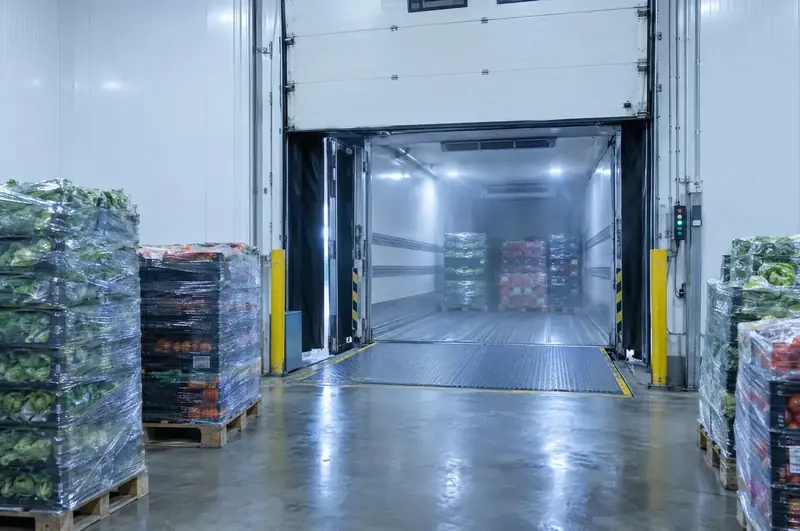
A cold store dock door is an insulated loading bay door built for chilled or frozen buildings, usually a sectional door with thick insulated panels or a high-speed door with an insulated curtain. It differs from a standard dock door in its thermal breaks, extra seals and, on freezer docks, heating in the frame or seals so that ice cannot lock the door shut or tear the seals.
Why do sites in Cambridgeshire choose this?
Food manufacturers in Cambridgeshire moving finished product into frozen storage need doors that resist ice and close quickly behind each forklift or trailer movement. A chilled distribution centre in Cambridgeshire opens its dock doors many times a shift, so the door specification matters far more than at an ambient bay.
For a packhouse in Cambridgeshire handling fresh produce, a well-sealed chilled dock door helps keep warm air out of the store once produce has been cooled.
It starts with a free site survey in Cambridgeshire, where we measure the openings, check the dock and talk through how the bay is used. You then receive a fixed written quote. Once you accept, we manage the job: specialist installation engineers carry out the work under our management, planned around your deliveries, and out-of-hours working can be arranged. At handover we test everything with you and leave the documentation.
Do cold store dock doors have to meet building regulations?
Yes, a new or replacement cold store dock door is still a vehicle access door, so building energy rules apply alongside workplace safety law and product standards.
- England: Approved Document L (2021) Volume 2 limits the U-value of vehicle access and similar large doors to 1.3 W/m²K in new and replacement work. Cold store doors are normally specified to perform better than that to protect the store.
- Wales, Scotland and Northern Ireland: Approved Document L for Wales, Section 6 of the Scottish Building Standards Technical Handbook and Technical Booklet F2 in Northern Ireland apply. We confirm the figure for your nation and project.
- Power failure: under the Workplace (Health, Safety and Welfare) Regulations 1992 in Great Britain, or the 1993 Northern Ireland regulations, a powered door must be operable by hand where needed for health or safety, unless it opens automatically when power fails.
- Standards: BS EN 13241 for the door and BS EN 12453 for powered operation.
Why does ice form around a freezer dock door, and how is it stopped?
Ice forms when warm, moist outside air meets the cold surfaces of the door, frame and floor, and the moisture freezes. Over time it builds up in the seals and guides until the door jams or tears its seals.
Ice is controlled by tackling both the cold surfaces and the warm air:
- Heated frames and seals: low-power heating in the side frames and bottom seal keeps those surfaces above freezing.
- Threshold heating: stops the door freezing to the floor.
- A tight seal at the trailer: an inflatable dock shelter or a well-fitted seal keeps outside air away from the opening.
- Short open times: fast operators and interlocks mean the door is only open while a trailer is sealed to the dock.
Condensation dripping inside the store near the door is an early sign of the same problem and worth raising at survey.
Towns we cover in Cambridgeshire
We cover cold store dock doors throughout Cambridgeshire, and the towns below each have their own page. If yours is not listed, get in touch anyway.
Budget range for supply and fit. The written quote after a free survey is the fixed price. All guide prices.
Which rules apply in England?
Sites in Cambridgeshire fall under the rules for England. Structural changes such as forming a new opening or a dock leveller pit may need Building Regulations approval, and external structures such as loading houses, canopies or new dock approaches can need planning permission from the local planning authority. We check what applies at survey and build any approvals into the plan.
Questions
Do you remove and dispose of the old equipment?
Yes, where it is part of the scope. When we replace doors, levellers, shelters or seals at a site in Cambridgeshire, removal and disposal of the old equipment can be included and is itemised in the quote, so it is clear what is covered. If anything should be kept, such as a frame or motor that is still serviceable, we agree that at survey.
How do you price cold store dock doors for a site in Cambridgeshire?
Guide budgets for supply and fit are £4,800 to £9,500 per door, excluding VAT. The figure moves with size, insulation, the operator, electrics, access, any pit or groundworks and out-of-hours working. Where levellers are involved, the guide assumes an existing, sound pit. After the free survey you receive a fixed written quote, and that is the price for the agreed scope.
Do heated door frames use a lot of power?
Frame and seal heaters are low-power elements designed to keep surfaces just above freezing rather than to heat the dock. Many can be controlled by a thermostat so they only run when needed. We set out the supply required in the written quote so it can be planned before installation.
What happens to a cold store door in a power cut?
In a power cut the door stops where it is and the frame heating switches off, so it must be possible to operate the door by hand. Powered dock doors normally have a hand chain, crank or release for this. We show your team how to use it at handover so the store can be closed up quickly.
Other services in Cambridgeshire
Full guide to cold store dock doors · All loading bay services in Cambridgeshire