
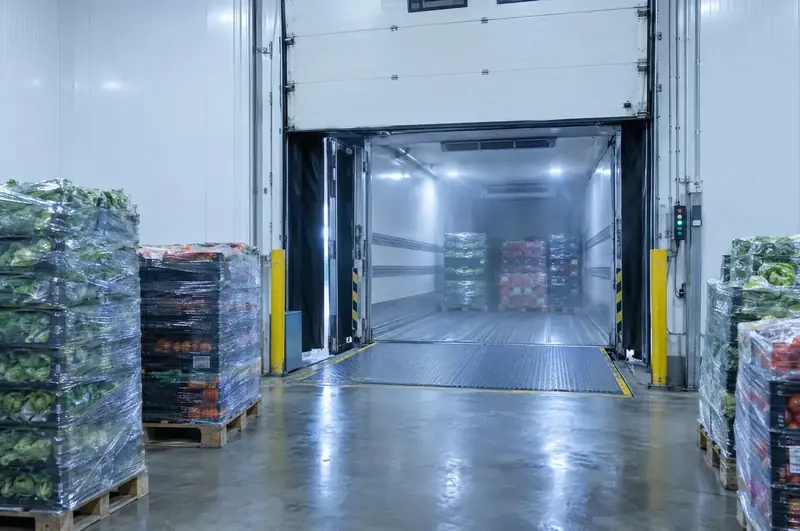
A cold store dock door is an insulated loading bay door built for chilled or frozen buildings, usually a sectional door with thick insulated panels or a high-speed door with an insulated curtain. It differs from a standard dock door in its thermal breaks, extra seals and, on freezer docks, heating in the frame or seals so that ice cannot lock the door shut or tear the seals.
Is this right for your site in Edinburgh and the Lothians?
During warm, humid spells, any cold store dock in Edinburgh and the Lothians is most exposed to condensation and ice, which is why heated frames and good shelters are worth considering. Converting an ambient unit in Edinburgh and the Lothians to chilled storage usually means replacing standard dock doors with insulated ones and sealing around the trailers.
Food manufacturers in Edinburgh and the Lothians moving finished product into frozen storage need doors that resist ice and close quickly behind each forklift or trailer movement.
Our part of the job in Edinburgh and the Lothians is to survey, quote and manage; the fitting itself is done by specialist installation engineers working under our management. The survey and the written quote are free. Once the fixed price is accepted, we agree dates that work around your deliveries and shifts, including out-of-hours working where needed. Every installation is tested before handover, and you receive the documentation for each item fitted.
How can a cold store door be replaced without losing temperature?
A cold store door can be replaced with very little temperature loss if the work is planned around the store, with the opening screened and the fitting done in one continuous visit.
On a live cold store we usually:
- schedule the work for the quietest period, often overnight or at a weekend,
- fit a temporary insulated screen or strip curtain while the opening is exposed,
- remove ice from the old frame and threshold before fixing the new door,
- pre-assemble as much as possible so the opening is exposed for the shortest time.
From your side we need product moved back from the opening, any site permits for working in cold areas, and power for the operator and frame heaters. Heated frames typically need their own supply, which we set out in the quote. Our cold store loading bays guide covers planning the work in more depth.
Do cold store dock doors have to meet building regulations?
Yes, a new or replacement cold store dock door is still a vehicle access door, so building energy rules apply alongside workplace safety law and product standards.
- England: Approved Document L (2021) Volume 2 limits the U-value of vehicle access and similar large doors to 1.3 W/m²K in new and replacement work. Cold store doors are normally specified to perform better than that to protect the store.
- Wales, Scotland and Northern Ireland: Approved Document L for Wales, Section 6 of the Scottish Building Standards Technical Handbook and Technical Booklet F2 in Northern Ireland apply. We confirm the figure for your nation and project.
- Power failure: under the Workplace (Health, Safety and Welfare) Regulations 1992 in Great Britain, or the 1993 Northern Ireland regulations, a powered door must be operable by hand where needed for health or safety, unless it opens automatically when power fails.
- Standards: BS EN 13241 for the door and BS EN 12453 for powered operation.
Towns we cover in Edinburgh and the Lothians
Each of the following towns in Edinburgh and the Lothians has its own page on cold store dock doors, covering how we work and what to send us.
Budget range for supply and fit. The written quote after a free survey is the fixed price. All guide prices.
Which rules apply in Scotland?
HSE is the workplace safety regulator in Scotland. At a loading bay in Edinburgh and the Lothians, doors need to satisfy regulation 18 of the Workplace (Health, Safety and Welfare) Regulations 1992, dock equipment must be kept safe under PUWER, and drivers must be prevented from pulling away too early. We check what applies at survey.
Questions
Will you deal with building control and planning for a project in Edinburgh and the Lothians?
We check at survey whether the work is likely to need approval. Forming a new opening or dock pit may need Building Regulations approval, a building warrant or building control approval, depending on the nation, and external structures such as loading houses can need planning permission. Where approval is needed, we explain what is involved, work with your designer or agent, and build it into the programme.
Do you remove and dispose of the old equipment?
Yes, where it is part of the scope. When we replace doors, levellers, shelters or seals at a site in Edinburgh and the Lothians, removal and disposal of the old equipment can be included and is itemised in the quote, so it is clear what is covered. If anything should be kept, such as a frame or motor that is still serviceable, we agree that at survey.
Do cold store doors need more frequent servicing?
Yes, cold store doors generally benefit from more frequent servicing than ambient dock doors. Low temperatures stiffen seals, stress springs and cables, and hide early ice build-up. Checking heaters, seals and operator settings before winter is particularly worthwhile. Servicing visits are chargeable and agreed in advance.
Do heated door frames use a lot of power?
Frame and seal heaters are low-power elements designed to keep surfaces just above freezing rather than to heat the dock. Many can be controlled by a thermostat so they only run when needed. We set out the supply required in the written quote so it can be planned before installation.
Other services in Edinburgh and the Lothians
Full guide to cold store dock doors · All loading bay services in Edinburgh and the Lothians