
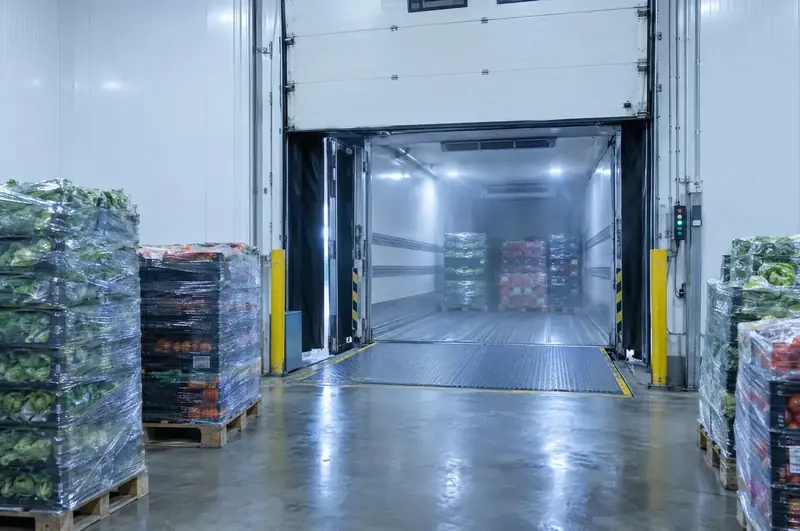
A cold store dock door is an insulated loading bay door built for chilled or frozen buildings, usually a sectional door with thick insulated panels or a high-speed door with an insulated curtain. It differs from a standard dock door in its thermal breaks, extra seals and, on freezer docks, heating in the frame or seals so that ice cannot lock the door shut or tear the seals.
Is this right for your site in Dorset?
For a packhouse in Dorset handling fresh produce, a well-sealed chilled dock door helps keep warm air out of the store once produce has been cooled. Converting an ambient unit in Dorset to chilled storage usually means replacing standard dock doors with insulated ones and sealing around the trailers.
A chilled distribution centre in Dorset opens its dock doors many times a shift, so the door specification matters far more than at an ambient bay.
Before anything is ordered, we visit your site in Dorset for a free survey and then send a written quote with a fixed price. From that point we manage the installation, coordinating delivery, access and any other trades. Fitting is done by specialist installation engineers engaged and managed by us, at times that suit your operation, including out of hours where agreed. You get a tested installation, a demonstration for your team and the manufacturer documentation.
How should a door be specified for a chilled dock compared with a freezer dock?
A chilled dock needs a well-insulated, well-sealed door, while a freezer dock also needs heating to stop ice forming in the frame and seals. The temperature difference across the door drives most specification choices.
- Chilled docks: an insulated sectional door at the thicker end of the common 40 to 80 mm panel range, good perimeter seals and a shelter or seal outside usually do the job.
- Freezer docks: thick panels, thermal breaks in the panel joints, heated side frames and a heated bottom seal, plus a fast operator to cut open time.
- Doors between zones: an insulated high-speed door often suits openings between a chilled marshalling area and a freezer, where traffic is constant.
- Vision panels: possible, but they reduce insulation and can mist, so many freezer docks leave them out.
A cold store door is only as good as the seal around the trailer, which is why we specify the door, shelter and leveller together.
Why does ice form around a freezer dock door, and how is it stopped?
Ice forms when warm, moist outside air meets the cold surfaces of the door, frame and floor, and the moisture freezes. Over time it builds up in the seals and guides until the door jams or tears its seals.
Ice is controlled by tackling both the cold surfaces and the warm air:
- Heated frames and seals: low-power heating in the side frames and bottom seal keeps those surfaces above freezing.
- Threshold heating: stops the door freezing to the floor.
- A tight seal at the trailer: an inflatable dock shelter or a well-fitted seal keeps outside air away from the opening.
- Short open times: fast operators and interlocks mean the door is only open while a trailer is sealed to the dock.
Condensation dripping inside the store near the door is an early sign of the same problem and worth raising at survey.
Towns we cover in Dorset
We take enquiries about cold store dock doors from across Dorset. These are the towns with their own pages:
Budget range for supply and fit. The written quote after a free survey is the fixed price. All guide prices.
Regulations and approvals in England
Powered doors and dock equipment installed in England may carry the UKCA or the CE mark, and doors are covered by the product standard BS EN 13241. We hand over the relevant documentation for each item fitted in Dorset. Planning and Building Regulations questions are never assumed either way: we check what applies at survey, so you know before work is booked.
Questions
How do you price cold store dock doors for a site in Dorset?
Guide budgets for supply and fit are £4,800 to £9,500 per door, excluding VAT. The figure moves with size, insulation, the operator, electrics, access, any pit or groundworks and out-of-hours working. Where levellers are involved, the guide assumes an existing, sound pit. After the free survey you receive a fixed written quote, and that is the price for the agreed scope.
Is VAT included in your guide prices for cold store dock doors?
No. Our customers are businesses, so guide prices exclude VAT, which is added at the standard rate. The same guide range applies in Dorset as everywhere else: for cold store dock doors, it is £4,800 to £9,500 per door, excluding VAT. It covers supply and fit for a typical installation. Your fixed written quote after the free survey shows the net price, the VAT and exactly what is included.
Can a cold store door be paired with a high-speed door?
Yes, cold store docks often pair an insulated sectional door on the outside with a fast door just inside it, or use an insulated high-speed door as the only door between zones. The right arrangement depends on traffic, security and how much space there is around the opening.
Do cold store doors need more frequent servicing?
Yes, cold store doors generally benefit from more frequent servicing than ambient dock doors. Low temperatures stiffen seals, stress springs and cables, and hide early ice build-up. Checking heaters, seals and operator settings before winter is particularly worthwhile. Servicing visits are chargeable and agreed in advance.
Other services in Dorset
Full guide to cold store dock doors · All loading bay services in Dorset