
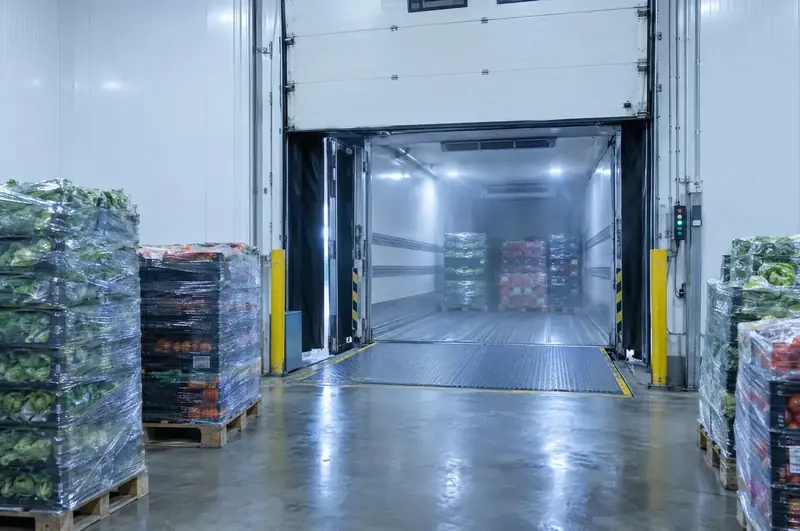
A cold store dock door is an insulated loading bay door built for chilled or frozen buildings, usually a sectional door with thick insulated panels or a high-speed door with an insulated curtain. It differs from a standard dock door in its thermal breaks, extra seals and, on freezer docks, heating in the frame or seals so that ice cannot lock the door shut or tear the seals.
Why do sites in Greater London choose this?
Food manufacturers in Greater London moving finished product into frozen storage need doors that resist ice and close quickly behind each forklift or trailer movement. For a packhouse in Greater London handling fresh produce, a well-sealed chilled dock door helps keep warm air out of the store once produce has been cooled.
When an older cold store in Greater London has a door that has been repaired many times, a planned replacement can be timed for a quieter trading period.
A single contact at Loading Bay Doors handles your project in Greater London from start to finish. The free site survey and fixed written quote come first, with no obligation to proceed. We then book the installation for times that suit the operation, including out of hours by arrangement, and manage the specialist engineers on site. At the end we commission and test the equipment, walk your team through it and provide the documentation.
How should a door be specified for a chilled dock compared with a freezer dock?
A chilled dock needs a well-insulated, well-sealed door, while a freezer dock also needs heating to stop ice forming in the frame and seals. The temperature difference across the door drives most specification choices.
- Chilled docks: an insulated sectional door at the thicker end of the common 40 to 80 mm panel range, good perimeter seals and a shelter or seal outside usually do the job.
- Freezer docks: thick panels, thermal breaks in the panel joints, heated side frames and a heated bottom seal, plus a fast operator to cut open time.
- Doors between zones: an insulated high-speed door often suits openings between a chilled marshalling area and a freezer, where traffic is constant.
- Vision panels: possible, but they reduce insulation and can mist, so many freezer docks leave them out.
A cold store door is only as good as the seal around the trailer, which is why we specify the door, shelter and leveller together.
Why does ice form around a freezer dock door, and how is it stopped?
Ice forms when warm, moist outside air meets the cold surfaces of the door, frame and floor, and the moisture freezes. Over time it builds up in the seals and guides until the door jams or tears its seals.
Ice is controlled by tackling both the cold surfaces and the warm air:
- Heated frames and seals: low-power heating in the side frames and bottom seal keeps those surfaces above freezing.
- Threshold heating: stops the door freezing to the floor.
- A tight seal at the trailer: an inflatable dock shelter or a well-fitted seal keeps outside air away from the opening.
- Short open times: fast operators and interlocks mean the door is only open while a trailer is sealed to the dock.
Condensation dripping inside the store near the door is an early sign of the same problem and worth raising at survey.
Towns we cover in Greater London
We cover cold store dock doors throughout Greater London, and the towns below each have their own page. If yours is not listed, get in touch anyway.
- Barking
- Sutton
- Croydon
- Ilford
- Enfield
- Harrow
- Tottenham
- Walthamstow
- Dagenham
- Romford
- Hayes
- Wembley
- Edmonton
- Southall
- Uxbridge
- Hounslow
- Feltham
- Acton
- Greenford
- Thamesmead
- Barnet
- South Ruislip
- Harringay
- Enfield Lock
- Stepney
- Worcester Park
- Beckton
- Erith
- Park Royal
- Rainham
Budget range for supply and fit. The written quote after a free survey is the fixed price. All guide prices.
Regulations and approvals in England
In England, Approved Document L (2021) sets a limiting U-value of 1.3 W/m²K for vehicle access and similar large doors in new and replacement work. That shapes door specification for sites in Greater London, so we confirm the requirement for your project and check what applies at survey before recommending a door.
Questions
What details do you need from us to quote for cold store dock doors?
To get started, send the site address in Greater London, the number of bays or openings, approximate sizes, and photos of the dock from inside and outside. Tell us what vehicles you load, what goods you handle and any temperature requirements. Drawings help on new builds. We then arrange the free survey and confirm the details before the written quote is issued.
What warranty comes with new loading bay equipment?
New equipment comes with the manufacturer's warranty, which varies by product. Our workmanship terms are set out in writing in the quote for your Greater London site, so you can see what is covered before you commit. Check the warranty terms for any servicing conditions, and we can quote for planned maintenance once the installation is complete.
Can a standard sectional door be used on a chilled dock?
A standard insulated sectional door can work on a chilled dock if its panels are thick enough and its seals are in good condition. For frozen docks it is not usually suitable, because it lacks the thermal breaks and frame heating needed to stop ice forming. We advise on the right specification after surveying the store.
What happens to a cold store door in a power cut?
In a power cut the door stops where it is and the frame heating switches off, so it must be possible to operate the door by hand. Powered dock doors normally have a hand chain, crank or release for this. We show your team how to use it at handover so the store can be closed up quickly.
Other services in Greater London
Full guide to cold store dock doors · All loading bay services in Greater London