
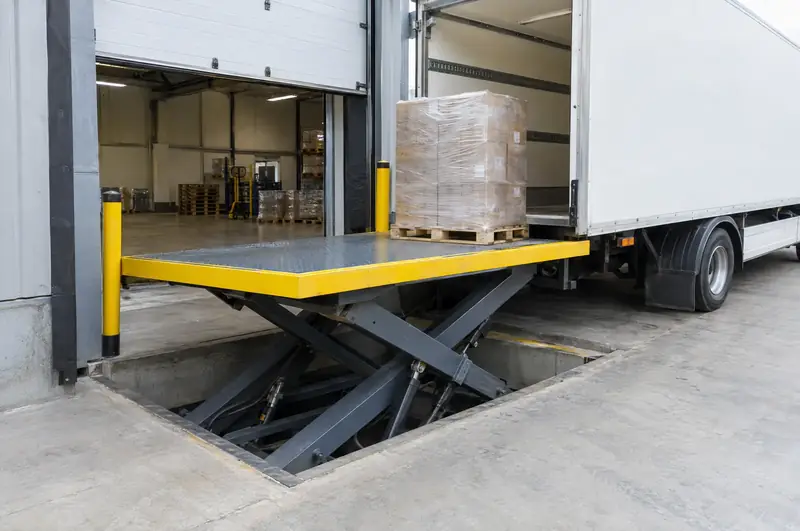
A scissor lift table, often called a dock lift, is a powered platform raised and lowered by a hydraulic scissor mechanism to move goods between two levels. At a loading bay it lifts pallets and pallet trucks from ground level to the height of a trailer bed, making it a practical alternative to a raised dock where forming one is not possible.
Where does this fit at a dock in Lancashire?
Businesses in Lancashire receiving both vans and articulated trailers through one doorway can use a lift table to serve every bed height from the same opening. Each lift table enquiry from Lancashire is surveyed and quoted in the same way as any other UK site, with groundworks for a pit priced separately.
Where ground conditions in Lancashire make a deep recessed dock costly, a pit-mounted or surface-mounted lift table can be the more practical option.
If you are planning scissor lift tables for a site in Lancashire, expect four stages. A free survey and fixed written quote come first. We then agree a programme with you, including any out-of-hours work. Specialist installation engineers carry out the installation under our management, with us as your single point of contact. Finally, the equipment is tested, your staff are shown how it works and everything is handed over with its documentation.
Where are scissor lift tables used at loading bays?
Scissor lift tables are used wherever goods need to move between yard level and trailer height without a raised dock. They are a common answer for buildings that were never designed for articulated trailers.
- Ground-level doors: older units, workshops and retail back doors with no dock.
- Mixed fleets: the same lift can serve a van, a rigid lorry and an articulated trailer at different bed heights, typically from around 900 mm to 1,600 mm.
- Tight sites: where there is no room for a recessed approach ramp in the yard.
- Split levels: inside buildings with floors at different heights.
- Supplementing a dock: one lift beside a row of docks to handle vehicles that do not suit the levellers.
Our guide to converting a ground-level door into a loading dock compares lift tables with the other ways of reaching trailer height.
What safety features should a loading bay lift table have?
A loading bay lift table should protect people from the scissor mechanism, stop if anything is trapped under the platform, and stop people or loads falling from the edges. Lift tables are specified to BS EN 1570-1:2024, and common features include:
- Toe guards: trip bars or sensitive edges around the platform underside that stop the lift descending on contact.
- Safety bellows or skirts: a flexible enclosure that keeps hands, feet and debris out of shear and crush points.
- Guard rails and gates: on open sides, sized to how people and pallet trucks move on and off.
- Bridge plate: a hinged plate that rests on the trailer bed to bridge the gap.
- Hold-to-run controls: the lift only moves while the button is held, with a stop button within reach.
- Hydraulic protection: valves that stop the platform dropping if a hose fails.
- Maintenance props: supports that hold the platform up safely during servicing.
Towns we cover in Lancashire
Choose a town below to see how we handle scissor lift tables in that part of Lancashire.
- Preston
- Burnley
- Blackburn
- Blackpool
- Morecambe
- Lancaster
- Lytham St Annes
- Skelmersdale
- Leyland
- Accrington
- Chorley
- Darwen
- Thornton-Cleveleys
- Nelson
- Fleetwood
- Ormskirk
- Rawtenstall
- Colne
- Poulton-le-Fylde
- Heysham
- Haslingden
Budget range for supply and fit. The written quote after a free survey is the fixed price. All guide prices.
What do the rules in England mean for the work?
Powered doors and dock equipment installed in England may carry the UKCA or the CE mark, and doors are covered by the product standard BS EN 13241. We hand over the relevant documentation for each item fitted in Lancashire. Planning and Building Regulations questions are never assumed either way: we check what applies at survey, so you know before work is booked.
Questions
Can you work outside our normal operating hours in Lancashire?
Yes, by arrangement. Evening, night and weekend working can be planned so the installation causes as little disruption as possible to your loading schedule. Out-of-hours work can affect the price, so mention it at the survey and we will include it in the written quote. The agreed times are confirmed in the programme before the job starts.
How long does installation take at a site in Lancashire?
It depends on the equipment, the number of bays, the condition of the dock and whether any building or electrical work is needed. We agree a programme with you after the survey, setting out which bays are out of use and when. Larger jobs are usually phased so that part of the dock stays open, and out-of-hours working can be arranged.
How often does a lift table need servicing?
A lift table needs routine maintenance as well as its LOLER thorough examinations. Many sites combine the two so the lift is serviced shortly before each examination. The right maintenance frequency depends on how heavily the lift is used, and we agree it with you at handover.
Can a forklift drive on to a scissor lift table?
Only if the lift has been designed and rated for forklift traffic. Most loading bay lift tables are built for pallet trucks, and a forklift's weight and wheel loads need a much heavier platform and mechanism. Tell us how you load at survey so the lift is specified correctly.
Other services in Lancashire
Full guide to scissor lift tables · All loading bay services in Lancashire