
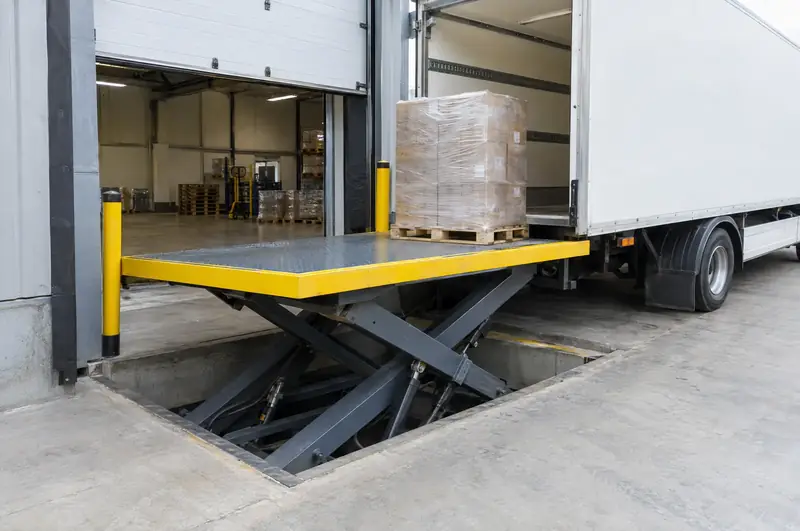
A scissor lift table, often called a dock lift, is a powered platform raised and lowered by a hydraulic scissor mechanism to move goods between two levels. At a loading bay it lifts pallets and pallet trucks from ground level to the height of a trailer bed, making it a practical alternative to a raised dock where forming one is not possible.
What should sites in Derbyshire consider?
Food, drink and pharmaceutical sites around Derbyshire that need clean, controlled loading points may prefer a lift table with bellows enclosing the scissor mechanism. Older industrial buildings in Derbyshire built with ground-level doors only can use a scissor lift table to load trailers without excavating the yard.
Town-centre and retail sites around Derbyshire with little yard space often choose a dock lift because a recessed approach ramp would take up too much room.
We do not give a fixed price without seeing the site. A free survey in Derbyshire lets us check the details that affect the job, and the written quote that follows is a fixed price for the agreed scope. We plan the work around your operation, arrange out-of-hours access if you need it and manage specialist installation engineers throughout. Handover includes testing, a demonstration and the paperwork you need for your records.
Where are scissor lift tables used at loading bays?
Scissor lift tables are used wherever goods need to move between yard level and trailer height without a raised dock. They are a common answer for buildings that were never designed for articulated trailers.
- Ground-level doors: older units, workshops and retail back doors with no dock.
- Mixed fleets: the same lift can serve a van, a rigid lorry and an articulated trailer at different bed heights, typically from around 900 mm to 1,600 mm.
- Tight sites: where there is no room for a recessed approach ramp in the yard.
- Split levels: inside buildings with floors at different heights.
- Supplementing a dock: one lift beside a row of docks to handle vehicles that do not suit the levellers.
Our guide to converting a ground-level door into a loading dock compares lift tables with the other ways of reaching trailer height.
What safety features should a loading bay lift table have?
A loading bay lift table should protect people from the scissor mechanism, stop if anything is trapped under the platform, and stop people or loads falling from the edges. Lift tables are specified to BS EN 1570-1:2024, and common features include:
- Toe guards: trip bars or sensitive edges around the platform underside that stop the lift descending on contact.
- Safety bellows or skirts: a flexible enclosure that keeps hands, feet and debris out of shear and crush points.
- Guard rails and gates: on open sides, sized to how people and pallet trucks move on and off.
- Bridge plate: a hinged plate that rests on the trailer bed to bridge the gap.
- Hold-to-run controls: the lift only moves while the button is held, with a stop button within reach.
- Hydraulic protection: valves that stop the platform dropping if a hose fails.
- Maintenance props: supports that hold the platform up safely during servicing.
Towns we cover in Derbyshire
Looking for scissor lift tables in a specific part of Derbyshire? Start with the nearest town on this list.
- Derby
- Chesterfield
- Long Eaton
- Ilkeston
- Swadlincote
- Staveley
- Belper
- Heanor
- Alfreton
- Dronfield
- Ripley
- Buxton
- New Mills
- Glossop
Budget range for supply and fit. The written quote after a free survey is the fixed price. All guide prices.
Regulations and approvals in England
Workplace safety in England is regulated by HSE. For a loading bay in Derbyshire, that means doors meeting regulation 18 of the Workplace (Health, Safety and Welfare) Regulations 1992, equipment maintained under PUWER and suitable safeguards against vehicles driving away too early. We check what applies at survey and design the bay accordingly.
Questions
Will you deal with building control and planning for a project in Derbyshire?
We check at survey whether the work is likely to need approval. Forming a new opening or dock pit may need Building Regulations approval, a building warrant or building control approval, depending on the nation, and external structures such as loading houses can need planning permission. Where approval is needed, we explain what is involved, work with your designer or agent, and build it into the programme.
What details do you need from us to quote for scissor lift tables?
To get started, send the site address in Derbyshire, the number of bays or openings, approximate sizes, and photos of the dock from inside and outside. Tell us what vehicles you load, what goods you handle and any temperature requirements. Drawings help on new builds. We then arrange the free survey and confirm the details before the written quote is issued.
What capacity of dock lift do I need?
A dock lift needs a capacity above the heaviest combined load it will carry, including the goods, the pallet truck and an operator if they ride on it. Loading bay lifts are typically rated somewhere between 2,000 and 6,000 kg. We work out the right rating from your loads at survey.
Does a scissor lift table need a pit?
No, a scissor lift table does not always need a pit. Surface-mounted lifts stand on the existing floor with a short ramp at the bottom. A pit lets the platform sit flush with the yard so pallet trucks roll straight on, which suits frequent or heavy loading. We recommend one or the other at survey.
Other services in Derbyshire
Full guide to scissor lift tables · All loading bay services in Derbyshire