
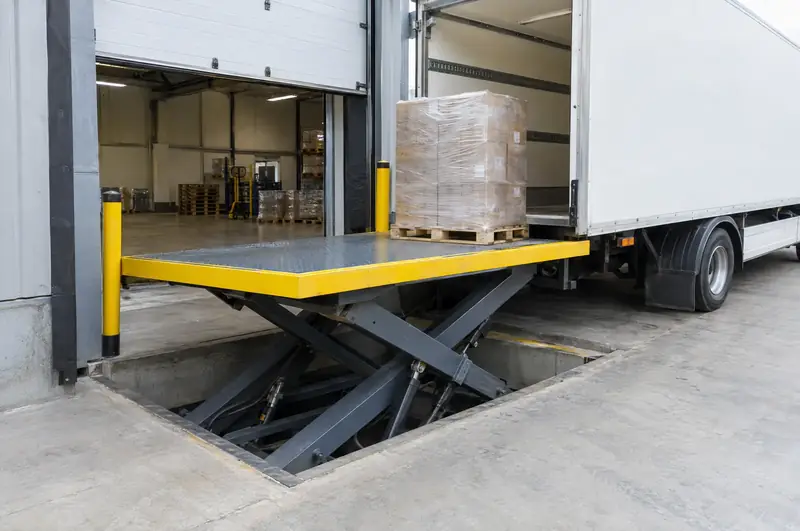
A scissor lift table, often called a dock lift, is a powered platform raised and lowered by a hydraulic scissor mechanism to move goods between two levels. At a loading bay it lifts pallets and pallet trucks from ground level to the height of a trailer bed, making it a practical alternative to a raised dock where forming one is not possible.
How does this suit sites in Cheshire?
Older industrial buildings in Cheshire built with ground-level doors only can use a scissor lift table to load trailers without excavating the yard. Each lift table enquiry from Cheshire is surveyed and quoted in the same way as any other UK site, with groundworks for a pit priced separately.
Where ground conditions in Cheshire make a deep recessed dock costly, a pit-mounted or surface-mounted lift table can be the more practical option.
If you are planning scissor lift tables for a site in Cheshire, expect four stages. A free survey and fixed written quote come first. We then agree a programme with you, including any out-of-hours work. Specialist installation engineers carry out the installation under our management, with us as your single point of contact. Finally, the equipment is tested, your staff are shown how it works and everything is handed over with its documentation.
What safety features should a loading bay lift table have?
A loading bay lift table should protect people from the scissor mechanism, stop if anything is trapped under the platform, and stop people or loads falling from the edges. Lift tables are specified to BS EN 1570-1:2024, and common features include:
- Toe guards: trip bars or sensitive edges around the platform underside that stop the lift descending on contact.
- Safety bellows or skirts: a flexible enclosure that keeps hands, feet and debris out of shear and crush points.
- Guard rails and gates: on open sides, sized to how people and pallet trucks move on and off.
- Bridge plate: a hinged plate that rests on the trailer bed to bridge the gap.
- Hold-to-run controls: the lift only moves while the button is held, with a stop button within reach.
- Hydraulic protection: valves that stop the platform dropping if a hose fails.
- Maintenance props: supports that hold the platform up safely during servicing.
What happens on site when a dock lift is installed?
Installing a dock lift takes the doorway out of use while any pit is formed and the lift fitted, so an alternative loading point should be planned for that period.
- Pit works: where a pit is needed, the yard is broken out, the pit formed and drained, and the concrete left to cure.
- Delivery and positioning: the lift is offloaded and set in place by forklift or crane, then levelled and fixed.
- Power and controls: the power pack and control station are connected to the supply confirmed at survey.
- Testing: the lift is run through its full travel, safety devices are checked and it is tested under load.
- Handover: operators are shown how to use it, and the documents and examination regime are explained.
We ask you to provide a delivery route, a cleared working area, the electrical supply, any drawings of buried services and a contact on site.
Towns we cover in Cheshire
We cover scissor lift tables throughout Cheshire, and the towns below each have their own page. If yours is not listed, get in touch anyway.
- Warrington
- Chester
- Crewe
- Ellesmere Port
- Widnes
- Runcorn
- Macclesfield
- Northwich
- Winsford
- Congleton
- Wilmslow
- Sandbach
- Nantwich
- Neston
Budget range for supply and fit. The written quote after a free survey is the fixed price. All guide prices.
What do the rules in England mean for the work?
Lift tables and dock lifts in Cheshire may fall under LOLER, with thorough examination at least every 12 months, or every 6 months where people are lifted. It depends on the equipment and how it is used, and your insurer or competent person will confirm. Dock levellers are usually treated as work equipment under PUWER. We check what applies at survey.
Questions
Do you cover Cheshire for scissor lift tables?
Yes. We take on scissor lift tables for businesses in Cheshire and across Cheshire. We survey the site, provide a fixed written quote and manage the installation, with specialist installation engineers working under our management. Visits are arranged in advance at a time that suits your operation, and the same single contact stays with the job through to handover.
Which building and safety rules apply to a site in Cheshire?
It depends on which UK nation the site is in. England and Wales use Building Regulations approval, Scotland uses building warrants and Northern Ireland uses building control approval from the council. Workplace safety is regulated by HSE in Great Britain and HSENI in Northern Ireland, and energy rules differ between nations. For your site in Cheshire, we check what applies at survey and design to it.
What capacity of dock lift do I need?
A dock lift needs a capacity above the heaviest combined load it will carry, including the goods, the pallet truck and an operator if they ride on it. Loading bay lifts are typically rated somewhere between 2,000 and 6,000 kg. We work out the right rating from your loads at survey.
Can a scissor lift table be installed outdoors?
Yes, scissor lift tables are often installed outdoors at the loading door. Outdoor lifts need a drained pit or a suitable base, weather-resistant finishes and controls, and sometimes a canopy over the loading area. A canopy is an external structure that may need planning permission, which we check at survey.
Other services in Cheshire
Full guide to scissor lift tables · All loading bay services in Cheshire