
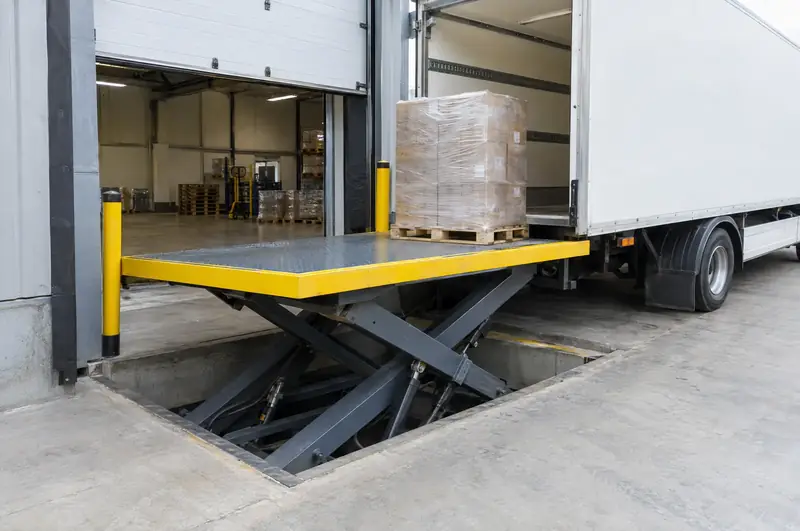
A scissor lift table, often called a dock lift, is a powered platform raised and lowered by a hydraulic scissor mechanism to move goods between two levels. At a loading bay it lifts pallets and pallet trucks from ground level to the height of a trailer bed, making it a practical alternative to a raised dock where forming one is not possible.
Is this right for your site in Lincolnshire?
Each lift table enquiry from Lincolnshire is surveyed and quoted in the same way as any other UK site, with groundworks for a pit priced separately. Older industrial buildings in Lincolnshire built with ground-level doors only can use a scissor lift table to load trailers without excavating the yard.
Sites in Lincolnshire replacing an ageing dock lift should look at its LOLER examination history, as repeated defects can signal that replacement is due.
Step one is a survey at your site in Lincolnshire, which costs nothing and carries no obligation. Step two is a written quote with a fixed price and a clear scope. Step three is installation, scheduled around your operation and carried out by specialist installation engineers working under our management, including evenings or weekends if agreed. Step four is handover, when the equipment is tested in front of you and the paperwork is passed over.
What inspections does a scissor lift table need under LOLER?
A scissor lift table is lifting equipment, so it needs a thorough examination under the Lifting Operations and Lifting Equipment Regulations 1998 (LOLER) at least every 12 months. If it lifts people, such as an operator riding with a pallet truck, the interval is every 6 months, unless a competent person draws up a written examination scheme instead. Which applies depends on the equipment and how it is used; your insurer or competent person will confirm.
In Northern Ireland the equivalent is LOLER (Northern Ireland) 1999, and the regulator is HSENI rather than HSE.
Thorough examination is separate from routine maintenance. The lift is also work equipment under PUWER, so it must be maintained in a safe condition between examinations.
We specify lift tables to BS EN 1570-1:2024, the current safety standard for lifting tables, and explain the examination regime at handover. Planned loading bay servicing can be arranged to fit around the examination dates.
Where are scissor lift tables used at loading bays?
Scissor lift tables are used wherever goods need to move between yard level and trailer height without a raised dock. They are a common answer for buildings that were never designed for articulated trailers.
- Ground-level doors: older units, workshops and retail back doors with no dock.
- Mixed fleets: the same lift can serve a van, a rigid lorry and an articulated trailer at different bed heights, typically from around 900 mm to 1,600 mm.
- Tight sites: where there is no room for a recessed approach ramp in the yard.
- Split levels: inside buildings with floors at different heights.
- Supplementing a dock: one lift beside a row of docks to handle vehicles that do not suit the levellers.
Our guide to converting a ground-level door into a loading dock compares lift tables with the other ways of reaching trailer height.
Towns we cover in Lincolnshire
Below is a list of towns in Lincolnshire for scissor lift tables. Each page explains our approach for sites in that town.
- Lincoln
- Grimsby
- Scunthorpe
- Boston
- Grantham
- Cleethorpes
- Spalding
- Skegness
- Stamford
- Gainsborough
- Louth
- Sleaford
- Immingham
Budget range for supply and fit. The written quote after a free survey is the fixed price. All guide prices.
What do the rules in England mean for the work?
Powered doors and dock equipment installed in England may carry the UKCA or the CE mark, and doors are covered by the product standard BS EN 13241. We hand over the relevant documentation for each item fitted in Lincolnshire. Planning and Building Regulations questions are never assumed either way: we check what applies at survey, so you know before work is booked.
Questions
How do you price scissor lift tables for a site in Lincolnshire?
Guide budgets for supply and fit are £9,500 to £28,000 per lift, excluding VAT. The figure moves with size, insulation, the operator, electrics, access, any pit or groundworks and out-of-hours working. Where levellers are involved, the guide assumes an existing, sound pit. After the free survey you receive a fixed written quote, and that is the price for the agreed scope.
Which building and safety rules apply to a site in Lincolnshire?
It depends on which UK nation the site is in. England and Wales use Building Regulations approval, Scotland uses building warrants and Northern Ireland uses building control approval from the council. Workplace safety is regulated by HSE in Great Britain and HSENI in Northern Ireland, and energy rules differ between nations. For your site in Lincolnshire, we check what applies at survey and design to it.
Can people ride on a dock lift?
Some lift tables are designed to carry an operator with the load, and others are for goods only. If the lift carries people, LOLER thorough examinations are typically needed every 6 months rather than every 12, unless a written examination scheme sets a different interval. Your insurer or competent person will confirm.
What capacity of dock lift do I need?
A dock lift needs a capacity above the heaviest combined load it will carry, including the goods, the pallet truck and an operator if they ride on it. Loading bay lifts are typically rated somewhere between 2,000 and 6,000 kg. We work out the right rating from your loads at survey.
Other services in Lincolnshire
Full guide to scissor lift tables · All loading bay services in Lincolnshire