
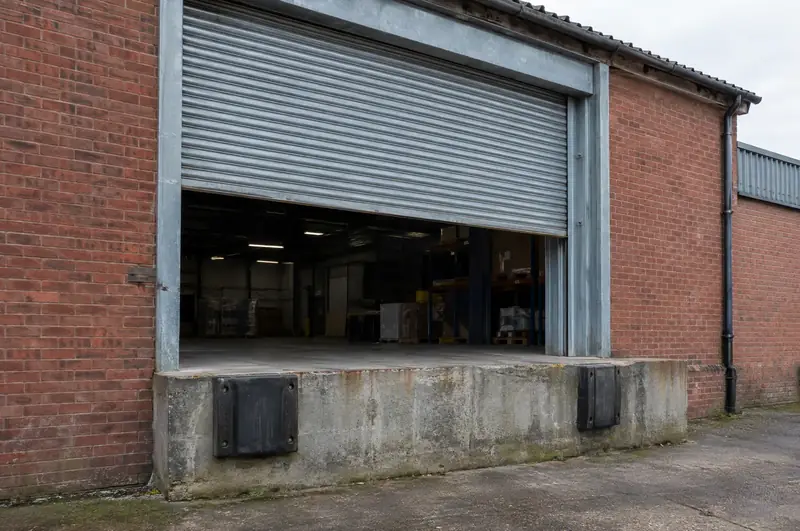
A roller shutter loading bay door is a door made from interlocking horizontal slats, called laths, that coil around a barrel in a box above the opening. Because it rolls up into a compact space, a shutter needs little headroom and no ceiling tracks, which suits older units, low-headroom openings and buildings with cranes, pipes or racking close above the door.
Why do sites in Devon choose this?
Landlords refurbishing a vacant unit in Devon may choose an insulated shutter where headroom is tight but a future tenant is likely to heat the building. Docks that face an open yard in Devon can catch strong gusts, so we check orientation and specify end locks and heavier laths where exposure calls for it.
Timber yards and builders merchants in Devon handling long loads and heavy forklift traffic can benefit from strong steel shutters that tolerate knocks.
Step one is a survey at your site in Devon, which costs nothing and carries no obligation. Step two is a written quote with a fixed price and a clear scope. Step three is installation, scheduled around your operation and carried out by specialist installation engineers working under our management, including evenings or weekends if agreed. Step four is handover, when the equipment is tested in front of you and the paperwork is passed over.
Is a roller shutter or a sectional door better for a loading bay?
A roller shutter is usually better where headroom is tight, budgets are limited or the building is unheated, while a sectional door is usually better for heated buildings and busy docks that open and close all day.
- Headroom: a shutter coils into a box above the opening; a sectional door needs track running back under the ceiling or up the wall.
- Insulation: insulated sectional panels generally outperform insulated laths.
- Speed: shutters are slower to open and close than most electric sectional doors.
- Security: a closed steel shutter is a robust barrier.
- Repairs: damaged laths can be replaced individually, just as a dented sectional panel can be swapped.
See sectional loading bay doors to compare the two. Where either would work, we can quote both so you can weigh price against performance.
What safety and energy rules apply to roller shutters at a dock?
A dock roller shutter must be protected against falling, must not trap anyone if powered, and in a heated building may need insulated laths to meet energy rules.
- Falling back: the Workplace (Health, Safety and Welfare) Regulations 1992 in Great Britain, and the Northern Ireland regulations of 1993, require upward-opening doors to have a device that stops them falling back. On a shutter this is usually a safety brake or anti-fall device on the barrel.
- Trapping: powered shutters need suitable features to prevent trapping, typically a safety edge and photocells, and a way to open by hand, such as a chain override, where needed.
- Energy: in England, Approved Document L (2021) Volume 2 sets a limiting U-value of 1.3 W/m²K for vehicle access doors in new and replacement work. A single-skin steel shutter will not normally reach that figure. Wales, Scotland and Northern Ireland set their own rules, and we confirm the figure for your nation and project.
Our guide to energy rules for loading bay doors explains U-values in more detail.
Towns we cover in Devon
We take enquiries about roller shutter loading bay doors from across Devon. These are the towns with their own pages:
Budget range for supply and fit. The written quote after a free survey is the fixed price. All guide prices.
Regulations and approvals in England
Workplace safety in England is regulated by HSE. For a loading bay in Devon, that means doors meeting regulation 18 of the Workplace (Health, Safety and Welfare) Regulations 1992, equipment maintained under PUWER and suitable safeguards against vehicles driving away too early. We check what applies at survey and design the bay accordingly.
Questions
How do you price roller shutter loading bay doors for a site in Devon?
Guide budgets for supply and fit are £1,600 to £4,800 per door, excluding VAT. The figure moves with size, insulation, the operator, electrics, access, any pit or groundworks and out-of-hours working. Where levellers are involved, the guide assumes an existing, sound pit. After the free survey you receive a fixed written quote, and that is the price for the agreed scope.
What warranty comes with new loading bay equipment?
New equipment comes with the manufacturer's warranty, which varies by product. Our workmanship terms are set out in writing in the quote for your Devon site, so you can see what is covered before you commit. Check the warranty terms for any servicing conditions, and we can quote for planned maintenance once the installation is complete.
Are roller shutters noisy at a loading bay?
A roller shutter is generally noisier than a sectional door because the laths move against each other as they coil, though insulated laths and well-adjusted guides reduce this. Noise matters most where the dock is close to offices or neighbours. Keeping the barrel and guides clean and lubricated keeps running noise down.
How long does a new roller shutter take to arrive?
Shutters are made to measure, so the lead time depends on size, lath type and finish, and we confirm it in the written quote. The existing door stays in use until the new shutter is ready, and installation is then booked for a time that suits your operation.
Other services in Devon
Full guide to roller shutter loading bay doors · All loading bay services in Devon