
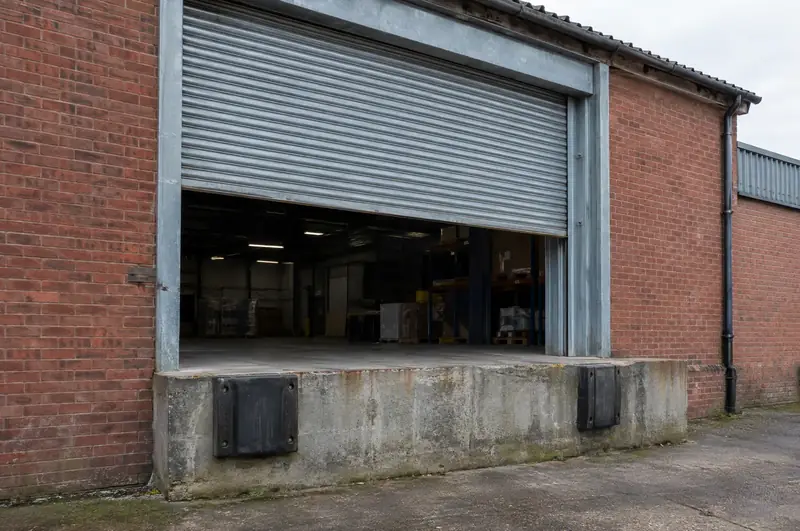
A roller shutter loading bay door is a door made from interlocking horizontal slats, called laths, that coil around a barrel in a box above the opening. Because it rolls up into a compact space, a shutter needs little headroom and no ceiling tracks, which suits older units, low-headroom openings and buildings with cranes, pipes or racking close above the door.
What should sites in Essex consider?
Where a site in Essex is exposed to salt air or regular washdown, aluminium laths or a good powder coat help slow corrosion on the curtain and guides. If a manual shutter on a site in Essex is hard work to open several times a day, a new electric shutter or a retrofit motor may solve it.
Low headroom is the deciding factor at many older buildings, whether in Essex or elsewhere, and a compact roller shutter avoids overhead tracks altogether.
How does an installation in Essex work? First, a free, no-obligation survey to measure up and understand the operation. Next, a fixed written quote. Then a programme agreed with you, so the work fits around deliveries, with out-of-hours slots if needed. The installation itself is carried out by specialist engineers who answer to us, and it finishes with testing, a walk-through for your staff and a handover pack.
What safety and energy rules apply to roller shutters at a dock?
A dock roller shutter must be protected against falling, must not trap anyone if powered, and in a heated building may need insulated laths to meet energy rules.
- Falling back: the Workplace (Health, Safety and Welfare) Regulations 1992 in Great Britain, and the Northern Ireland regulations of 1993, require upward-opening doors to have a device that stops them falling back. On a shutter this is usually a safety brake or anti-fall device on the barrel.
- Trapping: powered shutters need suitable features to prevent trapping, typically a safety edge and photocells, and a way to open by hand, such as a chain override, where needed.
- Energy: in England, Approved Document L (2021) Volume 2 sets a limiting U-value of 1.3 W/m²K for vehicle access doors in new and replacement work. A single-skin steel shutter will not normally reach that figure. Wales, Scotland and Northern Ireland set their own rules, and we confirm the figure for your nation and project.
Our guide to energy rules for loading bay doors explains U-values in more detail.
Can a roller shutter cope with high winds at an exposed dock?
Yes, if it is specified for the exposure. Wind pushes the curtain inwards or draws it outwards, and on a wide opening that load can pull laths out of their guides or bow the whole curtain.
For exposed docks we typically consider:
- End locks: clips on the ends of the laths that hold the curtain inside the guides under load.
- Deeper guides: give the end locks more to hold on to.
- Heavier gauge or profiled laths: stiffer across wide openings.
- Intermediate wind bars: horizontal reinforcement on very large shutters.
Openings that face open yards, sit at the end of a building or are funnelled between units tend to see the strongest gusts. We note orientation and surroundings at survey and choose a wind-resistant build where it is needed, rather than adding cost to every door on the site.
Towns we cover in Essex
Looking for roller shutter loading bay doors in a specific part of Essex? Start with the nearest town on this list.
- Southend-on-Sea
- Basildon
- Colchester
- Chelmsford
- Harlow
- Grays
- Braintree
- Brentwood
- Clacton-on-Sea
- South Benfleet
- Canvey Island
- Billericay
- Rayleigh
- Stanford-le-Hope
- Wickford
- Witham
- Maldon
- Waltham Abbey
- South Ockendon
- Harwich
- Hadleigh
- Tilbury
Budget range for supply and fit. The written quote after a free survey is the fixed price. All guide prices.
Planning, building control and safety law in England
Powered doors and dock equipment installed in England may carry the UKCA or the CE mark, and doors are covered by the product standard BS EN 13241. We hand over the relevant documentation for each item fitted in Essex. Planning and Building Regulations questions are never assumed either way: we check what applies at survey, so you know before work is booked.
Questions
Will you deal with building control and planning for a project in Essex?
We check at survey whether the work is likely to need approval. Forming a new opening or dock pit may need Building Regulations approval, a building warrant or building control approval, depending on the nation, and external structures such as loading houses can need planning permission. Where approval is needed, we explain what is involved, work with your designer or agent, and build it into the programme.
Is the site survey in Essex free?
Yes. For new installations, replacements, upgrades, conversions and complete bays, the site survey and written quote are free and come with no obligation. The survey lets us measure the openings, check the dock and structure, and understand how the bay is used, so the quote reflects your site. Repair and servicing visits are different: they are chargeable, with the price agreed before anyone attends.
Can an existing manual shutter be motorised?
Often yes. If the barrel, end plates and curtain are in good condition, an external or tubular motor can be added with controls and safety devices. Older or heavier shutters sometimes need a stronger barrel first, and a badly worn curtain is usually better replaced at the same time.
What finish options are available?
Most dock shutters are supplied in galvanised steel or powder-coated in a standard colour, with other colours available at extra cost. A hood box over the coil protects it from dust and weather and gives a tidier finish inside. We confirm finish and colour in the written quote.
Other services in Essex
Full guide to roller shutter loading bay doors · All loading bay services in Essex