
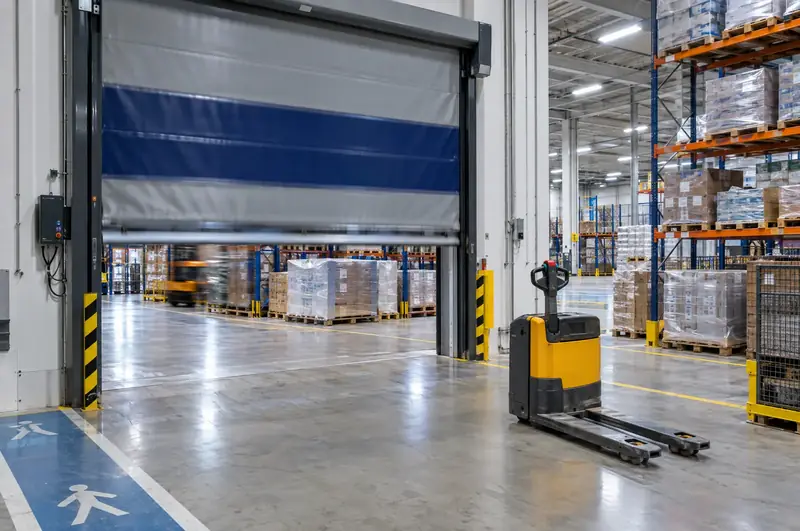
A high-speed dock door is a power-operated door with a flexible PVC fabric curtain that opens and closes much faster than a conventional sectional door or shutter, usually driven by a frequency-controlled motor. Many versions use a self-repairing curtain or breakaway bottom bar, so a forklift strike pushes the curtain out of its guides instead of wrecking it, and the door re-engages itself on the next cycle.
What should sites in Greater Manchester consider?
Busy cross-dock and parcel operations in Greater Manchester can use a high-speed door behind the main dock door to keep traffic flowing while limiting the time the bay stands open. Yards that are open to the weather in Greater Manchester may need a wind-reinforced build, because a standard internal high-speed door is not designed for gusts at an external opening.
Where a goods-in area in Greater Manchester borders a chilled zone, a fast fabric door helps hold the temperature line without slowing forklift movements between the two.
Your loading bay stays our responsibility from the survey to the handover. In Greater Manchester, the survey and written quote are free, and the quoted price is fixed for the agreed scope. Installation is carried out by specialist engineers working under our management, at times planned with you to protect your loading schedule. Out-of-hours work is available by arrangement. We finish by testing the equipment and handing over its documentation.
Can a high-speed door be used on an external dock opening?
Yes, provided it is specified for the wind and weather the opening faces. Many high-speed doors are designed for internal openings, so an external dock door needs a reinforced build.
- Wind resistance: external doors use stronger curtains, horizontal wind bars or tensioned belts, and deeper side guides so the curtain stays put in gusts.
- Insulation: a double-skin curtain reduces heat loss, though fabric does not insulate as well as a thick sectional door.
- Security: fabric doors are not security doors, so many sites keep a sectional door or shutter outside for closing at night.
- Impact protection: a self-repairing curtain re-engages after a knock, which matters at a busy dock.
For openings that are mainly internal, such as between goods-in and a chilled zone, a lighter single-skin door with vision panels is usually enough. We match the build to the exposure at survey.
Which safety rules and standards apply to a high-speed door?
A high-speed door is a power-operated door, so it must protect people from being struck or trapped, and it should be designed and tested to the product and safety-in-use standards for powered doors.
- Workplace law: regulation 18 of the Workplace (Health, Safety and Welfare) Regulations 1992 in Great Britain, and the Workplace (Health, Safety and Welfare) Regulations (Northern Ireland) 1993, require powered doors to have suitable and effective features to prevent trapping. Where needed for health or safety, the door must be operable by hand unless it opens automatically on power failure.
- Standards: BS EN 13241 is the product standard for industrial doors, and BS EN 12453 covers safety in use of power-operated doors, including test methods.
- Marking: in Great Britain the door may carry the UKCA or the CE mark. In Northern Ireland the CE mark, or CE with UKNI, applies.
In practice that means a light curtain or photocells across the opening, a safe bottom edge and a manual release or crank. HSE enforces these duties in Great Britain, and HSENI in Northern Ireland.
Towns we cover in Greater Manchester
We take enquiries about high-speed dock doors from across Greater Manchester. These are the towns with their own pages:
- Manchester
- Oldham
- Wigan
- Bolton
- Stockport
- Salford
- Rochdale
- Sale
- Bury
- Altrincham
- Middleton
- Ashton-under-Lyne
- Leigh
- Stretford
- Urmston
- Chadderton
- Eccles
- Tyldesley
- Hyde
- Walkden
- Prestwich
- Radcliffe
Budget range for supply and fit. The written quote after a free survey is the fixed price. All guide prices.
Regulations and approvals in England
Sites in Greater Manchester fall under the rules for England. Structural changes such as forming a new opening or a dock leveller pit may need Building Regulations approval, and external structures such as loading houses, canopies or new dock approaches can need planning permission from the local planning authority. We check what applies at survey and build any approvals into the plan.
Questions
What warranty comes with new loading bay equipment?
New equipment comes with the manufacturer's warranty, which varies by product. Our workmanship terms are set out in writing in the quote for your Greater Manchester site, so you can see what is covered before you commit. Check the warranty terms for any servicing conditions, and we can quote for planned maintenance once the installation is complete.
Will you deal with building control and planning for a project in Greater Manchester?
We check at survey whether the work is likely to need approval. Forming a new opening or dock pit may need Building Regulations approval, a building warrant or building control approval, depending on the nation, and external structures such as loading houses can need planning permission. Where approval is needed, we explain what is involved, work with your designer or agent, and build it into the programme.
What happens if a forklift hits a high-speed door?
On a door with a self-repairing curtain or breakaway bottom bar, the curtain is pushed out of its guides and re-engages on the next cycle, usually with no repair needed. Repeated hard impacts still wear the curtain and guides, so knocks should be logged and checked at the next service visit.
How fast does a high-speed door open?
Many dock and internal high-speed doors open at around 1 to 2 metres per second, so a typical opening clears in a few seconds. Speed depends on the size, the drive and whether the door is built for wind. Closing speed is usually set slower than opening for safety, and both are adjusted at handover.
Other services in Greater Manchester
Full guide to high-speed dock doors · All loading bay services in Greater Manchester