
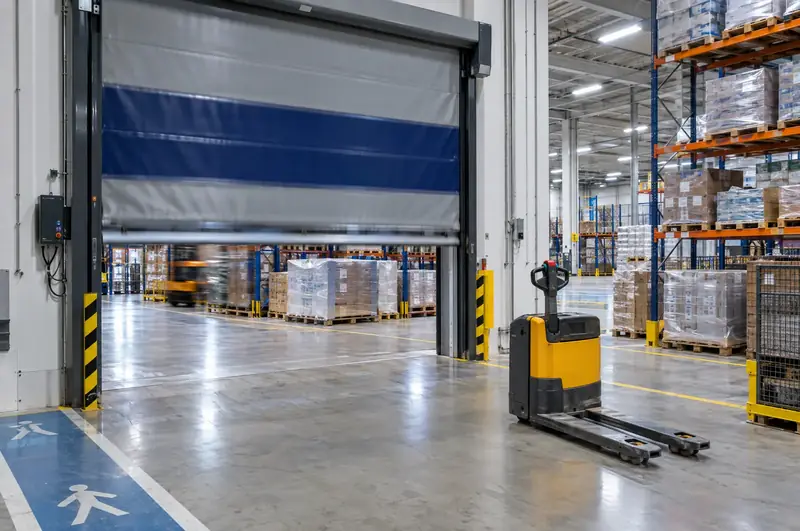
A high-speed dock door is a power-operated door with a flexible PVC fabric curtain that opens and closes much faster than a conventional sectional door or shutter, usually driven by a frequency-controlled motor. Many versions use a self-repairing curtain or breakaway bottom bar, so a forklift strike pushes the curtain out of its guides instead of wrecking it, and the door re-engages itself on the next cycle.
Why do sites in Cambridgeshire choose this?
Where a goods-in area in Cambridgeshire borders a chilled zone, a fast fabric door helps hold the temperature line without slowing forklift movements between the two. Replacing tired strip curtains is one reason a business in Cambridgeshire might consider a high-speed door, especially where drivers struggle to see through scratched strips.
Yards that are open to the weather in Cambridgeshire may need a wind-reinforced build, because a standard internal high-speed door is not designed for gusts at an external opening.
Any project involving high-speed dock doors at a working site in Cambridgeshire takes planning. We survey free of charge, quote a fixed price in writing, and then agree a programme that keeps as much of the dock running as possible. Specialist installation engineers carry out the work under our management, out of hours if that suits you better. On completion we test each item, show your team how it operates and leave the documentation with you.
Can a high-speed door be used on an external dock opening?
Yes, provided it is specified for the wind and weather the opening faces. Many high-speed doors are designed for internal openings, so an external dock door needs a reinforced build.
- Wind resistance: external doors use stronger curtains, horizontal wind bars or tensioned belts, and deeper side guides so the curtain stays put in gusts.
- Insulation: a double-skin curtain reduces heat loss, though fabric does not insulate as well as a thick sectional door.
- Security: fabric doors are not security doors, so many sites keep a sectional door or shutter outside for closing at night.
- Impact protection: a self-repairing curtain re-engages after a knock, which matters at a busy dock.
For openings that are mainly internal, such as between goods-in and a chilled zone, a lighter single-skin door with vision panels is usually enough. We match the build to the exposure at survey.
What does a high-speed dock door cost, and why does the price vary so much?
A high-speed dock door typically costs £6,500 to £14,500 per door, excluding VAT, supply and fit. The range is wide because each door is built to order, and an internal door between two zones is a very different product from one facing an exposed yard.
The main things that move the price are:
- Size and wind exposure: large external openings need reinforced curtains, wind bars or belts and heavier side frames.
- Curtain type: single-skin fabric costs less than an insulated double-skin curtain.
- Self-repair and breakaway features: worth paying for wherever forklifts pass through.
- Activation: radar, induction loops or pull cords, and how many control points are needed.
- Interlocks: links to an outer door, a leveller or traffic lights.
- Site works: power supply, removing an old door or strip curtain, and access equipment.
Our loading bay costs guide sets these figures alongside other dock equipment. After a free site survey you receive a fixed written price.
Towns we cover in Cambridgeshire
We provide high-speed dock doors right across Cambridgeshire. Pick the town closest to your site from the list below.
Budget range for supply and fit. The written quote after a free survey is the fixed price. All guide prices.
Planning, building control and safety law in England
Powered doors and dock equipment installed in England may carry the UKCA or the CE mark, and doors are covered by the product standard BS EN 13241. We hand over the relevant documentation for each item fitted in Cambridgeshire. Planning and Building Regulations questions are never assumed either way: we check what applies at survey, so you know before work is booked.
Questions
Will you deal with building control and planning for a project in Cambridgeshire?
We check at survey whether the work is likely to need approval. Forming a new opening or dock pit may need Building Regulations approval, a building warrant or building control approval, depending on the nation, and external structures such as loading houses can need planning permission. Where approval is needed, we explain what is involved, work with your designer or agent, and build it into the programme.
Do you remove and dispose of the old equipment?
Yes, where it is part of the scope. When we replace doors, levellers, shelters or seals at a site in Cambridgeshire, removal and disposal of the old equipment can be included and is itemised in the quote, so it is clear what is covered. If anything should be kept, such as a frame or motor that is still serviceable, we agree that at survey.
What happens if a forklift hits a high-speed door?
On a door with a self-repairing curtain or breakaway bottom bar, the curtain is pushed out of its guides and re-engages on the next cycle, usually with no repair needed. Repeated hard impacts still wear the curtain and guides, so knocks should be logged and checked at the next service visit.
How fast does a high-speed door open?
Many dock and internal high-speed doors open at around 1 to 2 metres per second, so a typical opening clears in a few seconds. Speed depends on the size, the drive and whether the door is built for wind. Closing speed is usually set slower than opening for safety, and both are adjusted at handover.
Other services in Cambridgeshire
Full guide to high-speed dock doors · All loading bay services in Cambridgeshire