
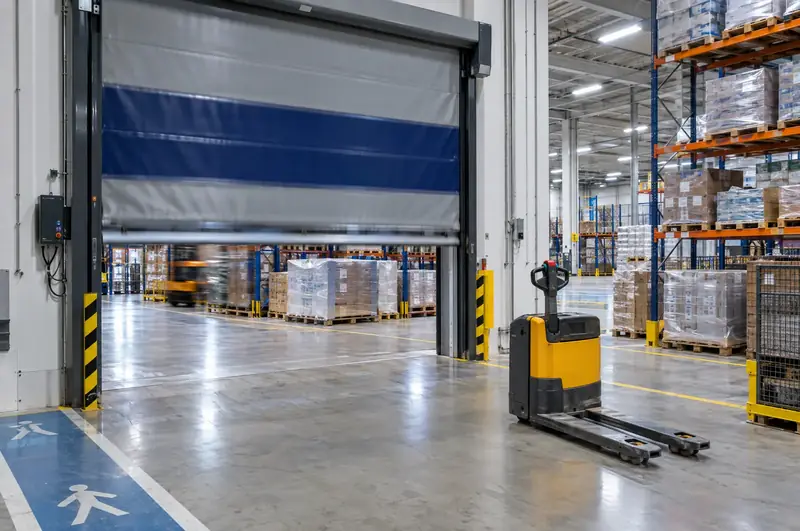
A high-speed dock door is a power-operated door with a flexible PVC fabric curtain that opens and closes much faster than a conventional sectional door or shutter, usually driven by a frequency-controlled motor. Many versions use a self-repairing curtain or breakaway bottom bar, so a forklift strike pushes the curtain out of its guides instead of wrecking it, and the door re-engages itself on the next cycle.
What matters for high-speed dock doors in Greater London?
Busy cross-dock and parcel operations in Greater London can use a high-speed door behind the main dock door to keep traffic flowing while limiting the time the bay stands open. Manufacturers around Greater London moving work in progress between production and dispatch can use high-speed doors to stop dust and draughts crossing departments.
Where a goods-in area in Greater London borders a chilled zone, a fast fabric door helps hold the temperature line without slowing forklift movements between the two.
We never ask you to commit before you have a fixed price. A free survey at your Greater London site comes first, followed by a written quote. When the order goes ahead, we plan the installation around your operation, book any out-of-hours working you need and manage the specialist installation engineers on site. The job ends with a full test, a run-through for the people who will use the equipment and a set of handover documents.
Which safety rules and standards apply to a high-speed door?
A high-speed door is a power-operated door, so it must protect people from being struck or trapped, and it should be designed and tested to the product and safety-in-use standards for powered doors.
- Workplace law: regulation 18 of the Workplace (Health, Safety and Welfare) Regulations 1992 in Great Britain, and the Workplace (Health, Safety and Welfare) Regulations (Northern Ireland) 1993, require powered doors to have suitable and effective features to prevent trapping. Where needed for health or safety, the door must be operable by hand unless it opens automatically on power failure.
- Standards: BS EN 13241 is the product standard for industrial doors, and BS EN 12453 covers safety in use of power-operated doors, including test methods.
- Marking: in Great Britain the door may carry the UKCA or the CE mark. In Northern Ireland the CE mark, or CE with UKNI, applies.
In practice that means a light curtain or photocells across the opening, a safe bottom edge and a manual release or crank. HSE enforces these duties in Great Britain, and HSENI in Northern Ireland.
What keeps a high-speed door reliable at a busy dock?
Servicing matched to the number of cycles is what keeps a high-speed door reliable, because these doors can open and close far more often in a shift than a conventional door.
- Duty cycle: check the drive is rated for the openings per hour your site actually runs, including peaks.
- Safety devices: the light curtain, photocells and bottom edge should be tested at every service.
- Curtain and guides: worn guide brushes, a stretched curtain or a damaged bottom bar cause misalignment and stoppages.
- Activation: poorly set radar can open the door for passing traffic, adding needless cycles and wear.
- Impact: repeated knocks shorten curtain life even when the door self-repairs, so look at traffic routes and driver habits.
Planned maintenance visits are chargeable and agreed in advance. Keeping a log of faults and knocks helps the engineer spot patterns before they stop the door.
Towns we cover in Greater London
We cover high-speed dock doors throughout Greater London, and the towns below each have their own page. If yours is not listed, get in touch anyway.
- Barking
- Sutton
- Croydon
- Ilford
- Enfield
- Harrow
- Tottenham
- Walthamstow
- Dagenham
- Romford
- Hayes
- Wembley
- Edmonton
- Southall
- Uxbridge
- Hounslow
- Feltham
- Acton
- Greenford
- Thamesmead
- Barnet
- South Ruislip
- Harringay
- Enfield Lock
- Stepney
- Worcester Park
- Beckton
- Erith
- Park Royal
- Rainham
Budget range for supply and fit. The written quote after a free survey is the fixed price. All guide prices.
Regulations and approvals in England
In England, Approved Document L (2021) sets a limiting U-value of 1.3 W/m²K for vehicle access and similar large doors in new and replacement work. That shapes door specification for sites in Greater London, so we confirm the requirement for your project and check what applies at survey before recommending a door.
Questions
Do you remove and dispose of the old equipment?
Yes, where it is part of the scope. When we replace doors, levellers, shelters or seals at a site in Greater London, removal and disposal of the old equipment can be included and is itemised in the quote, so it is clear what is covered. If anything should be kept, such as a frame or motor that is still serviceable, we agree that at survey.
Which building and safety rules apply to a site in Greater London?
It depends on which UK nation the site is in. England and Wales use Building Regulations approval, Scotland uses building warrants and Northern Ireland uses building control approval from the council. Workplace safety is regulated by HSE in Great Britain and HSENI in Northern Ireland, and energy rules differ between nations. For your site in Greater London, we check what applies at survey and design to it.
Can a high-speed door be opened in a power cut?
Yes, a high-speed door should have a manual release, crank or counterbalance so it can be opened if the power fails. This reflects the workplace rule that powered doors must be operable by hand where needed for health or safety, unless they open automatically on power failure.
What happens if a forklift hits a high-speed door?
On a door with a self-repairing curtain or breakaway bottom bar, the curtain is pushed out of its guides and re-engages on the next cycle, usually with no repair needed. Repeated hard impacts still wear the curtain and guides, so knocks should be logged and checked at the next service visit.
Other services in Greater London
Full guide to high-speed dock doors · All loading bay services in Greater London