
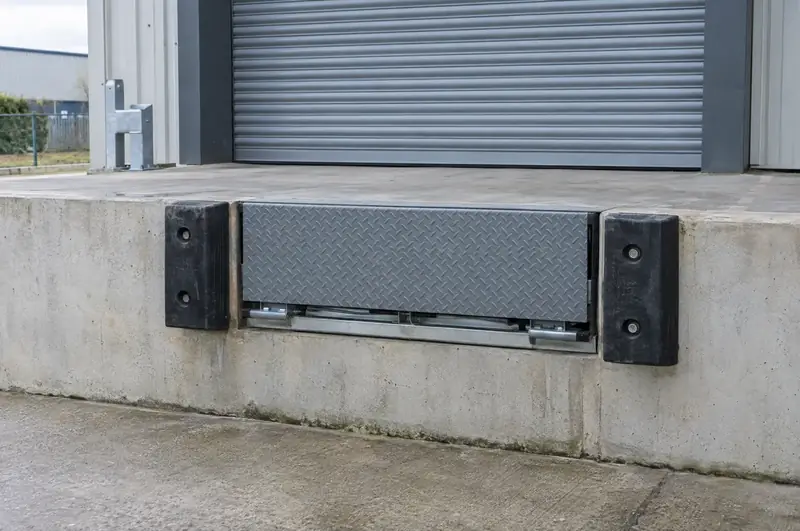
An edge-of-dock leveller is a compact leveller mounted on the front face or top edge of a loading dock, with no pit needed. A short hinged plate and lip bridge the gap between dock and trailer, but it can only cover a small height difference above and below dock level, so it suits sites where trailer bed heights are consistent.
What should sites in County Durham consider?
Wholesalers and trade suppliers in County Durham adding a second loading position can often do so economically with an edge-of-dock unit. Exposed external docks in County Durham call for a galvanised or well-painted edge-of-dock leveller that stands up to the weather all year round.
Companies running their own vehicles in County Durham, where every trailer has a known bed height, are well placed to use edge-of-dock levellers instead of pit units.
Step one is a survey at your site in County Durham, which costs nothing and carries no obligation. Step two is a written quote with a fixed price and a clear scope. Step three is installation, scheduled around your operation and carried out by specialist installation engineers working under our management, including evenings or weekends if agreed. Step four is handover, when the equipment is tested in front of you and the paperwork is passed over.
Do edge-of-dock levellers need the same inspections as pit levellers?
Yes, an edge-of-dock leveller is work equipment just like a pit leveller, so it must be kept in a safe condition and inspected where deterioration could lead to danger. Its small size does not exempt it.
- Great Britain: PUWER 1998 applies, with HSE as the regulator.
- Northern Ireland: PUWER (Northern Ireland) 1999 applies, with HSENI as the regulator.
- Insurer inspections: engineering insurers commonly inspect dock levellers under PUWER at 12-month intervals, so ask your insurer to confirm edge-of-dock units are on the schedule.
- Standard: the dock leveller safety standard is BS EN 1398:2009, which is current and under review.
- Trapping points: HSE guidance notes that guards or skirting may be needed on dock levellers where something could be caught, so hinge areas and plate edges are checked.
Mechanical units rely on springs and hinges that wear, so an inspection should cover these as carefully as the hydraulics on a powered unit.
Should I choose a mechanical or hydraulic edge-of-dock leveller?
Choose a mechanical edge-of-dock leveller for occasional use and simple sites, and a hydraulic one where the bay is busy or operators need push-button control. Both bridge a similar small height range.
- Mechanical: the operator pulls a lever or handle and the lip lifts and drops onto the bed with spring assistance. No power is needed and there is little to go wrong, but it takes some physical effort.
- Hydraulic: a push button raises the plate and extends the lip, then lowers it onto the trailer. It is easier and quicker for frequent use and can be interlocked with the dock door and traffic lights.
Other choices include plate width, which should suit the wheel track of your pallet trucks and forklifts, and capacity, which must cover the truck and its heaviest load. On exposed external docks, a galvanised or well-painted finish helps the unit cope with rain, frost and road salt.
Towns we cover in County Durham
Each of the following towns in County Durham has its own page on edge-of-dock levellers, covering how we work and what to send us.
- Darlington
- Hartlepool
- Stockton-on-Tees
- Durham
- Chester-le-Street
- Billingham
- Stanley
- Consett
- Newton Aycliffe
- Bishop Auckland
- Seaham
- Peterlee
- Spennymoor
Budget range for supply and fit. The written quote after a free survey is the fixed price. All guide prices.
Which rules apply in England?
Powered doors and dock equipment installed in England may carry the UKCA or the CE mark, and doors are covered by the product standard BS EN 13241. We hand over the relevant documentation for each item fitted in County Durham. Planning and Building Regulations questions are never assumed either way: we check what applies at survey, so you know before work is booked.
Questions
Do you cover County Durham for edge-of-dock levellers?
Yes. We take on edge-of-dock levellers for businesses in County Durham and across County Durham. We survey the site, provide a fixed written quote and manage the installation, with specialist installation engineers working under our management. Visits are arranged in advance at a time that suits your operation, and the same single contact stays with the job through to handover.
Can you work outside our normal operating hours in County Durham?
Yes, by arrangement. Evening, night and weekend working can be planned so the installation causes as little disruption as possible to your loading schedule. Out-of-hours work can affect the price, so mention it at the survey and we will include it in the written quote. The agreed times are confirmed in the programme before the job starts.
Do edge-of-dock levellers need servicing?
Yes, they should be serviced and inspected like any leveller. Mechanical units need their springs, hinges and lip checked and lubricated, and hydraulic units also need hoses and the power pack inspected. Service visits are chargeable and agreed before anyone attends.
Is an edge-of-dock leveller better than a loose dock plate?
For regular use, usually yes. A fixed edge-of-dock leveller cannot slide out of position or be dropped, and it does not need carrying between bays. Loose plates still have a place for occasional use, but they bring handling and slipping risks that a fixed unit avoids.
Other services in County Durham
Full guide to edge-of-dock levellers · All loading bay services in County Durham