
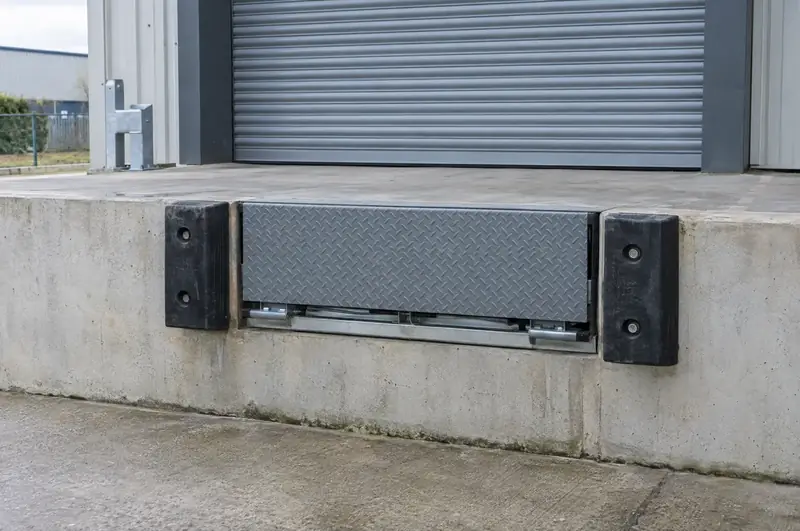
An edge-of-dock leveller is a compact leveller mounted on the front face or top edge of a loading dock, with no pit needed. A short hinged plate and lip bridge the gap between dock and trailer, but it can only cover a small height difference above and below dock level, so it suits sites where trailer bed heights are consistent.
How does this suit sites in Buckinghamshire?
Wholesalers and trade suppliers in Buckinghamshire adding a second loading position can often do so economically with an edge-of-dock unit. Exposed external docks in Buckinghamshire call for a galvanised or well-painted edge-of-dock leveller that stands up to the weather all year round.
On older buildings in Buckinghamshire where drains or services run close to the dock, avoiding a pit can make an edge-of-dock leveller the sensible route.
Your loading bay stays our responsibility from the survey to the handover. In Buckinghamshire, the survey and written quote are free, and the quoted price is fixed for the agreed scope. Installation is carried out by specialist engineers working under our management, at times planned with you to protect your loading schedule. Out-of-hours work is available by arrangement. We finish by testing the equipment and handing over its documentation.
How much height difference can an edge-of-dock leveller handle?
An edge-of-dock leveller can only handle a small height difference, typically in the region of 75 to 150 mm above and below dock level depending on the model. That is enough where trailers are consistent, but not where bed heights vary widely.
Typical UK docks are around 1,200 mm above yard level, while trailer bed heights can range from roughly 900 to 1,600 mm across rigid, curtain-sider, refrigerated, double-deck and container chassis. If your trailers sit outside the leveller's range, the plate becomes too steep to use safely.
- Good fit: dedicated fleets or regular suppliers with similar trailers.
- Poor fit: sites receiving everything from low rigids to high double-deck trailers.
Where trailer heights vary, a pit leveller such as a swing-lip dock leveller gives a much longer, gentler ramp. We record your trailer heights at survey to confirm which suits.
Do edge-of-dock levellers need the same inspections as pit levellers?
Yes, an edge-of-dock leveller is work equipment just like a pit leveller, so it must be kept in a safe condition and inspected where deterioration could lead to danger. Its small size does not exempt it.
- Great Britain: PUWER 1998 applies, with HSE as the regulator.
- Northern Ireland: PUWER (Northern Ireland) 1999 applies, with HSENI as the regulator.
- Insurer inspections: engineering insurers commonly inspect dock levellers under PUWER at 12-month intervals, so ask your insurer to confirm edge-of-dock units are on the schedule.
- Standard: the dock leveller safety standard is BS EN 1398:2009, which is current and under review.
- Trapping points: HSE guidance notes that guards or skirting may be needed on dock levellers where something could be caught, so hinge areas and plate edges are checked.
Mechanical units rely on springs and hinges that wear, so an inspection should cover these as carefully as the hydraulics on a powered unit.
Towns we cover in Buckinghamshire
Below is a list of towns in Buckinghamshire for edge-of-dock levellers. Each page explains our approach for sites in that town.
- Milton Keynes
- High Wycombe
- Aylesbury
- Bletchley
- Amersham
- Chesham
- Gerrards Cross
- Chalfont St Peter
- Marlow
- Newport Pagnell
Budget range for supply and fit. The written quote after a free survey is the fixed price. All guide prices.
Planning, building control and safety law in England
Lift tables and dock lifts in Buckinghamshire may fall under LOLER, with thorough examination at least every 12 months, or every 6 months where people are lifted. It depends on the equipment and how it is used, and your insurer or competent person will confirm. Dock levellers are usually treated as work equipment under PUWER. We check what applies at survey.
Questions
Will you deal with building control and planning for a project in Buckinghamshire?
We check at survey whether the work is likely to need approval. Forming a new opening or dock pit may need Building Regulations approval, a building warrant or building control approval, depending on the nation, and external structures such as loading houses can need planning permission. Where approval is needed, we explain what is involved, work with your designer or agent, and build it into the programme.
How do you price edge-of-dock levellers for a site in Buckinghamshire?
Guide budgets for supply and fit are £1,800 to £4,400 per leveller, excluding VAT. The figure moves with size, insulation, the operator, electrics, access, any pit or groundworks and out-of-hours working. Where levellers are involved, the guide assumes an existing, sound pit. After the free survey you receive a fixed written quote, and that is the price for the agreed scope.
Can edge-of-dock levellers be used with vans?
Usually not. Edge-of-dock levellers are designed for trailers whose beds sit close to dock height, and many vans sit well below a typical dock, beyond the leveller's range. A lift table or a ground-level door is normally the better way to handle vans.
How long does an edge-of-dock leveller take to install?
Usually half a day to a day per bay, as there is no pit to form. Concrete or edge steel repairs add time, and hydraulic units also need connecting to power. We plan the work so the rest of the dock keeps operating while each bay is fitted.
Other services in Buckinghamshire
Full guide to edge-of-dock levellers · All loading bay services in Buckinghamshire