
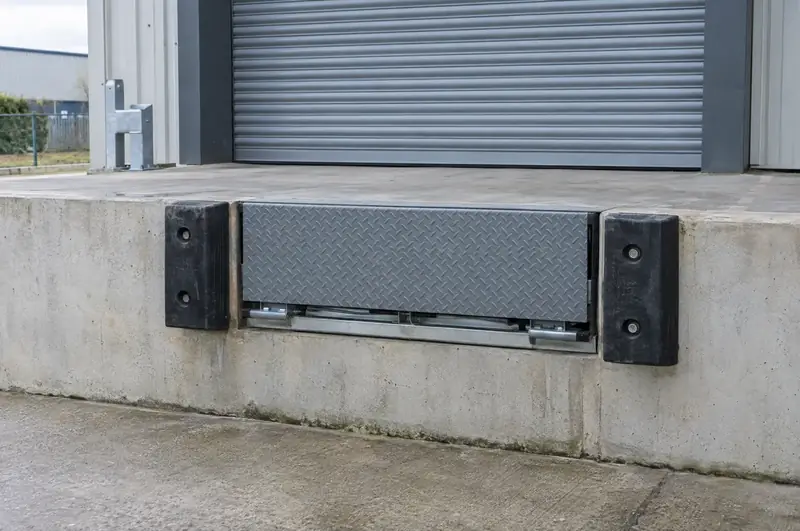
An edge-of-dock leveller is a compact leveller mounted on the front face or top edge of a loading dock, with no pit needed. A short hinged plate and lip bridge the gap between dock and trailer, but it can only cover a small height difference above and below dock level, so it suits sites where trailer bed heights are consistent.
Is this right for your site in the Isle of Wight?
Exposed external docks in the Isle of Wight call for a galvanised or well-painted edge-of-dock leveller that stands up to the weather all year round. Smaller distribution units in the Isle of Wight without dock pits can add a practical loading position with an edge-of-dock leveller fixed straight to the dock face.
Tenants of leased warehouses in the Isle of Wight who cannot cut into the slab may find an edge-of-dock leveller the most workable way to improve loading.
Any project involving edge-of-dock levellers at a working site in the Isle of Wight takes planning. We survey free of charge, quote a fixed price in writing, and then agree a programme that keeps as much of the dock running as possible. Specialist installation engineers carry out the work under our management, out of hours if that suits you better. On completion we test each item, show your team how it operates and leave the documentation with you.
How much does an edge-of-dock leveller cost?
An edge-of-dock leveller typically costs £1,800 to £4,400 per leveller, excluding VAT, supply and fit. That is considerably less than a pit leveller, because there is no pit to form or maintain and the unit itself is smaller.
The price depends on:
- Operation: mechanical units with a lever and spring assistance cost less than hydraulic push-button units.
- Width and capacity: wider plates and higher ratings for heavier forklifts.
- Fixing method: bolting to sound concrete, welding to an existing steel edge, or fitting a new edge angle first.
- Dock face condition: spalled or damaged concrete may need repair before fixing.
- Bumpers: often replaced or repositioned at the same time.
- Power: hydraulic units need a supply at the bay.
Concrete repairs or new edge steel are priced as separate items after survey, so you can see exactly what the leveller costs on its own. The written quote is the fixed price.
Where does an edge-of-dock leveller work best?
An edge-of-dock leveller works best where trailer heights are consistent, a pit is impractical, or the budget rules out a pit leveller. It is a practical choice for many smaller operations and for adding capacity at larger ones.
- Leased units: where the lease or landlord does not allow a pit to be cut into the slab.
- Dedicated fleets: sites loading their own vehicles of a known bed height.
- Extra bays: adding loading positions at a dock where most bays already have pit levellers.
- Difficult slabs: where drainage, services or the structure would make a pit costly.
- Low-volume docks: occasional deliveries that do not justify a pit leveller.
Our guide on how to choose a dock leveller compares edge-of-dock, swing-lip and telescopic units in more detail, including the trailer and equipment questions to answer before deciding.
Towns we cover in the Isle of Wight
Below is a list of towns in the Isle of Wight for edge-of-dock levellers. Each page explains our approach for sites in that town.
Budget range for supply and fit. The written quote after a free survey is the fixed price. All guide prices.
Regulations and approvals in England
Lift tables and dock lifts in the Isle of Wight may fall under LOLER, with thorough examination at least every 12 months, or every 6 months where people are lifted. It depends on the equipment and how it is used, and your insurer or competent person will confirm. Dock levellers are usually treated as work equipment under PUWER. We check what applies at survey.
For the Isle of Wight, installation work is planned in advance rather than on a routine round. The survey and quote are free; where we can, we group installation visits with other work nearby, and any travel and accommodation costs for fitting are set out clearly in the quote.
Questions
How do you price edge-of-dock levellers for a site in the Isle of Wight?
Guide budgets for supply and fit are £1,800 to £4,400 per leveller, excluding VAT. The figure moves with size, insulation, the operator, electrics, access, any pit or groundworks and out-of-hours working. Where levellers are involved, the guide assumes an existing, sound pit. After the free survey you receive a fixed written quote, and that is the price for the agreed scope.
Is VAT included in your guide prices for edge-of-dock levellers?
No. Our customers are businesses, so guide prices exclude VAT, which is added at the standard rate. The same guide range applies in the Isle of Wight as everywhere else: for edge-of-dock levellers, it is £1,800 to £4,400 per leveller, excluding VAT. It covers supply and fit for a typical installation. Your fixed written quote after the free survey shows the net price, the VAT and exactly what is included.
How long does an edge-of-dock leveller take to install?
Usually half a day to a day per bay, as there is no pit to form. Concrete or edge steel repairs add time, and hydraulic units also need connecting to power. We plan the work so the rest of the dock keeps operating while each bay is fitted.
Do edge-of-dock levellers need servicing?
Yes, they should be serviced and inspected like any leveller. Mechanical units need their springs, hinges and lip checked and lubricated, and hydraulic units also need hoses and the power pack inspected. Service visits are chargeable and agreed before anyone attends.
Other services in the Isle of Wight
Full guide to edge-of-dock levellers · All loading bay services in the Isle of Wight