
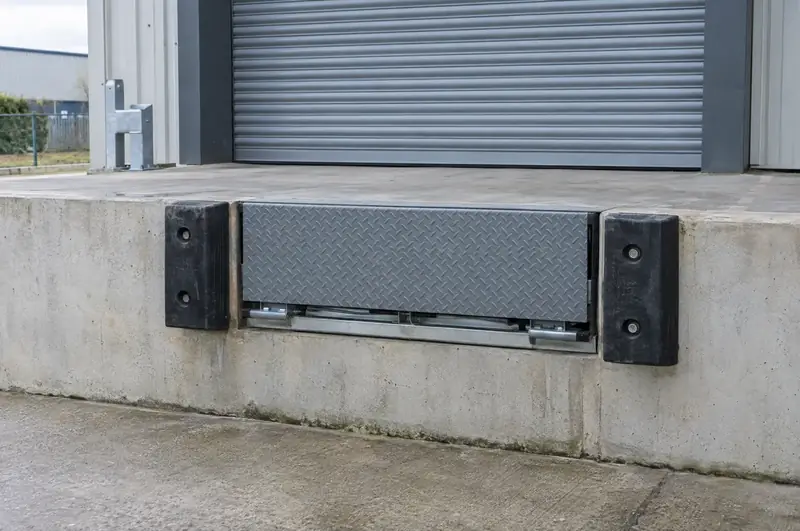
An edge-of-dock leveller is a compact leveller mounted on the front face or top edge of a loading dock, with no pit needed. A short hinged plate and lip bridge the gap between dock and trailer, but it can only cover a small height difference above and below dock level, so it suits sites where trailer bed heights are consistent.
What matters for edge-of-dock levellers in the East Riding of Yorkshire?
If trailer heights at a site in the East Riding of Yorkshire vary widely, our survey will tell you plainly whether an edge-of-dock leveller can cope or a pit leveller is needed. On older buildings in the East Riding of Yorkshire where drains or services run close to the dock, avoiding a pit can make an edge-of-dock leveller the sensible route.
Replacing loose bridge plates at a dock in the East Riding of Yorkshire with a fixed edge-of-dock leveller removes the need to lift and position heavy plates by hand.
Keeping the dock running is usually the first concern, so we plan around it. After a free survey of your the East Riding of Yorkshire site and a written quote at a fixed price, we agree when each bay can be released and whether any work should happen out of hours. Specialist installation engineers working under our management then fit the equipment, and we test it and hand over the documentation before the bay goes back into use.
How much height difference can an edge-of-dock leveller handle?
An edge-of-dock leveller can only handle a small height difference, typically in the region of 75 to 150 mm above and below dock level depending on the model. That is enough where trailers are consistent, but not where bed heights vary widely.
Typical UK docks are around 1,200 mm above yard level, while trailer bed heights can range from roughly 900 to 1,600 mm across rigid, curtain-sider, refrigerated, double-deck and container chassis. If your trailers sit outside the leveller's range, the plate becomes too steep to use safely.
- Good fit: dedicated fleets or regular suppliers with similar trailers.
- Poor fit: sites receiving everything from low rigids to high double-deck trailers.
Where trailer heights vary, a pit leveller such as a swing-lip dock leveller gives a much longer, gentler ramp. We record your trailer heights at survey to confirm which suits.
How is an edge-of-dock leveller fitted to an existing dock?
An edge-of-dock leveller is fixed to the front face or top edge of the dock from the yard side, and installation usually takes around half a day to a day per bay. No digging is involved.
- The dock face is inspected, and damaged concrete or worn edge steel is repaired or replaced first if needed.
- The leveller is positioned centrally on the door opening and bolted or welded in place.
- Bumpers are fitted or repositioned so trailers stop at the right distance from the plate.
- On hydraulic units, the power pack and controls are connected.
- The leveller is tested across its working range.
You will need to keep the yard approach to the bay clear, take the bay out of use and, for hydraulic units, provide a power supply near the door or ask us to include one. Because the work is outside, very wet or freezing weather can affect welding and fixing, so we keep the date flexible where we can.
Towns we cover in the East Riding of Yorkshire
Find your town in the list below for details of edge-of-dock levellers across the East Riding of Yorkshire, or contact us if your location is not shown.
Budget range for supply and fit. The written quote after a free survey is the fixed price. All guide prices.
Regulations and approvals in England
Sites in the East Riding of Yorkshire fall under the rules for England. Structural changes such as forming a new opening or a dock leveller pit may need Building Regulations approval, and external structures such as loading houses, canopies or new dock approaches can need planning permission from the local planning authority. We check what applies at survey and build any approvals into the plan.
Questions
What details do you need from us to quote for edge-of-dock levellers?
To get started, send the site address in the East Riding of Yorkshire, the number of bays or openings, approximate sizes, and photos of the dock from inside and outside. Tell us what vehicles you load, what goods you handle and any temperature requirements. Drawings help on new builds. We then arrange the free survey and confirm the details before the written quote is issued.
Is the site survey in the East Riding of Yorkshire free?
Yes. For new installations, replacements, upgrades, conversions and complete bays, the site survey and written quote are free and come with no obligation. The survey lets us measure the openings, check the dock and structure, and understand how the bay is used, so the quote reflects your site. Repair and servicing visits are different: they are chargeable, with the price agreed before anyone attends.
Can edge-of-dock levellers be used with vans?
Usually not. Edge-of-dock levellers are designed for trailers whose beds sit close to dock height, and many vans sit well below a typical dock, beyond the leveller's range. A lift table or a ground-level door is normally the better way to handle vans.
Is an edge-of-dock leveller better than a loose dock plate?
For regular use, usually yes. A fixed edge-of-dock leveller cannot slide out of position or be dropped, and it does not need carrying between bays. Loose plates still have a place for occasional use, but they bring handling and slipping risks that a fixed unit avoids.
Other services in the East Riding of Yorkshire
Full guide to edge-of-dock levellers · All loading bay services in the East Riding of Yorkshire