
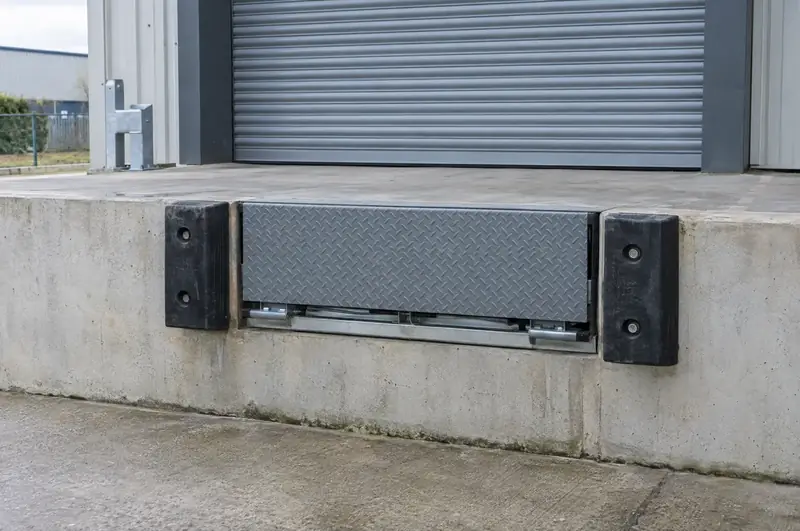
An edge-of-dock leveller is a compact leveller mounted on the front face or top edge of a loading dock, with no pit needed. A short hinged plate and lip bridge the gap between dock and trailer, but it can only cover a small height difference above and below dock level, so it suits sites where trailer bed heights are consistent.
What should sites in West Yorkshire consider?
On older buildings in West Yorkshire where drains or services run close to the dock, avoiding a pit can make an edge-of-dock leveller the sensible route. If trailer heights at a site in West Yorkshire vary widely, our survey will tell you plainly whether an edge-of-dock leveller can cope or a pit leveller is needed.
Exposed external docks in West Yorkshire call for a galvanised or well-painted edge-of-dock leveller that stands up to the weather all year round.
Keeping the dock running is usually the first concern, so we plan around it. After a free survey of your West Yorkshire site and a written quote at a fixed price, we agree when each bay can be released and whether any work should happen out of hours. Specialist installation engineers working under our management then fit the equipment, and we test it and hand over the documentation before the bay goes back into use.
Should I choose a mechanical or hydraulic edge-of-dock leveller?
Choose a mechanical edge-of-dock leveller for occasional use and simple sites, and a hydraulic one where the bay is busy or operators need push-button control. Both bridge a similar small height range.
- Mechanical: the operator pulls a lever or handle and the lip lifts and drops onto the bed with spring assistance. No power is needed and there is little to go wrong, but it takes some physical effort.
- Hydraulic: a push button raises the plate and extends the lip, then lowers it onto the trailer. It is easier and quicker for frequent use and can be interlocked with the dock door and traffic lights.
Other choices include plate width, which should suit the wheel track of your pallet trucks and forklifts, and capacity, which must cover the truck and its heaviest load. On exposed external docks, a galvanised or well-painted finish helps the unit cope with rain, frost and road salt.
How much height difference can an edge-of-dock leveller handle?
An edge-of-dock leveller can only handle a small height difference, typically in the region of 75 to 150 mm above and below dock level depending on the model. That is enough where trailers are consistent, but not where bed heights vary widely.
Typical UK docks are around 1,200 mm above yard level, while trailer bed heights can range from roughly 900 to 1,600 mm across rigid, curtain-sider, refrigerated, double-deck and container chassis. If your trailers sit outside the leveller's range, the plate becomes too steep to use safely.
- Good fit: dedicated fleets or regular suppliers with similar trailers.
- Poor fit: sites receiving everything from low rigids to high double-deck trailers.
Where trailer heights vary, a pit leveller such as a swing-lip dock leveller gives a much longer, gentler ramp. We record your trailer heights at survey to confirm which suits.
Towns we cover in West Yorkshire
We cover edge-of-dock levellers throughout West Yorkshire, and the towns below each have their own page. If yours is not listed, get in touch anyway.
- Leeds
- Bradford
- Huddersfield
- Wakefield
- Halifax
- Dewsbury
- Morley
- Keighley
- Castleford
- Pontefract
- Batley
- Yeadon
- Brighouse
- Shipley
- Cleckheaton
- Pudsey
- Ossett
- Guiseley
- Liversedge
- Horsforth
- South Elmsall
- Normanton
Budget range for supply and fit. The written quote after a free survey is the fixed price. All guide prices.
Regulations and approvals in England
Powered doors and dock equipment installed in England may carry the UKCA or the CE mark, and doors are covered by the product standard BS EN 13241. We hand over the relevant documentation for each item fitted in West Yorkshire. Planning and Building Regulations questions are never assumed either way: we check what applies at survey, so you know before work is booked.
Questions
Will you deal with building control and planning for a project in West Yorkshire?
We check at survey whether the work is likely to need approval. Forming a new opening or dock pit may need Building Regulations approval, a building warrant or building control approval, depending on the nation, and external structures such as loading houses can need planning permission. Where approval is needed, we explain what is involved, work with your designer or agent, and build it into the programme.
Can you work outside our normal operating hours in West Yorkshire?
Yes, by arrangement. Evening, night and weekend working can be planned so the installation causes as little disruption as possible to your loading schedule. Out-of-hours work can affect the price, so mention it at the survey and we will include it in the written quote. The agreed times are confirmed in the programme before the job starts.
How long does an edge-of-dock leveller take to install?
Usually half a day to a day per bay, as there is no pit to form. Concrete or edge steel repairs add time, and hydraulic units also need connecting to power. We plan the work so the rest of the dock keeps operating while each bay is fitted.
Can edge-of-dock levellers be used with vans?
Usually not. Edge-of-dock levellers are designed for trailers whose beds sit close to dock height, and many vans sit well below a typical dock, beyond the leveller's range. A lift table or a ground-level door is normally the better way to handle vans.
Other services in West Yorkshire
Full guide to edge-of-dock levellers · All loading bay services in West Yorkshire