
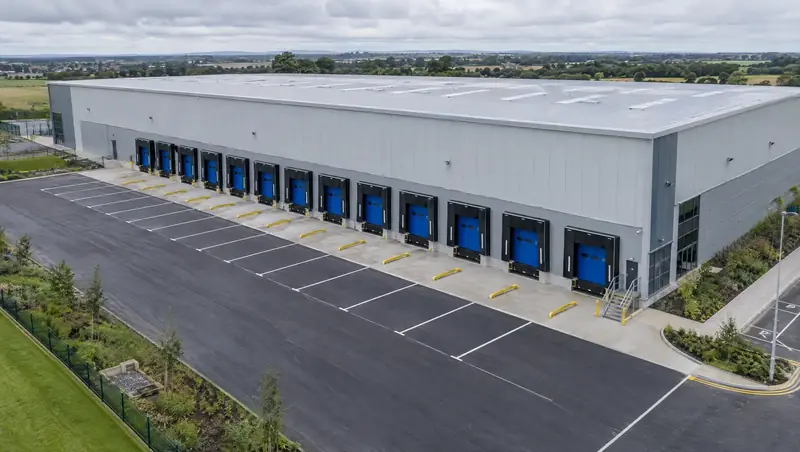
A complete loading bay installation is the supply and fitting of every item a dock needs as one coordinated package: typically an insulated door, a dock leveller, a shelter or seal, bumpers, wheel guides, a dock light and traffic lights or interlocks. One party manages the design, sequence and commissioning, so the parts fit together and work as a single system.
How does this suit sites in Cornwall?
Ageing bays in Cornwall where the door, leveller and shelter are all worn can be replaced together, avoiding three separate disruptions to the same dock. Occupiers taking on a shell unit in Cornwall often need every bay fitted out at once, and a single programme keeps the handover date predictable.
Third-party logistics providers in Cornwall taking on a new contract may need bays reconfigured quickly, and one coordinated package keeps the programme manageable.
We do not give a fixed price without seeing the site. A free survey in Cornwall lets us check the details that affect the job, and the written quote that follows is a fixed price for the agreed scope. We plan the work around your operation, arrange out-of-hours access if you need it and manage specialist installation engineers throughout. Handover includes testing, a demonstration and the paperwork you need for your records.
How is a complete bay coordinated with civils and electrics?
A complete bay is coordinated by issuing pit, dock face and electrical details early, so the groundworker, main contractor and electrician build exactly what the equipment needs. Most problems on new docks come from mismatches between trades, not from the equipment itself.
- Drawings: we provide pit dimensions, steel edge details, drainage points and dock face levels for each bay.
- Civils: the groundworker forms the pits, approach and dock face to those drawings, or the leveller is set in place for concrete to be poured around it.
- Building envelope: the main contractor forms the openings and cladding to suit the door and shelter sizes.
- Electrics: the electrician brings a supply to the agreed control panel position at each bay.
- Equipment: leveller, door, shelter and safety items are fitted in sequence, then commissioned together.
The quote states clearly which items are ours and which belong to other trades. See our guide to loading bay design for dock heights, widths and approaches.
How do you choose the right equipment for each bay?
The right equipment for each bay comes from three questions: what vehicles arrive, what goods move through the door, and how many trailers the bay handles each day. The answers drive each choice:
- Vehicles: trailer bed heights commonly range from about 900 to 1,600 mm, which sets leveller length. Trailers that cannot reverse tight to the dock, or need end-loading, suit a telescopic lip.
- Goods: chilled and frozen goods need a well-insulated door and a tight seal or inflatable shelter; ambient goods usually suit a retractable shelter.
- Traffic: very busy bays may justify faster doors and heavier-duty levellers, plus restraints and interlocks.
- Building: a pit leveller, an edge-of-dock leveller or a loading house, depending on floor height and space.
Not every bay on a site needs the same kit. One bay with a lift table or a telescopic lip can handle the awkward vehicles. Our guide to specifying the dock package for a new warehouse walks through the decisions.
Towns we cover in Cornwall
Looking for complete loading bay installations in a specific part of Cornwall? Start with the nearest town on this list.
Budget range for supply and fit. The written quote after a free survey is the fixed price. All guide prices.
What do the rules in England mean for the work?
Sites in Cornwall fall under the rules for England. Structural changes such as forming a new opening or a dock leveller pit may need Building Regulations approval, and external structures such as loading houses, canopies or new dock approaches can need planning permission from the local planning authority. We check what applies at survey and build any approvals into the plan.
Questions
How long does installation take at a site in Cornwall?
It depends on the equipment, the number of bays, the condition of the dock and whether any building or electrical work is needed. We agree a programme with you after the survey, setting out which bays are out of use and when. Larger jobs are usually phased so that part of the dock stays open, and out-of-hours working can be arranged.
Will you deal with building control and planning for a project in Cornwall?
We check at survey whether the work is likely to need approval. Forming a new opening or dock pit may need Building Regulations approval, a building warrant or building control approval, depending on the nation, and external structures such as loading houses can need planning permission. Where approval is needed, we explain what is involved, work with your designer or agent, and build it into the programme.
Do you work with main contractors on new builds?
Yes. On new warehouses we work as the specialist dock package contractor to the main contractor's programme. We provide pit, dock face and electrical details early so the groundworks and building envelope are built to suit the equipment, then install and commission each bay.
Who forms the leveller pit?
The leveller pit is usually formed by the groundworker or main contractor to our drawings. Where there is no groundworker on site, we can arrange the pit works as part of the project, priced separately after survey. Either way, the pit details come from the leveller chosen for the bay.
Other services in Cornwall
Full guide to complete loading bay installations · All loading bay services in Cornwall