
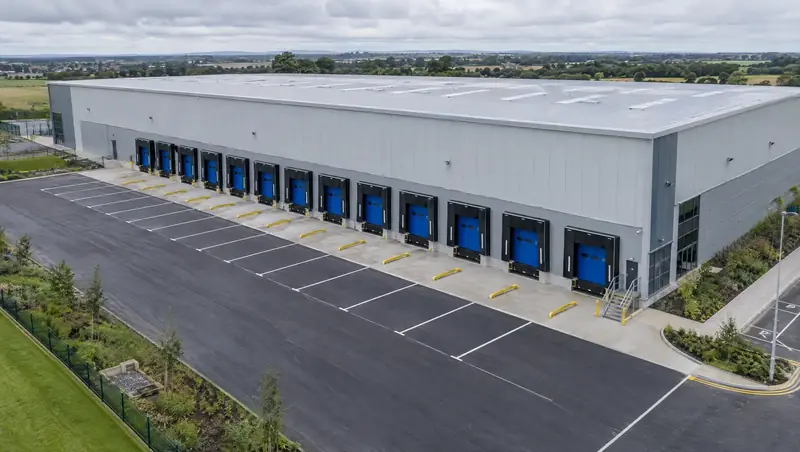
A complete loading bay installation is the supply and fitting of every item a dock needs as one coordinated package: typically an insulated door, a dock leveller, a shelter or seal, bumpers, wheel guides, a dock light and traffic lights or interlocks. One party manages the design, sequence and commissioning, so the parts fit together and work as a single system.
Where does this fit at a dock in Fife?
Every complete bay enquiry in Fife starts with a site survey and a written quote that sets out exactly what is included and what is priced separately. Ageing bays in Fife where the door, leveller and shelter are all worn can be replaced together, avoiding three separate disruptions to the same dock.
Developers building new distribution sheds in Fife can hand the whole dock package to one specialist, reducing the risk of gaps between the door, leveller and shelter trades.
Your loading bay stays our responsibility from the survey to the handover. In Fife, the survey and written quote are free, and the quoted price is fixed for the agreed scope. Installation is carried out by specialist engineers working under our management, at times planned with you to protect your loading schedule. Out-of-hours work is available by arrangement. We finish by testing the equipment and handing over its documentation.
What happens on site during a complete bay installation?
On a new build, a complete bay is installed to the main contractor's programme once the pits, openings and supplies are ready. In an operating warehouse, bays are replaced one at a time so the rest of the dock keeps working.
- Isolation: each bay is closed to trailers and its old equipment isolated and removed.
- Security: the opening is kept secure, either by fitting the new door early or with temporary hoarding.
- Lifting and deliveries: levellers and door sections need a clear delivery area and safe lifting.
- Commissioning: the door, leveller, shelter and controls are tested together, including any interlocks.
We ask you to provide access and a delivery area, power and welfare arrangements on construction sites, permit-to-work and induction details, and an agreed order for releasing bays. At handover you receive commissioning and test records, operating instructions and maintenance requirements. Equipment comes with the manufacturer's warranty, and workmanship terms are set out in writing in the quote.
What regulations and standards apply to a new loading bay?
A new loading bay has to meet door safety law, work equipment law and, for the door, energy rules. The main references are:
- Doors: regulation 18 of the Workplace (Health, Safety and Welfare) Regulations 1992 (Northern Ireland: the 1993 equivalent). Upward-opening doors need a device to stop them falling back, and powered doors need features to prevent trapping. Doors are made to BS EN 13241, with powered door safety covered by BS EN 12453.
- Levellers: BS EN 1398:2009, the dock leveller safety standard.
- All dock equipment: PUWER 1998, or PUWER (Northern Ireland) 1999, requiring suitable, maintained and inspected work equipment.
- Drive-away: HSE guidance (HSG136) says there should be safeguards against early drive-away, such as traffic lights, restraints or key control.
- Energy: in England, Approved Document L (2021) Volume 2 sets a limiting U-value of 1.3 W/m²K for vehicle access doors. Other nations have their own rules, and we confirm the figure for your project.
Equipment in Great Britain may carry UKCA or CE marking; in Northern Ireland, CE or CE with UKNI.
Towns we cover in Fife
We provide complete loading bay installations right across Fife. Pick the town closest to your site from the list below.
Budget range for supply and fit. The written quote after a free survey is the fixed price. All guide prices.
Which rules apply in Scotland?
In Scotland, building work such as forming a new opening or a dock leveller pit may need a building warrant from the local authority before it starts. For sites in Fife, external structures such as loading houses or canopies may also need planning permission from the council. We check what applies at survey and factor any approvals into the programme.
Questions
Will you deal with building control and planning for a project in Fife?
We check at survey whether the work is likely to need approval. Forming a new opening or dock pit may need Building Regulations approval, a building warrant or building control approval, depending on the nation, and external structures such as loading houses can need planning permission. Where approval is needed, we explain what is involved, work with your designer or agent, and build it into the programme.
Do you remove and dispose of the old equipment?
Yes, where it is part of the scope. When we replace doors, levellers, shelters or seals at a site in Fife, removal and disposal of the old equipment can be included and is itemised in the quote, so it is clear what is covered. If anything should be kept, such as a frame or motor that is still serviceable, we agree that at survey.
Who forms the leveller pit?
The leveller pit is usually formed by the groundworker or main contractor to our drawings. Where there is no groundworker on site, we can arrange the pit works as part of the project, priced separately after survey. Either way, the pit details come from the leveller chosen for the bay.
What is included in a complete loading bay package?
A complete loading bay package typically includes the door, leveller, shelter or seal, bumpers, wheel guides and a dock light. Vehicle restraints, traffic lights and interlocks can be added. Pits, concrete and groundworks are priced separately unless agreed otherwise, and the quote lists exactly what is included.
Other services in Fife
Full guide to complete loading bay installations · All loading bay services in Fife