
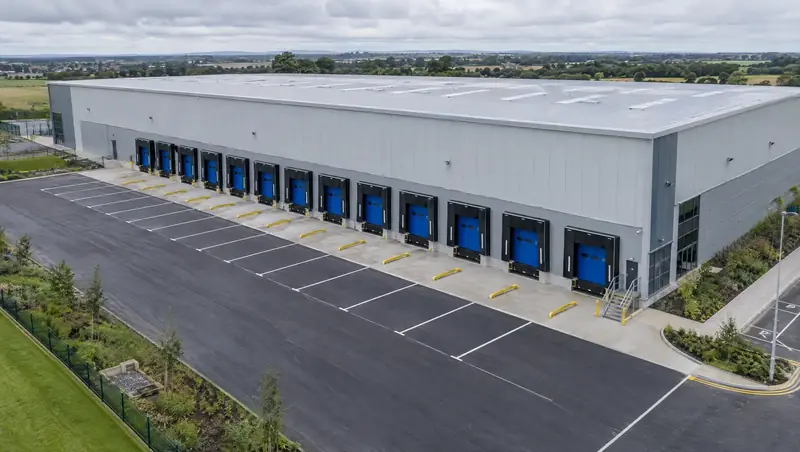
A complete loading bay installation is the supply and fitting of every item a dock needs as one coordinated package: typically an insulated door, a dock leveller, a shelter or seal, bumpers, wheel guides, a dock light and traffic lights or interlocks. One party manages the design, sequence and commissioning, so the parts fit together and work as a single system.
What matters for complete loading bay installations in Dyfed?
Main contractors working on warehouse schemes around Dyfed need pit drawings and embed details early, which a complete bay package provides at design stage. Ageing bays in Dyfed where the door, leveller and shelter are all worn can be replaced together, avoiding three separate disruptions to the same dock.
Developers building new distribution sheds in Dyfed can hand the whole dock package to one specialist, reducing the risk of gaps between the door, leveller and shelter trades.
How does an installation in Dyfed work? First, a free, no-obligation survey to measure up and understand the operation. Next, a fixed written quote. Then a programme agreed with you, so the work fits around deliveries, with out-of-hours slots if needed. The installation itself is carried out by specialist engineers who answer to us, and it finishes with testing, a walk-through for your staff and a handover pack.
What regulations and standards apply to a new loading bay?
A new loading bay has to meet door safety law, work equipment law and, for the door, energy rules. The main references are:
- Doors: regulation 18 of the Workplace (Health, Safety and Welfare) Regulations 1992 (Northern Ireland: the 1993 equivalent). Upward-opening doors need a device to stop them falling back, and powered doors need features to prevent trapping. Doors are made to BS EN 13241, with powered door safety covered by BS EN 12453.
- Levellers: BS EN 1398:2009, the dock leveller safety standard.
- All dock equipment: PUWER 1998, or PUWER (Northern Ireland) 1999, requiring suitable, maintained and inspected work equipment.
- Drive-away: HSE guidance (HSG136) says there should be safeguards against early drive-away, such as traffic lights, restraints or key control.
- Energy: in England, Approved Document L (2021) Volume 2 sets a limiting U-value of 1.3 W/m²K for vehicle access doors. Other nations have their own rules, and we confirm the figure for your project.
Equipment in Great Britain may carry UKCA or CE marking; in Northern Ireland, CE or CE with UKNI.
How do you choose the right equipment for each bay?
The right equipment for each bay comes from three questions: what vehicles arrive, what goods move through the door, and how many trailers the bay handles each day. The answers drive each choice:
- Vehicles: trailer bed heights commonly range from about 900 to 1,600 mm, which sets leveller length. Trailers that cannot reverse tight to the dock, or need end-loading, suit a telescopic lip.
- Goods: chilled and frozen goods need a well-insulated door and a tight seal or inflatable shelter; ambient goods usually suit a retractable shelter.
- Traffic: very busy bays may justify faster doors and heavier-duty levellers, plus restraints and interlocks.
- Building: a pit leveller, an edge-of-dock leveller or a loading house, depending on floor height and space.
Not every bay on a site needs the same kit. One bay with a lift table or a telescopic lip can handle the awkward vehicles. Our guide to specifying the dock package for a new warehouse walks through the decisions.
Towns we cover in Dyfed
Looking for complete loading bay installations in a specific part of Dyfed? Start with the nearest town on this list.
Budget range for supply and fit. The written quote after a free survey is the fixed price. All guide prices.
Planning, building control and safety law in Wales
Wales has its own energy requirements for buildings, set out in Approved Document L for Wales. For new or replacement loading bay doors in Dyfed, we confirm the figure that applies to your project rather than assuming the English one, and we check what applies at survey before a door is specified.
Questions
Do you remove and dispose of the old equipment?
Yes, where it is part of the scope. When we replace doors, levellers, shelters or seals at a site in Dyfed, removal and disposal of the old equipment can be included and is itemised in the quote, so it is clear what is covered. If anything should be kept, such as a frame or motor that is still serviceable, we agree that at survey.
Do you cover Dyfed for complete loading bay installations?
Yes. We take on complete loading bay installations for businesses in Dyfed and across Dyfed. We survey the site, provide a fixed written quote and manage the installation, with specialist installation engineers working under our management. Visits are arranged in advance at a time that suits your operation, and the same single contact stays with the job through to handover.
Who forms the leveller pit?
The leveller pit is usually formed by the groundworker or main contractor to our drawings. Where there is no groundworker on site, we can arrange the pit works as part of the project, priced separately after survey. Either way, the pit details come from the leveller chosen for the bay.
Do you work with main contractors on new builds?
Yes. On new warehouses we work as the specialist dock package contractor to the main contractor's programme. We provide pit, dock face and electrical details early so the groundworks and building envelope are built to suit the equipment, then install and commission each bay.
Other services in Dyfed
Full guide to complete loading bay installations · All loading bay services in Dyfed