
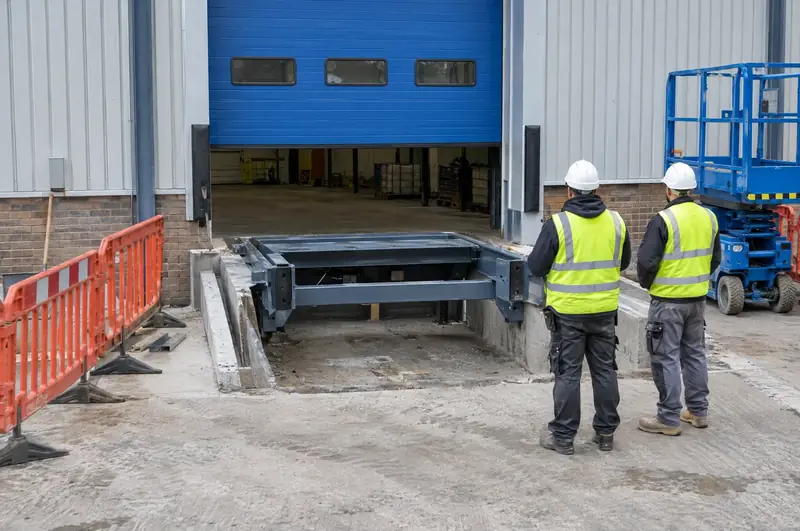
A loading bay conversion is a project that changes how a loading opening works, most often turning a ground-level door into a dock by lowering the approach, forming a leveller pit or adding a dock lift. It also covers upgrading older bays with new levellers, insulated doors, shelters and safety equipment while reusing the structure that is still sound.
What matters for loading bay conversions in Lancashire?
Landlords in Lancashire upgrading vacant units to attract logistics tenants can add docks or modernise tired bays as part of wider refurbishment works. A unit in Lancashire with enough yard depth may suit a recessed approach, while tighter plots usually point towards a dock lift or loading house.
Ground conditions, drainage and buried services vary from site to site in Lancashire, which is why every conversion starts with a levels survey before any design.
If you are planning loading bay conversions for a site in Lancashire, expect four stages. A free survey and fixed written quote come first. We then agree a programme with you, including any out-of-hours work. Specialist installation engineers carry out the installation under our management, with us as your single point of contact. Finally, the equipment is tested, your staff are shown how it works and everything is handed over with its documentation.
What does a loading bay conversion involve, step by step?
A loading bay conversion runs from a levels survey through design and approvals to civils, equipment and commissioning. A typical recessed-dock conversion follows this order:
- Levels survey: floor, yard and drainage levels, plus buried services.
- Design: approach gradient, pit and dock face details, drainage and equipment layout.
- Approvals: building control and any planning application.
- Civils: breaking out, excavation, retaining walls, drainage, pit and new concrete.
- Opening works: adjusting the opening and making good the cladding or masonry.
- Equipment: leveller, door, shelter or seal, bumpers and wheel guides.
- Electrics and controls: supplies, panels, lights and any interlocks.
- Commissioning: testing with a trailer and handover.
Upgrade-only projects skip most of the civils, which is why they cost less and finish sooner. All work is carried out by specialist groundworks, installation and electrical teams working under our management.
How much does a loading bay conversion cost?
A loading bay conversion typically costs £18,000 to £45,000 per bay, excluding VAT. Upgrades that reuse a sound pit and opening sit towards the lower end; full conversions with excavation, retaining walls and drainage sit towards the top.
What moves the price:
- Method: recessed approach, new internal pit, dock lift or bay upgrade.
- Ground and drainage: excavation depth, ground conditions, buried services and drainage at the foot of any ramp.
- Structure: widening or raising the opening, new lintels or steelwork, and making good cladding or masonry.
- Equipment: door, leveller, shelter and safety specification.
- Phasing: keeping a live dock running, and any out-of-hours working.
Unusual groundworks, such as diverting drains or major structural steel, are priced separately after survey. Following a free site survey, the written quote is the fixed price. VAT is added at the standard rate.
Towns we cover in Lancashire
Looking for loading bay conversions in a specific part of Lancashire? Start with the nearest town on this list.
- Preston
- Burnley
- Blackburn
- Blackpool
- Morecambe
- Lancaster
- Lytham St Annes
- Skelmersdale
- Leyland
- Accrington
- Chorley
- Darwen
- Thornton-Cleveleys
- Nelson
- Fleetwood
- Ormskirk
- Rawtenstall
- Colne
- Poulton-le-Fylde
- Heysham
- Haslingden
Budget range for supply and fit. The written quote after a free survey is the fixed price. All guide prices.
What do the rules in England mean for the work?
In England, Approved Document L (2021) sets a limiting U-value of 1.3 W/m²K for vehicle access and similar large doors in new and replacement work. That shapes door specification for sites in Lancashire, so we confirm the requirement for your project and check what applies at survey before recommending a door.
Questions
Can you work alongside our main contractor on a new build in Lancashire?
Yes. For new warehouses and fit-outs, we can supply and install the dock package as part of a wider project, working to the main contractor's programme, site rules and permits. We will need drawings, dock levels and the programme, and we coordinate pit details, power supplies and door openings with the relevant trades before installation begins.
What warranty comes with new loading bay equipment?
New equipment comes with the manufacturer's warranty, which varies by product. Our workmanship terms are set out in writing in the quote for your Lancashire site, so you can see what is covered before you commit. Check the warranty terms for any servicing conditions, and we can quote for planned maintenance once the installation is complete.
Is a recessed dock or a dock lift better?
A recessed dock is usually better for high trailer volumes, because forklifts drive straight on and off. A dock lift suits tight sites, mixed fleets and lower volumes, and avoids excavating the yard. The survey looks at space, levels, drainage and traffic before recommending one.
Can we keep working during a conversion?
Yes, in most cases. Conversions are phased bay by bay so the rest of the dock keeps running, and temporary loading is agreed before any bay is taken out of use. Openings are kept secure throughout, and noisy or disruptive work can be timed around your busiest periods.
Other services in Lancashire
Full guide to loading bay conversions · All loading bay services in Lancashire