
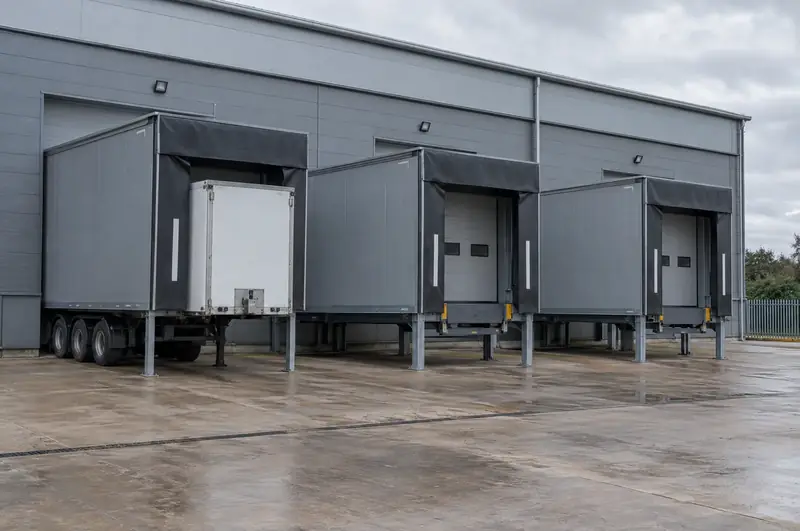
A loading house is an insulated steel structure built against the outside wall of a building, containing a dock leveller and usually a shelter or seal at its front. The building door closes at the wall line, while trailers dock against the house. Loading houses suit buildings whose floor is at dock height but which have no room inside for a leveller pit.
Is this right for your site in Lincolnshire?
Units in Lincolnshire with floors at dock height but no room for an internal leveller pit are typical candidates for an external loading house. For older buildings in Lincolnshire with a raised floor and little internal space by the wall, an external house can provide a modern hydraulic dock without major alterations.
Developers bringing forward industrial units in Lincolnshire can specify loading houses at design stage, keeping the internal slab clear for whichever tenant takes the unit.
We keep the process simple for sites in Lincolnshire. A free survey tells us what the dock needs; a fixed written quote tells you what it will cost and what is included. We then organise the installation, with specialist engineers under our management and a programme agreed around your shifts. Night and weekend work is available by arrangement. Before we leave, the new equipment is tested, demonstrated and handed over with its documentation.
What happens on site when a loading house is installed?
Installing a loading house takes the bay out of use from the foundation works to commissioning, but the building can stay secure because the existing wall and door remain until late in the job.
- Foundations: concrete pads or footings are formed in the yard and left to cure.
- Erection: the steel frame is lifted into place, usually by crane, and fixed to the foundations and building.
- Cladding and equipment: panels, leveller, shelter or seal, bumpers and lights are fitted.
- Door and electrics: the building door is fitted or adapted and the leveller and lights connected.
- Commissioning: everything is tested with a trailer before handover.
We ask you to provide yard space for the crane and deliveries, any drawings of drains or buried services, a power supply, and clear arrangements for keeping vehicles and people away from the lifting zone. Neighbouring bays may need to close briefly while the crane is working.
When is a loading house better than an internal dock?
A loading house is usually the better option when the building floor is already at dock height but there is no practical way to form a leveller pit inside. It moves the whole dock outside the wall, leaving the internal floor clear.
- No room inside: racking, production lines or mezzanines sit right up to the wall.
- Difficult slab: the floor slab carries services or is unsuited to breaking out for a pit.
- Thermal control: the building door closes at the wall line, so the leveller sits outside the heated or chilled space when no trailer is docked.
- Security: the building can be closed at the wall line while the house itself stays open to the yard.
- Narrow yards: an angled house lets trailers approach on a diagonal and can fit more bays along one wall.
Where the building floor is at yard level, a loading house alone will not solve the height difference, and a recessed approach or lift table is usually needed instead.
Towns we cover in Lincolnshire
We cover loading houses throughout Lincolnshire, and the towns below each have their own page. If yours is not listed, get in touch anyway.
- Lincoln
- Grimsby
- Scunthorpe
- Boston
- Grantham
- Cleethorpes
- Spalding
- Skegness
- Stamford
- Gainsborough
- Louth
- Sleaford
- Immingham
Budget range for supply and fit. The written quote after a free survey is the fixed price. All guide prices.
What do the rules in England mean for the work?
Lift tables and dock lifts in Lincolnshire may fall under LOLER, with thorough examination at least every 12 months, or every 6 months where people are lifted. It depends on the equipment and how it is used, and your insurer or competent person will confirm. Dock levellers are usually treated as work equipment under PUWER. We check what applies at survey.
Questions
How do you price loading houses for a site in Lincolnshire?
Guide budgets for supply and fit are £14,500 to £32,000 per house, excluding VAT. The figure moves with size, insulation, the operator, electrics, access, any pit or groundworks and out-of-hours working. Where levellers are involved, the guide assumes an existing, sound pit. After the free survey you receive a fixed written quote, and that is the price for the agreed scope.
Is the site survey in Lincolnshire free?
Yes. For new installations, replacements, upgrades, conversions and complete bays, the site survey and written quote are free and come with no obligation. The survey lets us measure the openings, check the dock and structure, and understand how the bay is used, so the quote reflects your site. Repair and servicing visits are different: they are chargeable, with the price agreed before anyone attends.
What door is used with a loading house?
The building wall behind a loading house usually has an insulated sectional door, which closes the building at the wall line when no trailer is docked. An existing door can sometimes be kept if it is in good condition. In England, replacement doors need to meet the Approved Document L limiting U-value for large doors.
Can a loading house be used for a cold store?
Yes. Loading houses suit chilled and frozen operations because the building door closes at the wall line, keeping the cold space sealed when no trailer is docked. The panels, door and shelter or seal are specified to suit the temperatures involved, which we confirm at survey.
Other services in Lincolnshire
Full guide to loading houses · All loading bay services in Lincolnshire