
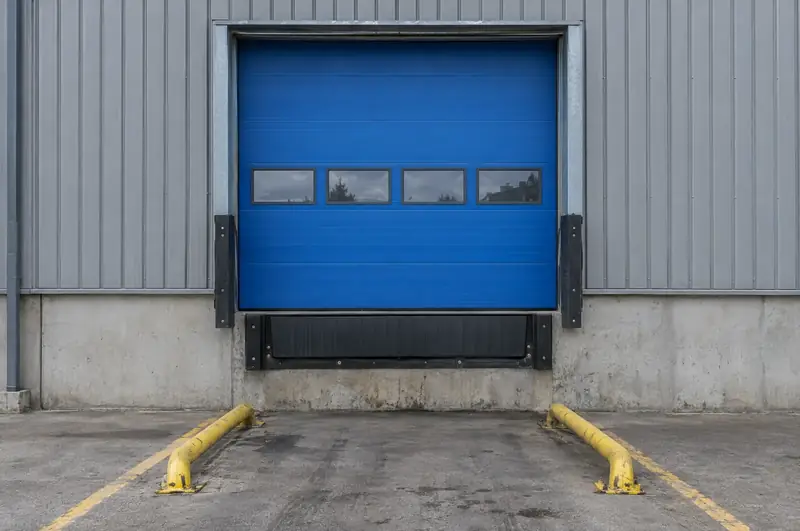
A sectional loading bay door is an overhead door made from horizontal insulated steel panels hinged together, which run up on rollers in side tracks and park beneath the ceiling or up the wall when open. Panels are commonly 40 to 80 mm thick, so the door seals and insulates better than a single-skin shutter, and it can be operated by hand chain, push-up or electric motor.
How does this suit sites in Lincolnshire?
Warehouses across Lincolnshire that still rely on single-skin shutters may switch to insulated sectional doors when heating costs or cold goods-in areas become a problem. Landlords preparing an industrial unit in Lincolnshire for a new tenant may choose to replace tired dock doors so the building is ready to trade from day one.
For distribution sites in Lincolnshire with heavy daily trailer traffic, an electric sectional door with photocells keeps the bay moving without staff hauling on a chain.
Here is what happens after you contact us about a site in Lincolnshire. We arrange a free survey, measure up and send a fixed written quote. If you go ahead, we manage the whole job, including ordering, delivery and coordination with your site team. Specialist installation engineers working under our management do the fitting, at times built around your loading schedule, with out-of-hours work by arrangement. Testing and handover documents close the job.
How long does a sectional loading bay door last and what wears out?
A sectional dock door can give many years of service, but its working life depends far more on how often it cycles and how often it is hit than on age. The parts that wear are predictable, so planned servicing catches most problems before the door stops.
- Torsion springs: rated for a set number of cycles, so a busy bay uses them up faster than a quiet one.
- Bottom and side seals: crushed by trailers and forklifts, and worth replacing as soon as they split.
- Rollers, hinges and cables: need lubrication and adjustment as the door beds in.
- Bottom panel: the panel most often struck by forklifts; individual panels can usually be replaced.
Bollards or guides inside the opening reduce impact damage. When a door is dented across several panels, the springs are near the end of their cycles and the operator is unreliable, replacement often makes more sense than another repair.
What happens on site when a sectional dock door is installed?
Fitting a sectional dock door often takes around a day per opening once the door is on site, though very large doors or awkward fixings take longer. The bay is out of use while the work is under way.
A typical installation runs like this:
- The old door, if there is one, is taken down and removed from site.
- Steel angles or packers are fixed to the opening so the tracks run true.
- Tracks, springs and panels are assembled and the door is balanced.
- The operator, safety edge, photocells and controls are fitted and wired.
- The door is tested, adjusted and handed over.
Before we arrive you will need a clear area inside the opening for access equipment and the bay taken out of service. Electric doors also need a suitable isolated power supply near the door head, single or three-phase depending on the operator, which we confirm in the quote. On multi-door sites we work bay by bay so the rest of the dock keeps running.
Towns we cover in Lincolnshire
Below is a list of towns in Lincolnshire for sectional loading bay doors. Each page explains our approach for sites in that town.
- Lincoln
- Grimsby
- Scunthorpe
- Boston
- Grantham
- Cleethorpes
- Spalding
- Skegness
- Stamford
- Gainsborough
- Louth
- Sleaford
- Immingham
Budget range for supply and fit. The written quote after a free survey is the fixed price. All guide prices.
What do the rules in England mean for the work?
Powered doors and dock equipment installed in England may carry the UKCA or the CE mark, and doors are covered by the product standard BS EN 13241. We hand over the relevant documentation for each item fitted in Lincolnshire. Planning and Building Regulations questions are never assumed either way: we check what applies at survey, so you know before work is booked.
Questions
Can you work outside our normal operating hours in Lincolnshire?
Yes, by arrangement. Evening, night and weekend working can be planned so the installation causes as little disruption as possible to your loading schedule. Out-of-hours work can affect the price, so mention it at the survey and we will include it in the written quote. The agreed times are confirmed in the programme before the job starts.
Is the site survey in Lincolnshire free?
Yes. For new installations, replacements, upgrades, conversions and complete bays, the site survey and written quote are free and come with no obligation. The survey lets us measure the openings, check the dock and structure, and understand how the bay is used, so the quote reflects your site. Repair and servicing visits are different: they are chargeable, with the price agreed before anyone attends.
Can a manual sectional door be motorised later?
Often yes, if the door is sound and correctly balanced. An operator is fitted to the spring shaft or a trolley drive is fixed to the ceiling, and the door gets a safety edge and photocells at the same time. We check spring condition and balance first, because a motor should never be used to make up for a badly balanced door.
What panel thickness should we choose for a heated warehouse?
For most heated warehouses a panel at the thicker end of the common 40 to 80 mm range is the sensible starting point, because it insulates better. Thinner panels can suit unheated stores. New and replacement doors also need to meet the energy rules for your nation, which we check when specifying.
Other services in Lincolnshire
Full guide to sectional loading bay doors · All loading bay services in Lincolnshire