
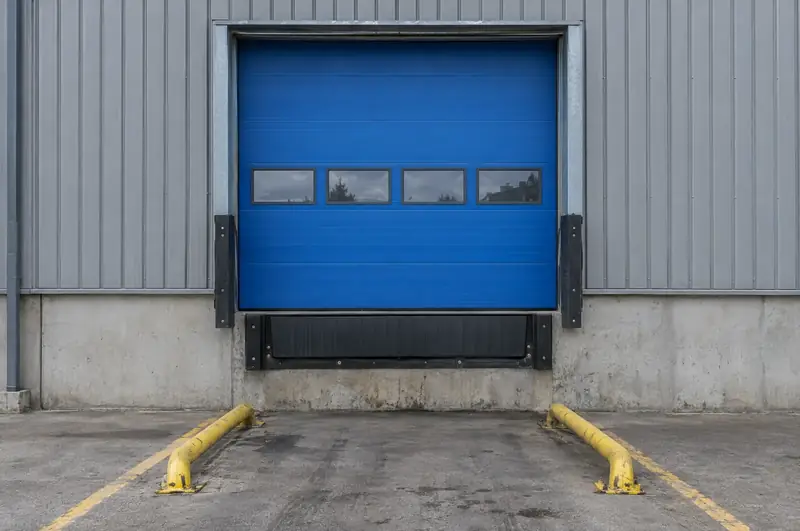
A sectional loading bay door is an overhead door made from horizontal insulated steel panels hinged together, which run up on rollers in side tracks and park beneath the ceiling or up the wall when open. Panels are commonly 40 to 80 mm thick, so the door seals and insulates better than a single-skin shutter, and it can be operated by hand chain, push-up or electric motor.
Why do sites in Cambridgeshire choose this?
Landlords preparing an industrial unit in Cambridgeshire for a new tenant may choose to replace tired dock doors so the building is ready to trade from day one. Ageing units around Cambridgeshire sometimes have low lintels or pipework above the opening, which a low-headroom or high-lift track can be chosen to work around.
If you are fitting out a new warehouse in Cambridgeshire, specifying insulated sectional doors from the start avoids disruptive changes once the building is occupied.
Step one is a survey at your site in Cambridgeshire, which costs nothing and carries no obligation. Step two is a written quote with a fixed price and a clear scope. Step three is installation, scheduled around your operation and carried out by specialist installation engineers working under our management, including evenings or weekends if agreed. Step four is handover, when the equipment is tested in front of you and the paperwork is passed over.
How long does a sectional loading bay door last and what wears out?
A sectional dock door can give many years of service, but its working life depends far more on how often it cycles and how often it is hit than on age. The parts that wear are predictable, so planned servicing catches most problems before the door stops.
- Torsion springs: rated for a set number of cycles, so a busy bay uses them up faster than a quiet one.
- Bottom and side seals: crushed by trailers and forklifts, and worth replacing as soon as they split.
- Rollers, hinges and cables: need lubrication and adjustment as the door beds in.
- Bottom panel: the panel most often struck by forklifts; individual panels can usually be replaced.
Bollards or guides inside the opening reduce impact damage. When a door is dented across several panels, the springs are near the end of their cycles and the operator is unreliable, replacement often makes more sense than another repair.
Do sectional loading bay doors have to meet energy and safety rules?
Yes. New and replacement sectional loading bay doors fall under building energy rules and workplace safety law, and the detail differs between the four nations.
- Energy: in England, Approved Document L (2021) Volume 2 sets a limiting U-value of 1.3 W/m²K for vehicle access and similar large doors in new and replacement work. Wales, Scotland and Northern Ireland each have their own energy rules, and we confirm the figure that applies to your nation and project.
- Falling back: the Workplace (Health, Safety and Welfare) Regulations 1992 in Great Britain, and the Workplace (Health, Safety and Welfare) Regulations (Northern Ireland) 1993, require upward-opening doors to have a device that stops them falling back. On a sectional door that usually means spring break and cable break protection.
- Product standard: BS EN 13241 is the product standard for industrial doors, and powered doors are also assessed against BS EN 12453 for safety in use.
- Marking: a powered door in Great Britain may be UKCA or CE marked, while in Northern Ireland it is the CE mark, or CE with UKNI, that applies.
Towns we cover in Cambridgeshire
Choose a town below to see how we handle sectional loading bay doors in that part of Cambridgeshire.
Budget range for supply and fit. The written quote after a free survey is the fixed price. All guide prices.
Planning, building control and safety law in England
Powered doors and dock equipment installed in England may carry the UKCA or the CE mark, and doors are covered by the product standard BS EN 13241. We hand over the relevant documentation for each item fitted in Cambridgeshire. Planning and Building Regulations questions are never assumed either way: we check what applies at survey, so you know before work is booked.
Questions
Can you work alongside our main contractor on a new build in Cambridgeshire?
Yes. For new warehouses and fit-outs, we can supply and install the dock package as part of a wider project, working to the main contractor's programme, site rules and permits. We will need drawings, dock levels and the programme, and we coordinate pit details, power supplies and door openings with the relevant trades before installation begins.
Which building and safety rules apply to a site in Cambridgeshire?
It depends on which UK nation the site is in. England and Wales use Building Regulations approval, Scotland uses building warrants and Northern Ireland uses building control approval from the council. Workplace safety is regulated by HSE in Great Britain and HSENI in Northern Ireland, and energy rules differ between nations. For your site in Cambridgeshire, we check what applies at survey and design to it.
Can a sectional dock door be made to fit our existing opening?
Yes, sectional doors are made to measure, so they can be fitted to most existing dock openings. We measure the structural opening, headroom and side room at survey and choose a track to suit. Uneven reveals or a low lintel can usually be dealt with using packers, steel angles or a low-headroom track rather than building work.
Will the bay be out of action for long?
Usually only on installation day. The door is made to order before we book the fitting, so the old door stays in use until the new one is ready to go in. On sites with several bays we fit one opening at a time, keeping the rest of the dock running.
Other services in Cambridgeshire
Full guide to sectional loading bay doors · All loading bay services in Cambridgeshire