
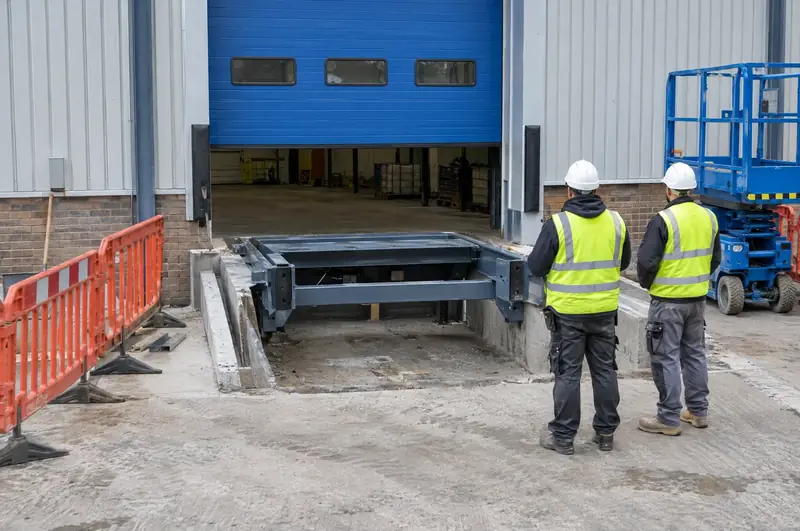
A loading bay conversion is a project that changes how a loading opening works, most often turning a ground-level door into a dock by lowering the approach, forming a leveller pit or adding a dock lift. It also covers upgrading older bays with new levellers, insulated doors, shelters and safety equipment while reusing the structure that is still sound.
What should sites in Oxfordshire consider?
Planning and building control questions for a conversion in Oxfordshire are checked during the survey, so the programme allows for any approvals that are needed. Older factories in Oxfordshire built with ground-level roller shutters are frequent conversion candidates once the business starts receiving articulated trailers rather than vans.
Changes of use on industrial estates around Oxfordshire, such as manufacturing to distribution, often mean the existing loading arrangements no longer match the vehicles arriving.
If you are planning loading bay conversions for a site in Oxfordshire, expect four stages. A free survey and fixed written quote come first. We then agree a programme with you, including any out-of-hours work. Specialist installation engineers carry out the installation under our management, with us as your single point of contact. Finally, the equipment is tested, your staff are shown how it works and everything is handed over with its documentation.
Does a loading bay conversion need building regulations approval or planning permission?
A loading bay conversion often needs building approval, and sometimes planning permission, so we check both at survey before the design is fixed. Forming a new opening or a dock pit is a structural alteration.
- England and Wales: Building Regulations approval may be needed.
- Scotland: a building warrant may be needed.
- Northern Ireland: building control approval may be needed.
External changes such as a new dock approach, a loading house or a canopy can need planning permission. We never assume permission is not needed.
Replacement doors also fall under energy rules. In England, Approved Document L (2021) Volume 2 sets a limiting U-value of 1.3 W/m²K for vehicle access and similar large doors in new and replacement work. Wales, Scotland and Northern Ireland have their own energy rules, and we confirm the figure that applies to your nation and project.
Once complete, the new equipment is work equipment under PUWER, or PUWER (Northern Ireland) 1999, and must be maintained and inspected.
How is downtime managed during a loading bay conversion?
Downtime during a conversion is managed by phasing the work bay by bay and agreeing a temporary loading arrangement before anything is broken out. A converted bay is out of use for the whole of its civils and installation period, so planning matters.
- Phasing: one bay or a pair of bays at a time, keeping enough doors open for your peak loads.
- Temporary loading: a neighbouring dock, a ground-level door or a mobile ramp used while the bay is closed.
- Curing time: new concrete needs time to gain strength before trailers and forklifts use it, and the programme allows for this.
- Security: openings are kept secure with temporary hoarding or the new door fitted early.
We ask you to provide site plans and any drawings of buried services, space for plant and spoil, a delivery area and a nominated contact. Our guide to upgrading loading bays without stopping the operation has more on phasing.
Towns we cover in Oxfordshire
We take enquiries about loading bay conversions from across Oxfordshire. These are the towns with their own pages:
Budget range for supply and fit. The written quote after a free survey is the fixed price. All guide prices.
Which rules apply in England?
Lift tables and dock lifts in Oxfordshire may fall under LOLER, with thorough examination at least every 12 months, or every 6 months where people are lifted. It depends on the equipment and how it is used, and your insurer or competent person will confirm. Dock levellers are usually treated as work equipment under PUWER. We check what applies at survey.
Questions
Do you cover Oxfordshire for loading bay conversions?
Yes. We take on loading bay conversions for businesses in Oxfordshire and across Oxfordshire. We survey the site, provide a fixed written quote and manage the installation, with specialist installation engineers working under our management. Visits are arranged in advance at a time that suits your operation, and the same single contact stays with the job through to handover.
Is the site survey in Oxfordshire free?
Yes. For new installations, replacements, upgrades, conversions and complete bays, the site survey and written quote are free and come with no obligation. The survey lets us measure the openings, check the dock and structure, and understand how the bay is used, so the quote reflects your site. Repair and servicing visits are different: they are chargeable, with the price agreed before anyone attends.
Is a recessed dock or a dock lift better?
A recessed dock is usually better for high trailer volumes, because forklifts drive straight on and off. A dock lift suits tight sites, mixed fleets and lower volumes, and avoids excavating the yard. The survey looks at space, levels, drainage and traffic before recommending one.
Can we keep working during a conversion?
Yes, in most cases. Conversions are phased bay by bay so the rest of the dock keeps running, and temporary loading is agreed before any bay is taken out of use. Openings are kept secure throughout, and noisy or disruptive work can be timed around your busiest periods.
Other services in Oxfordshire
Full guide to loading bay conversions · All loading bay services in Oxfordshire