
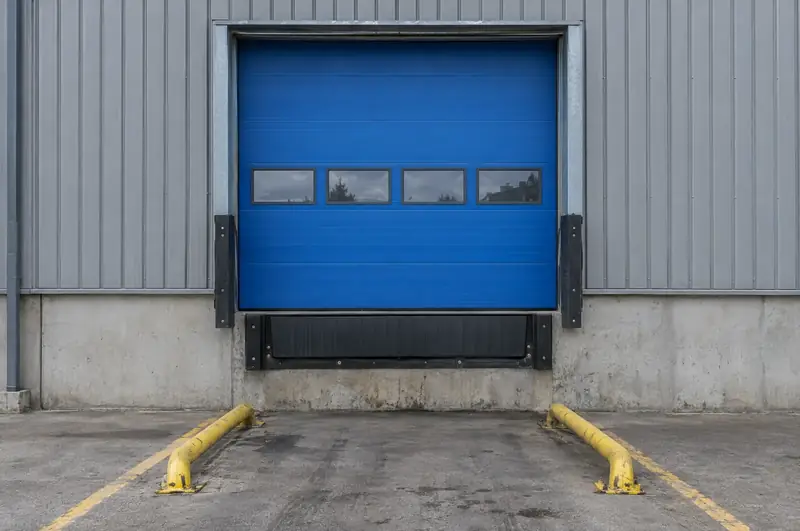
A sectional loading bay door is an overhead door made from horizontal insulated steel panels hinged together, which run up on rollers in side tracks and park beneath the ceiling or up the wall when open. Panels are commonly 40 to 80 mm thick, so the door seals and insulates better than a single-skin shutter, and it can be operated by hand chain, push-up or electric motor.
Why do sites in Edinburgh and the Lothians choose this?
If you are fitting out a new warehouse in Edinburgh and the Lothians, specifying insulated sectional doors from the start avoids disruptive changes once the building is occupied. Ageing units around Edinburgh and the Lothians sometimes have low lintels or pipework above the opening, which a low-headroom or high-lift track can be chosen to work around.
Warehouses across Edinburgh and the Lothians that still rely on single-skin shutters may switch to insulated sectional doors when heating costs or cold goods-in areas become a problem.
We keep the process simple for sites in Edinburgh and the Lothians. A free survey tells us what the dock needs; a fixed written quote tells you what it will cost and what is included. We then organise the installation, with specialist engineers under our management and a programme agreed around your shifts. Night and weekend work is available by arrangement. Before we leave, the new equipment is tested, demonstrated and handed over with its documentation.
Do sectional loading bay doors have to meet energy and safety rules?
Yes. New and replacement sectional loading bay doors fall under building energy rules and workplace safety law, and the detail differs between the four nations.
- Energy: in England, Approved Document L (2021) Volume 2 sets a limiting U-value of 1.3 W/m²K for vehicle access and similar large doors in new and replacement work. Wales, Scotland and Northern Ireland each have their own energy rules, and we confirm the figure that applies to your nation and project.
- Falling back: the Workplace (Health, Safety and Welfare) Regulations 1992 in Great Britain, and the Workplace (Health, Safety and Welfare) Regulations (Northern Ireland) 1993, require upward-opening doors to have a device that stops them falling back. On a sectional door that usually means spring break and cable break protection.
- Product standard: BS EN 13241 is the product standard for industrial doors, and powered doors are also assessed against BS EN 12453 for safety in use.
- Marking: a powered door in Great Britain may be UKCA or CE marked, while in Northern Ireland it is the CE mark, or CE with UKNI, that applies.
Which track type suits my dock: standard, high-lift or vertical lift?
The right track depends on how much headroom sits above the opening and what is in it. Standard lift track turns the door through a tight radius so it parks just under the ceiling, and suits units with limited space above the lintel.
- Standard lift: needs the least headroom; the open door rests horizontally close to the head of the opening.
- High-lift: the door travels further up the wall before turning, keeping it above lighting, sprinkler pipes or overhead conveyors and away from forklift masts.
- Vertical lift: the door runs straight up the wall and never turns, which suits tall buildings with racking or cranes close to the opening.
- Low headroom: a special track arrangement for openings with very little space above, often found in older units.
We measure headroom, side room and back room at survey and check where lights, ducts and pipework run, because a door that clashes with services cannot open fully. Our door types guide compares sectional doors with shutters and high-speed doors.
Towns we cover in Edinburgh and the Lothians
Find your town in the list below for details of sectional loading bay doors across Edinburgh and the Lothians, or contact us if your location is not shown.
Budget range for supply and fit. The written quote after a free survey is the fixed price. All guide prices.
Regulations and approvals in Scotland
Doors and dock equipment installed in Scotland may carry the UKCA or the CE mark, and we pass on the documentation for everything fitted in Edinburgh and the Lothians. Because building warrant and planning questions can affect the programme, we check what applies at survey and raise any approvals early rather than assuming none are needed.
Questions
Do you cover Edinburgh and the Lothians for sectional loading bay doors?
Yes. We take on sectional loading bay doors for businesses in Edinburgh and the Lothians and across Edinburgh and the Lothians. We survey the site, provide a fixed written quote and manage the installation, with specialist installation engineers working under our management. Visits are arranged in advance at a time that suits your operation, and the same single contact stays with the job through to handover.
Do you remove and dispose of the old equipment?
Yes, where it is part of the scope. When we replace doors, levellers, shelters or seals at a site in Edinburgh and the Lothians, removal and disposal of the old equipment can be included and is itemised in the quote, so it is clear what is covered. If anything should be kept, such as a frame or motor that is still serviceable, we agree that at survey.
Can the door be supplied in our company colours?
Yes, panels come in a range of standard colours, and many manufacturers can supply other shades at extra cost and with a longer lead time. The inside face is usually white or light grey. We confirm the colour, finish and lead time in the written quote.
How is a sectional loading bay door locked?
A manual sectional door is usually locked with a slide bolt or shoot bolt on the inside, while an electric door is held closed by its operator. Because dock doors are secured from inside the building, extra locks are not often needed, but we can add bolts or a locking operator where security is a priority.
Other services in Edinburgh and the Lothians
Full guide to sectional loading bay doors · All loading bay services in Edinburgh and the Lothians