
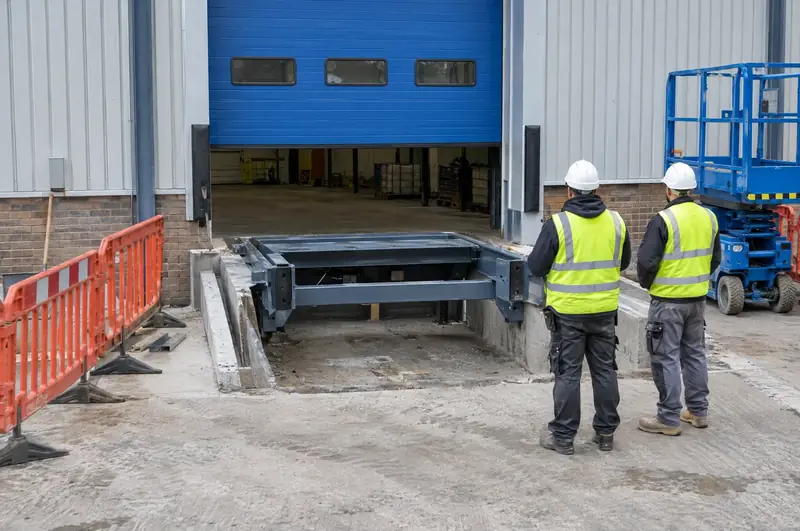
A loading bay conversion is a project that changes how a loading opening works, most often turning a ground-level door into a dock by lowering the approach, forming a leveller pit or adding a dock lift. It also covers upgrading older bays with new levellers, insulated doors, shelters and safety equipment while reusing the structure that is still sound.
What should sites in Derbyshire consider?
Changes of use on industrial estates around Derbyshire, such as manufacturing to distribution, often mean the existing loading arrangements no longer match the vehicles arriving. A unit in Derbyshire with enough yard depth may suit a recessed approach, while tighter plots usually point towards a dock lift or loading house.
Landlords in Derbyshire upgrading vacant units to attract logistics tenants can add docks or modernise tired bays as part of wider refurbishment works.
Here is what happens after you contact us about a site in Derbyshire. We arrange a free survey, measure up and send a fixed written quote. If you go ahead, we manage the whole job, including ordering, delivery and coordination with your site team. Specialist installation engineers working under our management do the fitting, at times built around your loading schedule, with out-of-hours work by arrangement. Testing and handover documents close the job.
What are the ways to convert a ground-level door into a dock?
There are three main ways to convert a ground-level door into a dock: lower the yard to form a recessed approach, install a dock lift at the door, or add a dock alongside the building. The right one depends on yard space, levels and how many trailers you handle.
- Recessed approach: the yard is excavated on a gradient so the trailer bed meets the building floor, with a leveller and drainage at the dock face. Best for high trailer volumes where there is yard depth for the ramp.
- Dock lift: a scissor lift table at the door raises goods to trailer height. Good for tight sites and mixed fleets.
- Edge-of-dock solutions: where the height difference is small, a modest recess with an edge-of-dock leveller can be enough.
Upgrades to existing docks follow the same survey: replacing mechanical levellers, swapping shutters for insulated doors, and adding shelters and restraints. Our guide to converting a ground-level door into a loading dock compares the methods.
When is upgrading an old bay better than rebuilding it?
Upgrading is usually better when the pit, dock face and opening are sound and the right size for today's trailers, because the expensive structural work can be reused. Rebuilding makes sense when the structure itself is the problem.
Signs an upgrade will work:
- the pit is dry, uncracked and suits a modern hydraulic leveller of the length you need;
- the opening suits a modern insulated door and shelter;
- dock height suits most of the trailers you receive.
Signs a rebuild is needed:
- the pit is cracked, holds water or is too short for the trailer height range;
- the dock face is broken up from years of impact;
- the opening is too small for current trailers and loads.
The survey records the condition of each element, and the quote explains which parts are reused and which are replaced.
Towns we cover in Derbyshire
We cover loading bay conversions throughout Derbyshire, and the towns below each have their own page. If yours is not listed, get in touch anyway.
- Derby
- Chesterfield
- Long Eaton
- Ilkeston
- Swadlincote
- Staveley
- Belper
- Heanor
- Alfreton
- Dronfield
- Ripley
- Buxton
- New Mills
- Glossop
Budget range for supply and fit. The written quote after a free survey is the fixed price. All guide prices.
Which rules apply in England?
In England, Approved Document L (2021) sets a limiting U-value of 1.3 W/m²K for vehicle access and similar large doors in new and replacement work. That shapes door specification for sites in Derbyshire, so we confirm the requirement for your project and check what applies at survey before recommending a door.
Questions
Which building and safety rules apply to a site in Derbyshire?
It depends on which UK nation the site is in. England and Wales use Building Regulations approval, Scotland uses building warrants and Northern Ireland uses building control approval from the council. Workplace safety is regulated by HSE in Great Britain and HSENI in Northern Ireland, and energy rules differ between nations. For your site in Derbyshire, we check what applies at survey and design to it.
Is the site survey in Derbyshire free?
Yes. For new installations, replacements, upgrades, conversions and complete bays, the site survey and written quote are free and come with no obligation. The survey lets us measure the openings, check the dock and structure, and understand how the bay is used, so the quote reflects your site. Repair and servicing visits are different: they are chargeable, with the price agreed before anyone attends.
Can any ground-level door be converted into a loading dock?
Many ground-level doors can be converted, but not all. It depends on yard depth for a ramp, levels and drainage, the structure around the opening and buried services. Where a recessed approach will not fit, a dock lift is often the answer. We assess every option at survey.
Can we keep working during a conversion?
Yes, in most cases. Conversions are phased bay by bay so the rest of the dock keeps running, and temporary loading is agreed before any bay is taken out of use. Openings are kept secure throughout, and noisy or disruptive work can be timed around your busiest periods.
Other services in Derbyshire
Full guide to loading bay conversions · All loading bay services in Derbyshire